I recently had the pleasure of reading the new exhibition catalog, Caravaggio and his Followers in Rome. I've read this book with a great deal of personal interest - not only do I love Caravaggio, but I will be traveling to Texas later this year to see this historic exhibition! Many of you are probably aware that I highlighted some details from this catalog on a post at Three Pipe Problem - particularly information regarding the painting, Saint Augustine (c. 1600) which recently has been attributed to Caravaggio.
When opening this book for the first time, I was immediately struck by the beautiful images. This catalog is chock full of gorgeous, simply delicious color reproductions of paintings by Caravaggio and the Caravaggisti. There are numerous detail images for many of these paintings, too. The catalog also includes several dozen images that are not included in the actual exhibition, too. Honestly, I would own this book just for the reproductions themselves.
But praise for this catalog goes beyond the reproductions. This book also includes a lot of great essays about Caravaggio, written by prominent scholars like Sebastian Schütze, Francesca Cappelletti, and Michael Fried. That being said, though, this catalog isn't for someone with just a casual interest in art history or Caravaggio. The essays are pretty dense, and some writers (I'm particularly thinking of Fried and Schütze) use art historical terms that would be unfamiliar to the casual reader.
The first half of the book is dedicated to essays about general history regarding Caravaggio and the Caravaggisti (even mentioning Caravaggio's plate of artichokes that recently grabbed a bit of attention in the news). This section also includes a theoretical essay by Michael Fried. The essay is interesting (and, granted, is written in a slightly more approachable way than many of Fried's other essays on similar topics of absorption and spectatorship), but it seems quite out-of-place with the other historical essays in the book.
The second part of the book is dedicated to thematic essays related to works in the exhibition. I loved this section of the book the most. The essays are generally organized by different types of subject matter: gypsies, cardsharps, musicians, saints, etc. It's really fun. I was interested to learn that Caravaggio's painting The Cardsharps (c. 1595, shown left) has inspired more copies and variants than any other work by Caravaggio.1
In fact, themes of gambling (which expands to include dice players) and were popular among Caravaggio's Roman followers. One popular subject matter for the Caravaggisti was The Denial of Saint Peter (as can be seen in Bartolomeo Manfredi's work of c. 1616-18). These scenes were often expanded to include depictions of soldiers playing dice or cards. Interestingly, though, the Caravaggisti were not inspired by Caravaggio's personal treatment of the subject; Caravaggio's Denial of Saint Peter (c. 1609-10) includes only three half-figures. Instead, the Caravaggisti used Caravaggio's The Calling of Saint Matthew (1599-1600) as a prototype for their Denial of Saint Peter scenes. One can see similarities in composition by comparing Manfredi and Caravaggio's paintings, particularly since both works involve groups of men huddled around a table. In addition to these similarities, Nancy E. Edwards points out that "The Denial of Saint Peter and The Calling of Saint Matthew have similar subjects: an apostle's response to Christ's call of faith."2
Anyhow, that interesting tidbit of information is just a taste of what is available in this great catalog. I would heartily recommend it to anyone that has a keen interest in Caravaggio or the Caravaggisti. I only have one small complain about the book itself: it needs to have an index! I know that it is not common for exhibition catalogs to have indexes, so I realize that this complaint is geared more toward a cultural standard than this particular book. However, I have noticed that exhibition catalogs are becoming increasingly more scholarly in their content. If museums want scholars to use their catalogs as an academic resource, more indexes need to start showing up in catalogs!
As I read Caravaggio and his Followers in Rome, I wrote down a makeshift index on the last page of my book copy (see above right), with some of the topics that are particularly interesting to me. If there was an index, I would be spared such effort...
1 Nancy E. Edwards, "The Cardsharps," in Caravaggio and His Followers in Rome, edited by David Franklin and Sebastian Schütze (New Haven: Yale University Press, 2011), 180.
2 Ibid., 199.
Thank you to H Niyazi of Three Pipe Problem, Inbooks and Yale University Press for supplying the review copy.
Showing posts with label books. Show all posts
Saturday, September 17, 2011
Saturday, July 23, 2011
The "Collection Museum"
I have been doing some research on Isabella Stewart Gardner over the past few weeks, in hopes to present something at a conference this fall.
In doing this research, I've started to make a compilation of "collection museums" that were created by private collectors in the late 19th and early-to-mid 20th century. I love going to "collection museums," especially when such buildings also functioned as the residence for the collector. Two of my favorite museum experiences are when I visited the Phillips Collection in Washington, DC (shown right) and visited the Frick Collection (shown below on left).
First of all, I love seeing what types of art appeal to one individual, as a collector. It is also interesting to visit these museums and see how a collector would have potentially "decorated" their residence space. (The Isabella Stewart Gardner Museum is most interesting in this respect, since she specified in her will that the arrangement and presentation of her collection could not be altered after her death, or the whole collection would be given to Harvard University.)
I think that a museum visitor can make a lot of interesting associations with works of art when they are in such a personal, domestic setting. Although great works of art can undoubtedly stand (or hang!) on their own, I love seeing works of art in an interesting context and display. "Collector museums" are fun to have in a postmodern society, don't you think? It's much more interesting to me than the white cube gallery space, that's for sure.
Here are the "collection museums" that I have compiled so far (in chronological order of when the museums were built/founded):
UPDATE: A more comprehensive list (going outside the time frame from this post) was created in a separate post on this blog.
I think it's really interesting that several women were among the first to convert their private residence into a museum space, including Lady Wallace (Wallace Collection) and Isabella Stewart Gardner. Many other women were key in forming collections, such as the Countess Wilhelmina van Hallwyl (Hallwyl Museum) and Loïe Fuller (Maryhill Museum of Art). Perhaps there was something about displaying art in a domestic space that was especially appealing to female collectors? I think that I might explore this idea further in my research!
Images from Wikipedia. Frick Collection image by Wikipedia user "Gryffindor."
In doing this research, I've started to make a compilation of "collection museums" that were created by private collectors in the late 19th and early-to-mid 20th century. I love going to "collection museums," especially when such buildings also functioned as the residence for the collector. Two of my favorite museum experiences are when I visited the Phillips Collection in Washington, DC (shown right) and visited the Frick Collection (shown below on left).
First of all, I love seeing what types of art appeal to one individual, as a collector. It is also interesting to visit these museums and see how a collector would have potentially "decorated" their residence space. (The Isabella Stewart Gardner Museum is most interesting in this respect, since she specified in her will that the arrangement and presentation of her collection could not be altered after her death, or the whole collection would be given to Harvard University.)
I think that a museum visitor can make a lot of interesting associations with works of art when they are in such a personal, domestic setting. Although great works of art can undoubtedly stand (or hang!) on their own, I love seeing works of art in an interesting context and display. "Collector museums" are fun to have in a postmodern society, don't you think? It's much more interesting to me than the white cube gallery space, that's for sure.
Here are the "collection museums" that I have compiled so far (in chronological order of when the museums were built/founded):
UPDATE: A more comprehensive list (going outside the time frame from this post) was created in a separate post on this blog.
- The Wallace Collection (London). The collection was mainly amassed by Richard Seymoure-Conway, who bequeathed the collection to his illigetimate son, Sir Richard Wallace. Collection is displayed in the Hertford House, the main London townhouse of Sir Richard Wallace. The collection was bequeathed to the British nation in 1897 by Lady Wallace (Julie-Amélie-Charlotte Castelnau), wife of Sir Richard Wallace.
- Musée Condé in the Château de Chantilly (near Paris). Bequeathed by the Duc d'Aumale to the Institut of France in 1897. (Note: From what I can tell, this museum is not the collection of one private collector, but a collection that was amassed over time by the Montmorency and Condé families. Museum also has a collection once owned by Caroline Murat, the sister of Napoleon.)
- The Isabella Stewart Gardner Museum (Boston, Massachusetts). Collection of Isabella Stewart Gardner. The museum ("Fenway Court") also served as Isabella's residence. Construction begun in 1899, opened to the public on Near Year's Day, 1903.
- Jacquemart-André Museum (Paris). Collection of André and Nélie Jacquemart. Nélie Jacquemart was a well known society painter. In accordance with her husband's wishes, Nélie bequeathed the mansion and collection to the Institut de France. Museum opened in 1913.
- The Hallwyl Museum (Stockholm). Primarily the collection of Countess Wilhelmina von Hallwyl. Museum is located in the Hallwyl House, which served as the private residence for Count and Countess van Hallwyl. Collection was donated to the state in 1920.
- The Phillips Collection (Washington, DC). Collection of Duncan Phillips. Museum building was once Phillip's residence. Founded 1921.
- Sinebrychoff Art Museum (Helsinki, Finland). Collection of Paul Sinebrychoff. Collection donated to the state in 1921. The Sinebrychoff private residence (the current location of the museum) was bequeathed to the state in 1975.
- The Barnes Foundation (originally located in Merion, Pennsylvania). Collection of Albert C. Barnes. Founded in 1922. I'm especially distraught over this museum, since the collection is currently being moved to a new location in Philadelphia. If you want to learn more about the situation involving the displacement of the Barnes Foundation, I'd recommend that you see the documentary The Art of the Steal.
- Freer Gallery of Art (Washington, DC). Collection of Charles Lang Freer. Construction begun in 1916, but gallery completion was delayed because of WWI. Gallery opened in 1926.
- Benaki Museum (Athens). Collections of Antonis Benakis. Founded in 1926.
- The Huntington Art Gallery (Pasadena, CA). Collection of Henry E. Huntington. Museum building was once Huntington's residence. Opened in 1928.
- Musée Marmottan Monet (Paris). Originally the collection of Paul Marmottan (which was partially inherited from his father, Christophe Edmond Kellermann, Duke of Valmy). Museum was bequeathed to the Académie des Beaux Arts. The museum location originally served as the hunting lodge for Christophe Edmond Kellermann and later the home of Paul Marmottan. The Academy opened the museum in 1935. Museum collection was expanded with a gift in 1957 (Impressionist collection once owned by Doctor Georges de Bellio) and in 1966 (the personal collection of Claude Monet, bequeathed by Monet's son Michel Monet). Museum also houses a collection of illuminated manuscripts once owned by Daniel Wildenstein (who died in 2001).
- The Frick Collection (New York City). Collection of Henry Clay Frick. Museum is housed in the former home of Henry Clay Frick. Museum opened to the public in 1935.
- The John and Mable Ringling Museum of Art (Sarasota, Florida). Collection of John and Mable Ringling. Museum functioned as the Ringling family's private residence. Art collection, mansion, and estate were bequeathed to the state of Florida in 1936, at the death of John Ringling. This museum boasts an eclectic Baroque collection, among other things.
- Maryhill Museum of Art (Goldendale, Washington). Collection of Sam Hill and Loïe Fuller. Construction of mansion (current location of museum) was begun in 1914 by owner Sam Hill. However, construction stopped in 1917. Work resumed in 1920s and 1930s, with the intent of turning the mansion into a museum. Museum opened to the public in 1940. This museum owns more than 80 works by Rodin.
- Dumbarton Oaks (Washington DC). Collection of Mildred and Robert Woods Bliss. Museum also functioned as residence for the Bliss family. Institution dedicated and transferred to Harvard University in 1940.
I think it's really interesting that several women were among the first to convert their private residence into a museum space, including Lady Wallace (Wallace Collection) and Isabella Stewart Gardner. Many other women were key in forming collections, such as the Countess Wilhelmina van Hallwyl (Hallwyl Museum) and Loïe Fuller (Maryhill Museum of Art). Perhaps there was something about displaying art in a domestic space that was especially appealing to female collectors? I think that I might explore this idea further in my research!
Images from Wikipedia. Frick Collection image by Wikipedia user "Gryffindor."
Tuesday, June 28, 2011
Book Review: "The Origins of Baroque Art in Rome" by Alois Riegl
Today I finished reading Riegl's The Origins of Baroque Art in Rome (2009, Getty Publications). As I mentioned in an earlier post, this publication is very significant, since it is the first time that Riegl's writings on Baroque art have been translated into English. Apart from a few introductory essays, this book is comprised of Riegl's lecture notes. Riegl taught lectures on Baroque art during three different university semesters in the late 19th and early 20th century. These lecture notes were first published posthumously in 1908, and now have appeared in English almost a century later!1
I have to say, I think that this book is very interesting in many respects, but it's not a book for someone who has a casual interest in Baroque art. Although Riegl's lecture notes are written in a relatively approachable manner (since the text was written with the intent of being spoken in a lecture hall), the publication itself is rather dense. Riegl takes many specific arguments in his lectures, and he assumes that his audience already has a solid foundation of Renaissance history. In fact, much of this book discusses Renaissance art, as opposed to the Baroque art that is commonly found in today's art history textbooks. For example, I was surprised to see more discussion of Bramante than Borromini (the latter was hardly mentioned at all!).
One of Riegl's arguments is that Michelangelo and Correggio should be seen as the earliest predecessors of the Baroque style. I think this is an interesting argument. On a whole, I think that today's Baroque scholars don't give a lot of attention or emphasis to Michelangelo, at least in comparison with Riegl. Michelangelo really is the core of Riegl's text. I think that today it is more common for people to think of Correggio as a "proto-Baroque" artist than Michelangelo. Perhaps 20th and 21st century Renaissance scholarship has such a vice-like grip on Michelangelo, that Baroque scholarship has been forced to back off a little bit?
I thought quite a bit about historiography while reading this book, and it wasn't just because I noticed a discrepancy between today's scholarship and Riegl's treatment of Michelangelo. Riegl also made a passing comment about naturalism, which caught my attention: "Naturally, for us northerners the naturalists are the most interesting [artists to discuss]."2 As an Austrian art historian, Riegl realized that his geographic area and cultural origins influenced the way he responded to artistic style. Is there more scholarly interest in "naturalist" Baroque artists because so many great Baroque art historians came from Germany and Austria? Perhaps so!3
As for the publication itself, I liked that many of the key ideas and artists were highlighted in bold text. This small detail helps the viewer to maneuver and search through the text quite easily. On the other hand, I was disappointed to see so few images included in the publication - and the images that are included are only black and white! Although I have a solid foundation of Renaissance/Baroque sculpture and painting, I am less familiar with the secular architecture that is produced during those periods. Without images to help me visualize Riegl's descriptions of the architectural pieces, I found myself a little bored and frustrated in that section of the text.
That being said, I really enjoyed reading the sections about painting and sculpture; I wasn't bothered by the lack of images since I am familiar with the works of art that were discussed. Since I had this mixed reaction to the images (and lack of images!) in this book, I really would recommend this book only to Renaissance and Baroque scholars. Without many pictures to entice or engage the casual reader, this publication could disappoint. However, if you are interested in early Baroque scholarship and historiography, this is a great resource!
1 Riegl died in 1905 at the young age of 47.
2 Alois Riegl, The Origins of Baroque Art in Rome (Los Angeles: Getty Research Institute, 2009), 216.
3 One such "naturalist" artist is Caravaggio, as opposed to more-so classical artists (or "eclectic" artists, to use Riegl's term) like the Carracci and Guido Reni. I personally think there is more interest in Baroque naturalism today, but I'm biased toward Caravaggio myself!
Thank you to H Niyazi of Three Pipe Problem, Inbooks and Getty Research Institute for supplying the review copy.
I have to say, I think that this book is very interesting in many respects, but it's not a book for someone who has a casual interest in Baroque art. Although Riegl's lecture notes are written in a relatively approachable manner (since the text was written with the intent of being spoken in a lecture hall), the publication itself is rather dense. Riegl takes many specific arguments in his lectures, and he assumes that his audience already has a solid foundation of Renaissance history. In fact, much of this book discusses Renaissance art, as opposed to the Baroque art that is commonly found in today's art history textbooks. For example, I was surprised to see more discussion of Bramante than Borromini (the latter was hardly mentioned at all!).
One of Riegl's arguments is that Michelangelo and Correggio should be seen as the earliest predecessors of the Baroque style. I think this is an interesting argument. On a whole, I think that today's Baroque scholars don't give a lot of attention or emphasis to Michelangelo, at least in comparison with Riegl. Michelangelo really is the core of Riegl's text. I think that today it is more common for people to think of Correggio as a "proto-Baroque" artist than Michelangelo. Perhaps 20th and 21st century Renaissance scholarship has such a vice-like grip on Michelangelo, that Baroque scholarship has been forced to back off a little bit?
I thought quite a bit about historiography while reading this book, and it wasn't just because I noticed a discrepancy between today's scholarship and Riegl's treatment of Michelangelo. Riegl also made a passing comment about naturalism, which caught my attention: "Naturally, for us northerners the naturalists are the most interesting [artists to discuss]."2 As an Austrian art historian, Riegl realized that his geographic area and cultural origins influenced the way he responded to artistic style. Is there more scholarly interest in "naturalist" Baroque artists because so many great Baroque art historians came from Germany and Austria? Perhaps so!3
As for the publication itself, I liked that many of the key ideas and artists were highlighted in bold text. This small detail helps the viewer to maneuver and search through the text quite easily. On the other hand, I was disappointed to see so few images included in the publication - and the images that are included are only black and white! Although I have a solid foundation of Renaissance/Baroque sculpture and painting, I am less familiar with the secular architecture that is produced during those periods. Without images to help me visualize Riegl's descriptions of the architectural pieces, I found myself a little bored and frustrated in that section of the text.
That being said, I really enjoyed reading the sections about painting and sculpture; I wasn't bothered by the lack of images since I am familiar with the works of art that were discussed. Since I had this mixed reaction to the images (and lack of images!) in this book, I really would recommend this book only to Renaissance and Baroque scholars. Without many pictures to entice or engage the casual reader, this publication could disappoint. However, if you are interested in early Baroque scholarship and historiography, this is a great resource!
1 Riegl died in 1905 at the young age of 47.
2 Alois Riegl, The Origins of Baroque Art in Rome (Los Angeles: Getty Research Institute, 2009), 216.
3 One such "naturalist" artist is Caravaggio, as opposed to more-so classical artists (or "eclectic" artists, to use Riegl's term) like the Carracci and Guido Reni. I personally think there is more interest in Baroque naturalism today, but I'm biased toward Caravaggio myself!
Thank you to H Niyazi of Three Pipe Problem, Inbooks and Getty Research Institute for supplying the review copy.
Labels:
books,
historiography,
Southern Baroque,
Southern Renaissance
Friday, June 17, 2011
Altar of Pergamon and Baroque Scholarship
I'm in the middle of reading The Origins of the Baroque Art in Rome by Alois Riegl. This recent publication is a really exciting and influential textbook in its own right, since it is the first time that Riegl's essays on Baroque art have been translated into English. I plan on writing a full review of the book very soon, but I just wanted to write something that I found particularly interesting.
As an introduction to Riegl's discussion of Baroque art, this book is prefaced with three essays. These essays largely deal with historiography in regards to Baroque scholarship. It's pretty fascinating stuff. I was particularly interested in the discussion about the excavation of the Altar of Pergamon in the late 19th century. Fragments of the altar started to arrive in Berlin in 1879 (which, incidentally, was the same year that prehistoric cave paintings were first discovered. But that's a topic for another day. My point: 1879 was a big year for art history.)
The Altar of Pergamon is from the Greek Hellenistic period (c. 175-150 BCE). It was excavated in the late 19th century by Carl Humann, a German road construction engineer. The continuous frieze depicts the Gigantomachy ("Battle of the Giants") with extremely high relief figures, dramatic emotional expressions, lots of diagonal compositions, and light/dark contrasts (see
detail on left). Baroque scholars (such as myself) eat this kind of stuff up, since the stylistic characteristics are very similar to those of the Baroque period. I think that even the placement of the frieze near the steps (as opposed to being placed above the columns, which is the traditional location for an Ionic frieze) ties into the Baroque characteristics of viewer participation and involvement.
So, how did the arrival of the Altar of Pergamon in Berlin change scholarship on Baroque art? Before this point, the Baroque period had been viewed with some disdain by art historians and scholars. In fact, in the 18th century Winckelmann used the word "baroque" as an abusive term (and unsurprisingly, Winckelmann also disliked Hellenistic art!). But the unquestionable quality of the Pergamon frieze caused 19th century scholars to reassess their previous negative interpretations of not only Hellenistic art, but Baroque art as well. In fact, the Hellenistic period began to be known by scholars as the "ancient Baroque."2
Consequently, because of the Altar of Pergamon's influence, German art historians began to write about Baroque art. Heinirch Wölfflin wrote his seminal book Renaissance and Baroque in 1888, less than a decade after the Pergamon altar began to arrive in Berlin. Wölfflin even wrote in the preface "that he had intended to include an evaluation of the 'ancient Baroque' but that his 'little book' did not afford enough scope for this project, and he promised to return to it at a later date."2 Unfortunately, Wölfflin never returned to write about the "ancient Baroque," though other scholars (such as Arnold von Salis) did. Now, I think that Baroque scholars take the connection between the Hellenistic and Baroque period for granted. But Baroque scholarship is quite indebted to the Altar of Pergamon. Without the arrival of the altar in Berlin, perhaps "baroque" would still be a demeaning term in art history.
1 Alina Payne, "Beyond Kunstwollen: Alois Riegl and the Baroque" in The Origins of Baroque Art in Rome by Andrew Hopkins and Arnold Witte, eds. (Los Angeles: Getty Research Institute, 2010), 8.
2 Ibid.
*Image for Pergamon altar photograph © Raimond Spekking (via Wikimedia Commons) CC-BY-SA-3.0
As an introduction to Riegl's discussion of Baroque art, this book is prefaced with three essays. These essays largely deal with historiography in regards to Baroque scholarship. It's pretty fascinating stuff. I was particularly interested in the discussion about the excavation of the Altar of Pergamon in the late 19th century. Fragments of the altar started to arrive in Berlin in 1879 (which, incidentally, was the same year that prehistoric cave paintings were first discovered. But that's a topic for another day. My point: 1879 was a big year for art history.)
The Altar of Pergamon is from the Greek Hellenistic period (c. 175-150 BCE). It was excavated in the late 19th century by Carl Humann, a German road construction engineer. The continuous frieze depicts the Gigantomachy ("Battle of the Giants") with extremely high relief figures, dramatic emotional expressions, lots of diagonal compositions, and light/dark contrasts (see
detail on left). Baroque scholars (such as myself) eat this kind of stuff up, since the stylistic characteristics are very similar to those of the Baroque period. I think that even the placement of the frieze near the steps (as opposed to being placed above the columns, which is the traditional location for an Ionic frieze) ties into the Baroque characteristics of viewer participation and involvement.So, how did the arrival of the Altar of Pergamon in Berlin change scholarship on Baroque art? Before this point, the Baroque period had been viewed with some disdain by art historians and scholars. In fact, in the 18th century Winckelmann used the word "baroque" as an abusive term (and unsurprisingly, Winckelmann also disliked Hellenistic art!). But the unquestionable quality of the Pergamon frieze caused 19th century scholars to reassess their previous negative interpretations of not only Hellenistic art, but Baroque art as well. In fact, the Hellenistic period began to be known by scholars as the "ancient Baroque."2
Consequently, because of the Altar of Pergamon's influence, German art historians began to write about Baroque art. Heinirch Wölfflin wrote his seminal book Renaissance and Baroque in 1888, less than a decade after the Pergamon altar began to arrive in Berlin. Wölfflin even wrote in the preface "that he had intended to include an evaluation of the 'ancient Baroque' but that his 'little book' did not afford enough scope for this project, and he promised to return to it at a later date."2 Unfortunately, Wölfflin never returned to write about the "ancient Baroque," though other scholars (such as Arnold von Salis) did. Now, I think that Baroque scholars take the connection between the Hellenistic and Baroque period for granted. But Baroque scholarship is quite indebted to the Altar of Pergamon. Without the arrival of the altar in Berlin, perhaps "baroque" would still be a demeaning term in art history.
1 Alina Payne, "Beyond Kunstwollen: Alois Riegl and the Baroque" in The Origins of Baroque Art in Rome by Andrew Hopkins and Arnold Witte, eds. (Los Angeles: Getty Research Institute, 2010), 8.
2 Ibid.
*Image for Pergamon altar photograph © Raimond Spekking (via Wikimedia Commons) CC-BY-SA-3.0
Labels:
books,
Greek and Roman,
historiography,
Southern Baroque,
Winckelmann
Monday, June 13, 2011
Condivi and Michelangelo's "Pietà"
Well my friends, I think I may have found another minor error in an art history textbook. The textbook I use for my Renaissance classes, The Changing Status of the Artist, says the following: "Ascanio Condivi recorded that his friend Michelangelo carved himself in the guise of Nicodemus mourning over the dead Christ"1. This seemingly insignificant comment has captured my attention for several months, and consequently I have long wanted to read Condivi's biography of Michelangelo (first printed 1553). Now that the school quarter is finished, I finally found time to read the biography this past weekend. But when I got to Condivi's discussion on the Duomo Pietà (c. 1550, see below), I couldn't find any discussion about a self-portrait! Only in the footnote of biography did I notice this information from the editor: "The figure of Nicodemus, according to a letter from Vasari to Michelangelo's nephew Leonardo shortly after the artist's death, is a self-portrait"2
Now, in the great scheme of things, perhaps it isn't too a big deal that my textbook misattributed this self-portrait information to Condivi instead of Vasari. I understand that. But I also am in favor of historical accuracy, and I thought I would put the record straight here. If any of my past students are reading this, please make a note of the error on page 69 of your textbook!
That being said, this misattribution happily led me to become familiar with Condivi's book first-hand. Many scholars believe that Condivi's work is the best account of Michelangelo's life; this book can practically be considered an autobiography. Condivi wrote that he got his information "with long patience from the living oracle of his [master's] speech."3 It appears that Michelangelo wanted this biography to be written for two reasons: 1) to correct omissions and errors about Michelangelo that appeared in Vasari's first edition of Lives of the Artists and 2) to exonerate Michelangelo from accusations that he deceived the heirs of Julius II and embezzled sums of money (in regards to Michelangelo's seemingly-endless sculptural project for Pope Julius II's tomb).
Condivi's biography is a great resource for any Renaissance scholar, and it's a rather quick read. And although I didn't read any new information about Michelangelo's self-portrait on the Duomo Pietà, I was prompted to consider reasons why Michelangelo included his self-portrait. Condivi wrote that "Michelangelo plans to donate this Pietà to some church and to have himself buried at the foot of the altar where it is placed."4
So, if this was to be a funerary function in some sense, Michelangelo may have wanted to include his portrait as part of the traditional convention to represent an image of the deceased on funerary monuments. Michelangelo may have also identified with Nicodemus for either spiritual or personal reasons. For example, according to legend, Nicodemus was a sculptor.5
However, this Pietà never was placed next to Michelangelo's tomb. Vasari, who designed Michelangelo's tomb, unsuccessfully tried to acquire the Pietà from the family who owned the sculpture at the time. However, I think it's best that Vasari didn't get his hands on the Pietà: it appears that Michelangelo changed his mind and didn't want the sculpture for his tomb after all. In 1555, two years after Condivi wrote his biography, Michelangelo abandoned and mutilated the Pietà. He then sold the sculpture in 1561 to his friend Francesco Bandini, a Florentine banker in Rome. So if Michelangelo sold the sculpture, it's very likely that he had no intention of using the sculpture on his own tomb. In a way, I'm surprised that Vasari didn't pick up on that simple concept.
A lot of scholars have discussed and analyzed why Michelangelo mutilated the Duomo Pietà, and I think I will compile some thoughts in a forthcoming post. Stay tuned!
1 Catherine King, "Italian Artists in Search of Virtue, Fame, and Honor c. 1450-1650," in The Changing Status of the Artist by Emma Barker, Nick Webb and Kim Woods, eds. (London: Yale University Press, 1999), 69.
2 Ascanio Condivi, The Life of Michelangelo, translated by Alice Sedgwick Wohl, edited by Hellmut Wohl, 2nd ed. (University Park, PA: The Pennsylvania State University Press, 1999), 140 (my emphasis). I realize that the Changing Status textbook could be referring to something else written by Condivi besides his biography (such as a letter), but I highly doubt it. The editor of this Condivi text probably would have mentioned if Condivi had written anything about Michelangelo's self-portrait, instead of only mentioning this letter by Vasari.
3 Ibid., xvi-xviii.
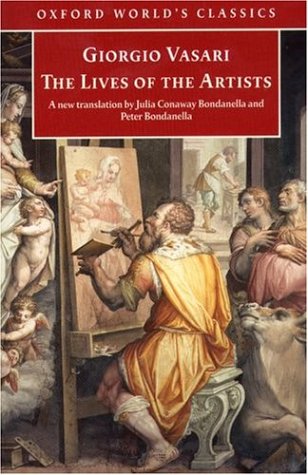
4 Ibid., 90. Michelangelo wanted to be buried in Santa Maria Maggiore, but was actually interred in the Florentine church Santa Croce. Vasari writes details of the internment (and opening Michelangelo's casket to reveal a body untouched by decay!) in his second version of Lives of the Artists (1568). See Giorgio Vasari, The Lives of the Artists, translation by Julia Conway Bondanella and Peter Bondanella (London: Oxford University Press, 1991), 486.
5 King, 69.
Now, in the great scheme of things, perhaps it isn't too a big deal that my textbook misattributed this self-portrait information to Condivi instead of Vasari. I understand that. But I also am in favor of historical accuracy, and I thought I would put the record straight here. If any of my past students are reading this, please make a note of the error on page 69 of your textbook!
That being said, this misattribution happily led me to become familiar with Condivi's book first-hand. Many scholars believe that Condivi's work is the best account of Michelangelo's life; this book can practically be considered an autobiography. Condivi wrote that he got his information "with long patience from the living oracle of his [master's] speech."3 It appears that Michelangelo wanted this biography to be written for two reasons: 1) to correct omissions and errors about Michelangelo that appeared in Vasari's first edition of Lives of the Artists and 2) to exonerate Michelangelo from accusations that he deceived the heirs of Julius II and embezzled sums of money (in regards to Michelangelo's seemingly-endless sculptural project for Pope Julius II's tomb).
Condivi's biography is a great resource for any Renaissance scholar, and it's a rather quick read. And although I didn't read any new information about Michelangelo's self-portrait on the Duomo Pietà, I was prompted to consider reasons why Michelangelo included his self-portrait. Condivi wrote that "Michelangelo plans to donate this Pietà to some church and to have himself buried at the foot of the altar where it is placed."4
So, if this was to be a funerary function in some sense, Michelangelo may have wanted to include his portrait as part of the traditional convention to represent an image of the deceased on funerary monuments. Michelangelo may have also identified with Nicodemus for either spiritual or personal reasons. For example, according to legend, Nicodemus was a sculptor.5
However, this Pietà never was placed next to Michelangelo's tomb. Vasari, who designed Michelangelo's tomb, unsuccessfully tried to acquire the Pietà from the family who owned the sculpture at the time. However, I think it's best that Vasari didn't get his hands on the Pietà: it appears that Michelangelo changed his mind and didn't want the sculpture for his tomb after all. In 1555, two years after Condivi wrote his biography, Michelangelo abandoned and mutilated the Pietà. He then sold the sculpture in 1561 to his friend Francesco Bandini, a Florentine banker in Rome. So if Michelangelo sold the sculpture, it's very likely that he had no intention of using the sculpture on his own tomb. In a way, I'm surprised that Vasari didn't pick up on that simple concept.
A lot of scholars have discussed and analyzed why Michelangelo mutilated the Duomo Pietà, and I think I will compile some thoughts in a forthcoming post. Stay tuned!
1 Catherine King, "Italian Artists in Search of Virtue, Fame, and Honor c. 1450-1650," in The Changing Status of the Artist by Emma Barker, Nick Webb and Kim Woods, eds. (London: Yale University Press, 1999), 69.
2 Ascanio Condivi, The Life of Michelangelo, translated by Alice Sedgwick Wohl, edited by Hellmut Wohl, 2nd ed. (University Park, PA: The Pennsylvania State University Press, 1999), 140 (my emphasis). I realize that the Changing Status textbook could be referring to something else written by Condivi besides his biography (such as a letter), but I highly doubt it. The editor of this Condivi text probably would have mentioned if Condivi had written anything about Michelangelo's self-portrait, instead of only mentioning this letter by Vasari.
3 Ibid., xvi-xviii.
4 Ibid., 90. Michelangelo wanted to be buried in Santa Maria Maggiore, but was actually interred in the Florentine church Santa Croce. Vasari writes details of the internment (and opening Michelangelo's casket to reveal a body untouched by decay!) in his second version of Lives of the Artists (1568). See Giorgio Vasari, The Lives of the Artists, translation by Julia Conway Bondanella and Peter Bondanella (London: Oxford University Press, 1991), 486.
5 King, 69.
Tuesday, May 17, 2011
Art History Buffness
Some of you may have noticed the new list of "40 Books that Art History Buffs Love," which was recently compiled by Accredited Online Colleges. I looked through the list, and noticed that I have read (or at least read a good portion from) twelve out of the forty books listed. By my calculations, that means that I'm 30% of an art history buff, right?
I tweeted about my 30% buff-ness online, and my friend heidenkind jokingly made me this button. (I think she threw in an extra 10% for good measure, which is great - then I get a little bit of a reading buffer while building up my buff-ness!)
What percentage of art historical buff-ness are you? Any books that you want to read from the list, or have no desire to read? I think there are a lot more books that I would add to the list (why isn't there anything by Winckelmann or Burckhardt?!?). And I'd probably take out a few books that are on there - I've never even heard of the Cezanne book by Rainer Maria Rilke...
I tweeted about my 30% buff-ness online, and my friend heidenkind jokingly made me this button. (I think she threw in an extra 10% for good measure, which is great - then I get a little bit of a reading buffer while building up my buff-ness!)
What percentage of art historical buff-ness are you? Any books that you want to read from the list, or have no desire to read? I think there are a lot more books that I would add to the list (why isn't there anything by Winckelmann or Burckhardt?!?). And I'd probably take out a few books that are on there - I've never even heard of the Cezanne book by Rainer Maria Rilke...
Monday, April 11, 2011
"Stealing the Mystic Lamb": A Review
This past weekend I finally finished reading art historian Noah Charney's book Stealing the Mystic Lamb: The True Story of the World's Most Coveted Masterpiece. I've wanted to read this book for a long time, and I finally got my hands on a copy over a month ago. It took me several weeks to read this book, not because it was boring, but because I kept pausing to type notes on my computer. And now, with eighteen pages of notes in my computer files, I have finally finished the book. Phew!
This book recounts the troubled (and bizarre!) history of the Ghent Altarpiece by Jan van Eyck. Specifically, Charney deals with the many crimes (particularly thefts and attempted thefts) of this famous altarpiece from the Northern Renaissance. Historically, this work of art has been stolen and "coveted" more than any other work of art. I was particularly interested in how much of the altarpiece ended up in France during the Napoleonic era. During this time, the panels were put on display at the Louvre. The panels were undoubtedly seen in the Louvre by the artist Ingres, whose painting Napoleon on his Imperial Throne quotes van Eyck's image of God the Father.1
Although I liked all of the book, I think that I enjoyed the first half of the book a little bit more. In this first half, Charney races through several centuries of history in a lively discussion of the altarpiece's creation and thefts before WWII. I really enjoyed the quick, animated pace in the first few chapters. The latter half of Charney's book slows down considerably to focus on just one historical event: the theft of the Ghent Altarpiece by Nazis during WWII. The altarpiece panels, which were intended to be placed in Hitler's super-museum for art, were kept in the Alt Aussee mine in Austria. Although I thought that this story was still very interesting, it took a some mental adjustment to move at a slower pace in terms of chronology.
This book is fascinating and written with a very engaging tone. Aside from the change in pace, I only had one other teensy-weensy issue with Charney's book: I was really surprised to see that he referred to Jan van Eyck's The Arnolfini Portrait (1434) as a marriage scene.2 Since the marriage interpretation has been questioned by art historians for so long (and has been disproved in many ways), it ever-so-slightly undermined the quality of Charney's book. But that being said, don't let my nit-picky issue deter you from reading Stealing the Mystic Lamb. On the contrary, please read it. (Just know that I have crossed out the word "wedding" on a few pages. That's all.)
P.S. There is a great interview of Noah Charney on Three Pipe Problem. Be sure to check it out!
1 Noah Charney, Stealing the Mystic Lamb: The True Story of the World's Most Coveted Masterpiece (New York: PublicAffairs, 2010), 104.
2 Ibid., 22.
Tuesday, March 22, 2011
The Scream!
I've had Edvard Munch's The Scream (right, 1893 version, also known as The Cry) keep popping into my mind lately. This week I'm getting ready for an extremely busy spring quarter, which will start next Monday. Although I know that the workload will be manageable (I'm too organized to let things become unmanageable!), this image keeps coming to mind when I look at my upcoming calendar. There's so much work to be done!
I thought I'd share my two favorite things about this painting (well, I should say that there are four versions of this painting, but I especially like the 1893 version). My favorite art historical argument about The Scream was put forth in 1978 by Robert Rosenblum.1 Rosenblum argued is that the screaming figure was inspired by a Peruvian Mummy, which Munch would have seen on view at the 1889 Exposition Universelle in Paris. This mummy, called the "momie trépanée," is now located in the Musee de l'Homme in Paris (see an additional image of the mummy here). It is thought that Gauguin also saw this mummy on display; the old woman in his painting Where Do We Come From? What Are We? Where Are We Going? (1897) bears a strong resemblance to the mummy's features and fetal position.
I also love that The Scream has quite a history when it comes to art crime. Versions of The Scream have been stolen from the National Gallery in Norway (in 1994) and the Munch Museum (in 2004 - Wikipedia even has a photo of the thieves with their loot!). I think the 1994 story is especially interesting; a few years ago I read The Rescue Artist by Edward Dolnick, which discusses the theft and recovery in detail. If you're interested in art crime, I'd recommend this book. Essentially, two thieves simply propped a ladder against the window of the museum, shattered the glass, and stole the painting around 6:30 in the morning. The crime occurred on quite a historic day, 12 February 1994, the opening day for the Olympic Games held in Lillehammer. The painting was recovered in May of that same year.
On a side note, I wanted to point out that The Scream was originally titled Despair. (This original title doesn't surprise me, since it seems like Munch experienced a lot of despair and turmoil in his personal life.) I have to say, though, that I don't feel despair when I think about the upcoming spring quarter. Actually, I'm quite excited about it, even though I know it will be very busy.
1 Robert Rosenblum, "Symbols and Images of Edvard Munch," (National Gallery of Art, Washington, 1978).
I thought I'd share my two favorite things about this painting (well, I should say that there are four versions of this painting, but I especially like the 1893 version). My favorite art historical argument about The Scream was put forth in 1978 by Robert Rosenblum.1 Rosenblum argued is that the screaming figure was inspired by a Peruvian Mummy, which Munch would have seen on view at the 1889 Exposition Universelle in Paris. This mummy, called the "momie trépanée," is now located in the Musee de l'Homme in Paris (see an additional image of the mummy here). It is thought that Gauguin also saw this mummy on display; the old woman in his painting Where Do We Come From? What Are We? Where Are We Going? (1897) bears a strong resemblance to the mummy's features and fetal position.
I also love that The Scream has quite a history when it comes to art crime. Versions of The Scream have been stolen from the National Gallery in Norway (in 1994) and the Munch Museum (in 2004 - Wikipedia even has a photo of the thieves with their loot!). I think the 1994 story is especially interesting; a few years ago I read The Rescue Artist by Edward Dolnick, which discusses the theft and recovery in detail. If you're interested in art crime, I'd recommend this book. Essentially, two thieves simply propped a ladder against the window of the museum, shattered the glass, and stole the painting around 6:30 in the morning. The crime occurred on quite a historic day, 12 February 1994, the opening day for the Olympic Games held in Lillehammer. The painting was recovered in May of that same year.
On a side note, I wanted to point out that The Scream was originally titled Despair. (This original title doesn't surprise me, since it seems like Munch experienced a lot of despair and turmoil in his personal life.) I have to say, though, that I don't feel despair when I think about the upcoming spring quarter. Actually, I'm quite excited about it, even though I know it will be very busy.
1 Robert Rosenblum, "Symbols and Images of Edvard Munch," (National Gallery of Art, Washington, 1978).
Tuesday, November 16, 2010
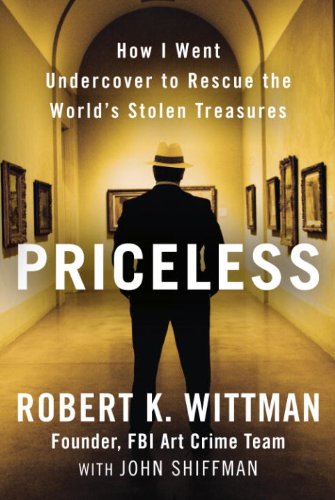
"Priceless" by Robert K. Wittman
I recently finished reading Robert K. Wittman's book Priceless: How I Went Undercover to Rescue the World's Stolen Treasures. I had waited several weeks (months?) to get my hands on a library copy of this book, and became even more anxious after reading this great review of the book on Truth, Beauty, Freedom and Books.
The wait paid off, though. Not only is this book entertaining and informative, but it also gives a really interesting perspective on art. As an undercover FBI agent, Wittman has to be informed about the historical significance of the art in his cases, but it is also clear that he views art as objects and historical artifacts. There definitely is nothing wrong with this perspective, and it is a logical perspective for Wittman (since he's interested in recovering a physical object that has been stolen).
Anyhow, it was interesting to think about Wittman's apparent "art as object" perspective, since art historians sometimes forget that a work of art is, in its essence, an object: art is paint on a canvas, a block of marble, or metal. I think art historians often "mysticize" or elevate works of art to the point that the objects are exempt from their actual physical properties. Gombrich, for example, tried to humanize art by comparing it to the complexity of "real human beings" (see here). In some ways, I don't have issue with this perspective either, but it's interesting to think about how art historians sometimes divorce themselves from the physicality of the art they discuss. But I digress. The point is: it was interesting to see Wittman approach art from a different (more practical?) perspective than I usually encounter among art historians and critics.
Although I would have enjoyed reading more about the historical background for some of the art pieces, Wittman provided a decent amount of information. (Also on a side note, Wittman also works to recover historical artifacts, such as an original copy of the Bill of Rights. These cases are also interesting, but I assumed beforehand that I would only be reading about stolen fine art.)
I especially was interested in reading about the theft of Norman Rockwell's Spirit of '76 (1976, shown right).1 This painting was stolen from a gallery in 1978 and was never recovered. The FBI closed the case a few years after the theft, but the case resurfaced in the mid-to-late 1990s, when it became known that the painting had was in the possession of an art dealer in Rio de Janeiro. Wittman was deeply involved in this case by the time of 9/11. Unsurprisingly, the interest in Rockwell and Americana surged after 9/11, due to the rise of patriotism in the American people. Therefore, a whole new dimension and meaning was added to this case, given the 9/11 happenings and interest in Rockwell. And, even more interestingly, Rockwell's Spirit of '76 includes an image of the "Twin Towers" (shown in the bottom right corner of the painting). In fact, the inclusion of the "Twin Towers" helped give impetus to finishing this case and recover the artwork from Brazil: officials realized it would be a great public relations move.2
I'd recommend this book to anyone who likes art crime. I think Americans will find the cases especially interesting and meaningful, since Wittman recovered many objects that are significant to American history. However, there are several European pieces that Wittman also recovers/mentions. Really, though, I think that this book would appeal to most people who are interested in art and art crime.
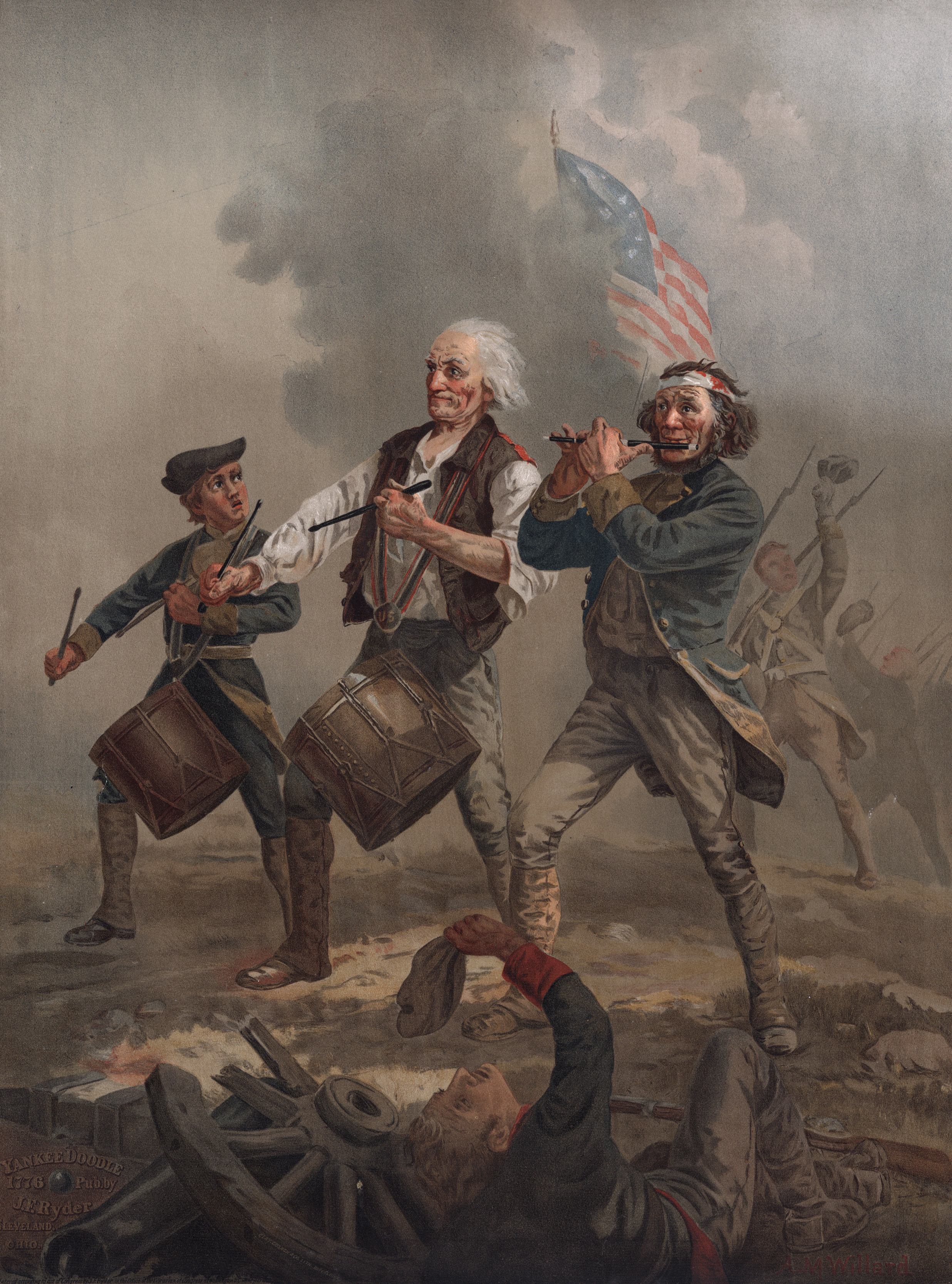
1 I can't help but add that Rockwell's composition was inspired by Archibald Willard's classic Spirit of '76 ("Yankee Doodle," the linked version dates c. 1875)
2 Robert K. Wittman, Priceless: How I Went Undercover to Rescue the World's Stolen Treasures (New York: Crown Publishers, 2010), 174.
The wait paid off, though. Not only is this book entertaining and informative, but it also gives a really interesting perspective on art. As an undercover FBI agent, Wittman has to be informed about the historical significance of the art in his cases, but it is also clear that he views art as objects and historical artifacts. There definitely is nothing wrong with this perspective, and it is a logical perspective for Wittman (since he's interested in recovering a physical object that has been stolen).
Anyhow, it was interesting to think about Wittman's apparent "art as object" perspective, since art historians sometimes forget that a work of art is, in its essence, an object: art is paint on a canvas, a block of marble, or metal. I think art historians often "mysticize" or elevate works of art to the point that the objects are exempt from their actual physical properties. Gombrich, for example, tried to humanize art by comparing it to the complexity of "real human beings" (see here). In some ways, I don't have issue with this perspective either, but it's interesting to think about how art historians sometimes divorce themselves from the physicality of the art they discuss. But I digress. The point is: it was interesting to see Wittman approach art from a different (more practical?) perspective than I usually encounter among art historians and critics.
Although I would have enjoyed reading more about the historical background for some of the art pieces, Wittman provided a decent amount of information. (Also on a side note, Wittman also works to recover historical artifacts, such as an original copy of the Bill of Rights. These cases are also interesting, but I assumed beforehand that I would only be reading about stolen fine art.)
I especially was interested in reading about the theft of Norman Rockwell's Spirit of '76 (1976, shown right).1 This painting was stolen from a gallery in 1978 and was never recovered. The FBI closed the case a few years after the theft, but the case resurfaced in the mid-to-late 1990s, when it became known that the painting had was in the possession of an art dealer in Rio de Janeiro. Wittman was deeply involved in this case by the time of 9/11. Unsurprisingly, the interest in Rockwell and Americana surged after 9/11, due to the rise of patriotism in the American people. Therefore, a whole new dimension and meaning was added to this case, given the 9/11 happenings and interest in Rockwell. And, even more interestingly, Rockwell's Spirit of '76 includes an image of the "Twin Towers" (shown in the bottom right corner of the painting). In fact, the inclusion of the "Twin Towers" helped give impetus to finishing this case and recover the artwork from Brazil: officials realized it would be a great public relations move.2
I'd recommend this book to anyone who likes art crime. I think Americans will find the cases especially interesting and meaningful, since Wittman recovered many objects that are significant to American history. However, there are several European pieces that Wittman also recovers/mentions. Really, though, I think that this book would appeal to most people who are interested in art and art crime.
1 I can't help but add that Rockwell's composition was inspired by Archibald Willard's classic Spirit of '76 ("Yankee Doodle," the linked version dates c. 1875)
2 Robert K. Wittman, Priceless: How I Went Undercover to Rescue the World's Stolen Treasures (New York: Crown Publishers, 2010), 174.
Wednesday, October 13, 2010
Naram-Sin Inscriptions
Bah! I found another problem with something in Stokstad's recent Art History text. I promise that I'm not spending my time scouting out errors in this book - they just happen to pop up. I like a lot of things about Stokstad's approach to art history, but these minor errors and misleading statements are making me question whether I want to use this textbook for my classes. (Plus, it's making me wonder: what other incorrect or misleading statements in the text could have escaped my notice?) Man, if I ever decide to give up teaching, maybe Pearson Prentice Hall would hire me as an editor for their future editions of Art History.
Right now I'm bothered about Stokstad's discussion of the Victory Stele of Naram-Sin (2254-2218 BCE, shown left). Stokstad writes about the significance of "the inscription" on the stele - which suggests that there is only one inscription.1 In reality, though, there are two inscriptions: one that was written by Naram-Sin, and another inscription (which is most prominent and recognizable) that was written about 1,000 years later. Not only does Stokstad fail to recognize that there are two inscriptions, but she also implies that the second (clearly visible) inscription is the one that was written to commemorate Naram-Sin's victory. This simply isn't true.
To prove my point, let me show you the inscriptions. Here's a detail image of the first inscription that was made:
Right now I'm bothered about Stokstad's discussion of the Victory Stele of Naram-Sin (2254-2218 BCE, shown left). Stokstad writes about the significance of "the inscription" on the stele - which suggests that there is only one inscription.1 In reality, though, there are two inscriptions: one that was written by Naram-Sin, and another inscription (which is most prominent and recognizable) that was written about 1,000 years later. Not only does Stokstad fail to recognize that there are two inscriptions, but she also implies that the second (clearly visible) inscription is the one that was written to commemorate Naram-Sin's victory. This simply isn't true.
To prove my point, let me show you the inscriptions. Here's a detail image of the first inscription that was made:
This inscription is partially worn off (it is outlined by a rectangular shape over Naram-Sin's head) and states that Naram-Sin was victorious over the Lullubi people of the Zagros Mountains. The inscription was likely made at the time when the rest of the stele was fashioned.
Here is a detail image of the second (and easily recognizable) inscription:
This inscription was written by Shutruk-Nahhunte, an Elamite king who raided Sippar in the 12th century BC and carried the stele back to Susa as booty. Shutruk-Nahhunte recorded his actions in an Elamite text: "I am Shutruk-Nahhunte, son of Hallutush-Inshushinak, beloved servant of the god Inshushinak, king of Anshan and Susa, enlarger of my realm, protector of Elam, prince of Elam. At the command of [the god] Inshusinak, I struck down the city of Sippar. I took the stele of Naram-Sin in my hand, and I carried it off and brought it back to Elam. I set it up in dedication to my lord, Inshusinak."
This week my class has been reading a fascinating essay by Marian H. Feldman which discusses this latter inscription. (It is because of Feldman's article that I noticed the misleading information in Stokstad's book. Only after sorting out the two inscriptions did I discover that the most recent edition of Gardner's Art Through the Ages correctly describes the two different inscriptions. At least one general survey text has the correct information!) Feldman uses the Elamite inscription as a springboard to discuss how different Mesopotamian monuments became loot and booty after multiple wars in the ancient Near East. She discusses the various ways that conquering Mesopotamian groups would mutilate or deface artistic spoils of war. It's a really interesting essay, and I especially like her comparisons between ancient looting and the 2003 raiding of the National Museum of Iraq.
In regards to this stele, I liked Feldman's discussion of how Shutruk-Nahunte chose to associate himself with Naram-Sin in the second stele inscription. Feldman writes, "That Shutruk-Nahhunte did not overwrite or obliterate Naram-Sin's original inscription, as he did with other captured Mesopotamian monuments, and moreover, that in his own inscription he attributed the stele to Naram-Sin by name, suggests that this particular monument possessed a significance beyond simple war booty. Rather, Shutruk-Nahhunte's knowledge of the stele's association with a charismatic, if dishonored, ruler of the first great Near Eastern empire imbued the monument with added value."2 It's neat to think about how the value and meaning of this stele has changed over time.
Anyhow, thanks to Marian H. Feldman, I've now got my two inscriptions straight. Let's hope that Stokstad straightens out her own error in future editions of Art History.
1 Marilyn Stokstad and Michael W. Cothren, Art History, 4th edition (Upper Saddle River, New Jersey: Prentice Hall, 2011), 36.
2 Marian H. Feldman, "Knowledge as Cultural Biography: Lives of Mesopotamian Monuments," in Dialogues in Art History, from Mesopotamian to Modern: Readings for a New Century, Elizabeth Cropper, ed. (London: National Gallery of Art, Washington, 2009), 44.
In regards to this stele, I liked Feldman's discussion of how Shutruk-Nahunte chose to associate himself with Naram-Sin in the second stele inscription. Feldman writes, "That Shutruk-Nahhunte did not overwrite or obliterate Naram-Sin's original inscription, as he did with other captured Mesopotamian monuments, and moreover, that in his own inscription he attributed the stele to Naram-Sin by name, suggests that this particular monument possessed a significance beyond simple war booty. Rather, Shutruk-Nahhunte's knowledge of the stele's association with a charismatic, if dishonored, ruler of the first great Near Eastern empire imbued the monument with added value."2 It's neat to think about how the value and meaning of this stele has changed over time.
Anyhow, thanks to Marian H. Feldman, I've now got my two inscriptions straight. Let's hope that Stokstad straightens out her own error in future editions of Art History.
1 Marilyn Stokstad and Michael W. Cothren, Art History, 4th edition (Upper Saddle River, New Jersey: Prentice Hall, 2011), 36.
2 Marian H. Feldman, "Knowledge as Cultural Biography: Lives of Mesopotamian Monuments," in Dialogues in Art History, from Mesopotamian to Modern: Readings for a New Century, Elizabeth Cropper, ed. (London: National Gallery of Art, Washington, 2009), 44.
Monday, September 27, 2010
Henry "Box" Brown's Moving Panorama
Have you ever picked up a book and pleasantly discovered that the reading was more interesting than you anticipated? I recently read The Unboxing of Henry Brown by Jeffrey Ruggles, and I ended up feeling that way. I'm very interested in issues of slavery/antislavery in the United States (and elsewhere), and for a long time I've wanted to learn more about Henry "Box" Brown. I didn't anticipate reading about art history when I picked up this book, though, but was excited to find a lot of discussion about the moving panorama, a popular form of art (and entertainment) in the mid-19th century.
Before reading this book, the only thing I knew about Brown was his escape from slavery: he climbed into a box and shipped himself from Virginia (a "slave" state) to Philadelphia (a "free" state). Various images of Brown's "resurrection" from his box (the one above is from Boston, 1850 (unsigned)) were used by abolitionists. One art historian commented that these images of the unboxing were "perhaps the most potent single metaphor [that abolitionists used] for the displacement of the traditional image of the 'runaway' slave in popular imagination."1
The thing that surprised me most about this book, though, was to learn how Brown decided to earn a living after escaping from slavery. Brown commissioned a moving panorama to be painted, which he titled Mirror of Slavery.2 Moving panoramas consisted of huge canvases (sewn together) which were displayed on a type of vertical spool. The paintings could then be scrolled in front of an audience, revealing a sequence of scenes. In some ways, the moving panorama was the predecessor to the slide show. (If you like, you can get a sense of the moving panorama idea by watching the beginning of this scene from the film "Letter from an Unknown Woman," 1948). During the middle of the 19th century, the moving panorama was an extremely popular form of entertainment. It's sad that few moving panoramas exist today. Those that do exist are never shown in their original format, either, largely due to conservation issues.
A good portion of Ruggles' book discusses the history of the moving panorama (as a type of art) and the scenes which appeared on Mirror of Slavery. Although Mirror of Slavery doesn't exist today, it was interesting to learn about the subject matter for the scenes. We also have a basic idea of the composition for some of the Mirror of Slavery scenes too, since it's obvious that Mirror of Slavery found inspiration in the illustrations for the Charles Green's book The Nubian Slave. Ruggles book is replete with lots of images that may have resembled the scenes from Mirror of Slavery.
Anyhow, for several years Brown traveled around the United States and England, giving presentations and lectures while exhibiting his moving panorama. I have to admit - while I was very interested to learn about Brown's life, I found it even more fascinating to learn more about the moving panorama. Although I was familiar with the idea of the moving panorama before, I didn't realize that such an artistic device helped to aid the antislavery movement.3
1 Marcus Wood, Blind Memory: Visual Representations of Slavery in England and America, 1780-1865 (Manchester, England: 2000), 103. (See text online here.)
2 Henry "Box" Brown's moving panorama was painted by three painters from Boston, with the primary artist probably being Josiah Wollcott. The other artists are described in an 1850 newspaper from Liverpool as "Rouse and Johnson." Ruggles suggests that these artists might have been Samuel Worcester Rowse and David Claypoole Johnston. See Ruggles, p. 75.
3 Henry "Box" Brown was not the only person to use the moving panorama to discuss slavery. Ruggles mentions a couple of others who also produced moving panoramas, including the black abolitionist William Wells Brown. See Ruggles, p. 72.
Before reading this book, the only thing I knew about Brown was his escape from slavery: he climbed into a box and shipped himself from Virginia (a "slave" state) to Philadelphia (a "free" state). Various images of Brown's "resurrection" from his box (the one above is from Boston, 1850 (unsigned)) were used by abolitionists. One art historian commented that these images of the unboxing were "perhaps the most potent single metaphor [that abolitionists used] for the displacement of the traditional image of the 'runaway' slave in popular imagination."1
The thing that surprised me most about this book, though, was to learn how Brown decided to earn a living after escaping from slavery. Brown commissioned a moving panorama to be painted, which he titled Mirror of Slavery.2 Moving panoramas consisted of huge canvases (sewn together) which were displayed on a type of vertical spool. The paintings could then be scrolled in front of an audience, revealing a sequence of scenes. In some ways, the moving panorama was the predecessor to the slide show. (If you like, you can get a sense of the moving panorama idea by watching the beginning of this scene from the film "Letter from an Unknown Woman," 1948). During the middle of the 19th century, the moving panorama was an extremely popular form of entertainment. It's sad that few moving panoramas exist today. Those that do exist are never shown in their original format, either, largely due to conservation issues.
A good portion of Ruggles' book discusses the history of the moving panorama (as a type of art) and the scenes which appeared on Mirror of Slavery. Although Mirror of Slavery doesn't exist today, it was interesting to learn about the subject matter for the scenes. We also have a basic idea of the composition for some of the Mirror of Slavery scenes too, since it's obvious that Mirror of Slavery found inspiration in the illustrations for the Charles Green's book The Nubian Slave. Ruggles book is replete with lots of images that may have resembled the scenes from Mirror of Slavery.
Anyhow, for several years Brown traveled around the United States and England, giving presentations and lectures while exhibiting his moving panorama. I have to admit - while I was very interested to learn about Brown's life, I found it even more fascinating to learn more about the moving panorama. Although I was familiar with the idea of the moving panorama before, I didn't realize that such an artistic device helped to aid the antislavery movement.3
1 Marcus Wood, Blind Memory: Visual Representations of Slavery in England and America, 1780-1865 (Manchester, England: 2000), 103. (See text online here.)
2 Henry "Box" Brown's moving panorama was painted by three painters from Boston, with the primary artist probably being Josiah Wollcott. The other artists are described in an 1850 newspaper from Liverpool as "Rouse and Johnson." Ruggles suggests that these artists might have been Samuel Worcester Rowse and David Claypoole Johnston. See Ruggles, p. 75.
3 Henry "Box" Brown was not the only person to use the moving panorama to discuss slavery. Ruggles mentions a couple of others who also produced moving panoramas, including the black abolitionist William Wells Brown. See Ruggles, p. 72.
Tuesday, September 14, 2010
I Heart Pliny the Elder
I've been reading snippets of Pliny the Elder's Natural History over the past few days, and I can't help but think that the ancient Roman and I would have been friends. I definitely feel as curious about the world as Pliny the Elder, but hopefully I am a little more practical (i.e. I wouldn't risk my life to observe the eruption of Mt. Vesuvius).
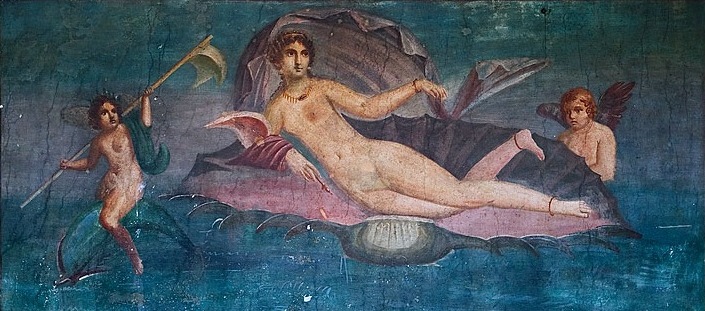
There are two things that I like about Natural History. For one thing, I like Pliny's little anecdotes about artists (I'm sure my penchant for anecdotes is no surprise, gentle reader!). Even though some of the stories seem a little too legendary and far-fetched (Vasari would have loved some of these stories for his Vite), they are still quite fun. For example, Pliny devotes a whole section to stories about the Greek painter Apelles of Cos (you can read some of the stories here). One such story involves speculation that Apelles painted Alexander the Great's mistress Pancaste for Aphrodite Rising from the Foam ("Aphrodite Anadyomene," shown above in a Roman mural from Pompeii (House of the Marine Venus, 1st century AD) which is thought to have been based on Apelles' original work). 1
I'm especially amused by this story about Apelles and a picture of a horse:
"There is, or at least there once existed, a picture of a horse by Apelles. It was painted for a competition in which he sought judgment not from men but from dumb animals. For, seeing that his rivals were getting the upper hand by devious means, he showed the pictures individually to some horses he had brought in, and they neighed only at Apelles' picture. As this frequently happened on subsequent occasions it proved to be a good test of the artist's skill." (Natural History XXXV:95).
The other thing I like about Pliny the Elder is his apparent passion and excitement for his subject matter. I love that he calls the pyramids "a pointless and absurd display of royal wealth." (Natural History XXXVI: 75) (Not that I agree with that statement, I just love his frank opinion.)
I also can relate to his awe regarding the Colossus of Rhodes (one of the Seven Wonders of the Ancient World, original c. 292-284 BC, shown left through a wood engraving reconstruction by Sidney Barclay, c. 1875). I'm always interested in how a sculpture's scale compares to that of a human being, and Pliny seems to have that same interest: "No statue has commanded greater admiration than the Colossus of Rhodes made by Chares of Lindos, the pupil of Lysippus. It was about 105 feet high. Sixty-six years after its erection the Colossus was toppled by an earthquake, but even lying on the ground it is amazing. Few people can make their arms meet round its thumb, and the fingers alone are larger than most statues." (Natural History XXXIV:42). (On a side note, it was announced about two years ago that the Colossus of Rhodes was going to be rebuilt as a giant light sculpture. Does anyone know if progress has been made on that project?)
Who here has read Natural History? Any likes or dislikes? If you haven't had a chance to get to know Pliny the Elder and his thoughts on art, I'd highly recommend those few chapters from Natural History. Pliny the Elder is witty, opinionated, and just all-around interesting.
1 Pancaste could really be labeled as Alexander the Great's ex-mistress. Pliny records that the ruler commissioned Apelles to paint Pancaste, and then Apelles ended up in love with his subject. In turn, Alexander gave Pancaste to Apelles, which Pliny noted was indicative of Alexander's magnanimity. (Natural History XXXV:86-87).
There are two things that I like about Natural History. For one thing, I like Pliny's little anecdotes about artists (I'm sure my penchant for anecdotes is no surprise, gentle reader!). Even though some of the stories seem a little too legendary and far-fetched (Vasari would have loved some of these stories for his Vite), they are still quite fun. For example, Pliny devotes a whole section to stories about the Greek painter Apelles of Cos (you can read some of the stories here). One such story involves speculation that Apelles painted Alexander the Great's mistress Pancaste for Aphrodite Rising from the Foam ("Aphrodite Anadyomene," shown above in a Roman mural from Pompeii (House of the Marine Venus, 1st century AD) which is thought to have been based on Apelles' original work). 1
I'm especially amused by this story about Apelles and a picture of a horse:
"There is, or at least there once existed, a picture of a horse by Apelles. It was painted for a competition in which he sought judgment not from men but from dumb animals. For, seeing that his rivals were getting the upper hand by devious means, he showed the pictures individually to some horses he had brought in, and they neighed only at Apelles' picture. As this frequently happened on subsequent occasions it proved to be a good test of the artist's skill." (Natural History XXXV:95).
The other thing I like about Pliny the Elder is his apparent passion and excitement for his subject matter. I love that he calls the pyramids "a pointless and absurd display of royal wealth." (Natural History XXXVI: 75) (Not that I agree with that statement, I just love his frank opinion.)
I also can relate to his awe regarding the Colossus of Rhodes (one of the Seven Wonders of the Ancient World, original c. 292-284 BC, shown left through a wood engraving reconstruction by Sidney Barclay, c. 1875). I'm always interested in how a sculpture's scale compares to that of a human being, and Pliny seems to have that same interest: "No statue has commanded greater admiration than the Colossus of Rhodes made by Chares of Lindos, the pupil of Lysippus. It was about 105 feet high. Sixty-six years after its erection the Colossus was toppled by an earthquake, but even lying on the ground it is amazing. Few people can make their arms meet round its thumb, and the fingers alone are larger than most statues." (Natural History XXXIV:42). (On a side note, it was announced about two years ago that the Colossus of Rhodes was going to be rebuilt as a giant light sculpture. Does anyone know if progress has been made on that project?)
Who here has read Natural History? Any likes or dislikes? If you haven't had a chance to get to know Pliny the Elder and his thoughts on art, I'd highly recommend those few chapters from Natural History. Pliny the Elder is witty, opinionated, and just all-around interesting.
1 Pancaste could really be labeled as Alexander the Great's ex-mistress. Pliny records that the ruler commissioned Apelles to paint Pancaste, and then Apelles ended up in love with his subject. In turn, Alexander gave Pancaste to Apelles, which Pliny noted was indicative of Alexander's magnanimity. (Natural History XXXV:86-87).
Wednesday, July 7, 2010
"Mask of Agamemnon": A Forgery and/or Misattribution?
I have just started to read David A. Traill's book Schliemann of Troy: Treasury and Deceit. The book functions as a biography and critique of Heinrich Schliemann, the archaeologist who excavated Troy and Mycenae. In this book, Traill argues that the so-called "Mask of Agamemnon" (a funerary mask excavated in Grave Circle A (southern burial shaft grave V) in Mycenae, ca. 1600-1500 BC, see left) could possibly be a 19th century forgery.1 One of Traill's main reasons is this the only discovered Mycenaean mask which shows facial hair. In addition, the upturned "handlebar" mustache looks like it was added later; it seems like the original mustache was created to turn down at the ends of the mouth. Traill does also posits, however, that this mask could be authentic but then Schliemann added the "handlebars" in order to give the mask a more authoritative appearance.1
Not all scholars accept this idea that the mask is a forgery, but it is accepted that this is not the mask of the fabled king Agamemnon, even though Schliemann had imagined and wished such a thing. If Agamemnon was a real person, he would have lived about 300 years after this mask was made.
Interestingly, though, some think that this mask (shown above) is the not the one which Schliemann originally identified as the mask of Agamemnon. Oliver Dickinson believes that Schliemann was referring to a different mask found in the same shaft grave (called "NM 623", from northern burial in shaft grave V, see below right).3
To support his argument, Dickinson cites a telegraph by Schliemann (translated into English) which reads: "In the last tomb three bodies, one without ornaments. Have telegraphed to Nauplia for a painter, to preserve the dead man with the round face [italics for emphasis]. This one is very like the picture which my imagination formed of Agamemnon long ago."4
Since only three burials were discovered in grave shaft V (and one of the burials had been presumably robbed, since it was devoid of goods), these two masks are the only ones by which we can compare Schliemann's statement. It doesn't take a genius to see that this second mask (NM 623) has a round face, whereas the other face could hardly be called "round." Could this be the mask that Schliemann originally identified as the "Mask of Agamemnon"? It certainly seems possible to me.
1 David A. Traill, Schliemann of Troy: Treasury and Deceit (New York: St. Martin's Press, 1995), 169-172.
2 Ibid., 172.
3 See Oliver Dickinson, "The 'Face of Agamemnon,'" Hesperia 74, no. 3 (July - Sept. 2005): 299-308.
Not all scholars accept this idea that the mask is a forgery, but it is accepted that this is not the mask of the fabled king Agamemnon, even though Schliemann had imagined and wished such a thing. If Agamemnon was a real person, he would have lived about 300 years after this mask was made.
Interestingly, though, some think that this mask (shown above) is the not the one which Schliemann originally identified as the mask of Agamemnon. Oliver Dickinson believes that Schliemann was referring to a different mask found in the same shaft grave (called "NM 623", from northern burial in shaft grave V, see below right).3
To support his argument, Dickinson cites a telegraph by Schliemann (translated into English) which reads: "In the last tomb three bodies, one without ornaments. Have telegraphed to Nauplia for a painter, to preserve the dead man with the round face [italics for emphasis]. This one is very like the picture which my imagination formed of Agamemnon long ago."4
Since only three burials were discovered in grave shaft V (and one of the burials had been presumably robbed, since it was devoid of goods), these two masks are the only ones by which we can compare Schliemann's statement. It doesn't take a genius to see that this second mask (NM 623) has a round face, whereas the other face could hardly be called "round." Could this be the mask that Schliemann originally identified as the "Mask of Agamemnon"? It certainly seems possible to me.
1 David A. Traill, Schliemann of Troy: Treasury and Deceit (New York: St. Martin's Press, 1995), 169-172.
2 Ibid., 172.
3 See Oliver Dickinson, "The 'Face of Agamemnon,'" Hesperia 74, no. 3 (July - Sept. 2005): 299-308.
Saturday, June 26, 2010
Bernini and Borromini's "Arms"
I just finished reading The Genius in the Design: Bernini, Borromini, and the Rivalry That Transformed Rome by Jake Morrissey. It was a pretty good book, although I fluctuated between being bored and fascinated. Morrissey covered a lot of information that I already knew (his discussion of St. Peter's building history bored me to no end), but he also presented many things that were new to me. It's always interesting for me to read popular history books like this one. I vacillate between feeling like a scholar (by already knowing the information that's presented in the book) and feeling like an idiot who doesn't know anything. I guess such vacillation is good, in a way. There is always more to learn on a subject, and it's good to be reminded of that.
This book revolved around the artistic rivalry that existed between Borromini and Bernini during the 17th century. Although the artists worked together for many years (did you know that Borromini helped Bernini make the baldacchino inside St. Peter's?), they eventually had a falling out. The two artists ended up competing for some of the same commissions. Things turned especially ugly when Borromini publicly and vehemently critiqued the instability of Bernini's bell towers at St. Peter's. It's interesting to realize, though, that although they two artists were rivals, they also undoubtedly influenced the work of each other. Morrissey points out one such influence by suggesting that Bernini's Scala Regia (1663-1666) was influenced by Borromini's colonnade at the Palazzo Spada (1652-53).
As I was reading Morrissey's book, I thought about another possible way that Borromini may have influenced Bernini. Morrissey quotes Borromini's description of his church Oratorio dei Filippini (Oratory of Saint Philip Neri, 1637-1650, shown left in a 1658-1662 engraving by Domenico Barrière). Borromini designed this church with specific intent to reference the human figure. He wrote in his treatise Opus Architectonicum, "In giving form to the facade...I created the figure of the human body with open arms as if it embraces everyone who enters; and this open-armed figure is divided in five parts, that is, the chest in the center, and the arm, each in two sections [arm and forearm] as they open out."1
This quote immediately reminded me of the many interpretations of Bernini's piazza of Saint Peter's (1656-1667, shown right), which has also been analyzed as anthropomorphic in form. In fact, Howard Hibbard notes that Bernini himself compared the colonnade of the piazza to those of outstretched arms (just like Borromini's comparison with the Oratorio dei Filippini and open arms!). Hibbard writes, "The image of the piazza was likened by Bernini to the outstretched arms of the Church welcoming the faithful, so that even this seemingly pure architectural creation has an anthropomorphic, and even quite sculptural connotation and function."2
Is it just coincidence that these two rivals both used the imagery of oustretched, open arms for their architectural designs? I doubt it, especially considering the rivalry between these two men. I think that Bernini's architectural "arms" were influenced by Borromini's "arms" at the Oratorio dei Filippini. Borromini's church was completed just six years before Bernini began work on his project. And, furthermore, the manuscript of Opus Architectonicum (in which Borromini outlines his explanation of the "arms" idea) is dated to 1656, the same year that Bernini began work on the piazza of St. Peter's. What if Bernini got a look at Borromini's treatise or heard of some of the ideas contained therein? I think it's possible that Borromini's "arms" theory may have actually influenced the piazza design at St. Peter's.3
1 Jake Morrissey, The Genius in the Design: Bernini, Borromini and the Rivalry That Transformed Rome (New York: Harper Collins, 2005), 132. Morrissey quotes Borromini's treatise Opus Architectonicum (Joseph Connors, ed. Milan: Il Polifilo, Trattati di architettura, 1998).
2 Howard Hibbard, Bernini (New York: Penguin Books, 1965), 155.
3 I realize that other architectural theories exist which compare architectural forms to the human figure. Even the ancient Roman writer Vitruvius compared the proportions of the Classical orders to the human form. Admittedly, Borromini is not the first architect to come up with this comparison between the human form and architecture. However, I wonder if Borromini could have been the first to incorporate the welcoming outstretched arms in architecture, particularly in its propagandistic role for the Counter-Reformation. If that's the case, then Borromini has once again been relegated to the sidelines, since most people associate this propagandistic idea of Catholic arms/hugs/embraces with Bernini's piazza.
This book revolved around the artistic rivalry that existed between Borromini and Bernini during the 17th century. Although the artists worked together for many years (did you know that Borromini helped Bernini make the baldacchino inside St. Peter's?), they eventually had a falling out. The two artists ended up competing for some of the same commissions. Things turned especially ugly when Borromini publicly and vehemently critiqued the instability of Bernini's bell towers at St. Peter's. It's interesting to realize, though, that although they two artists were rivals, they also undoubtedly influenced the work of each other. Morrissey points out one such influence by suggesting that Bernini's Scala Regia (1663-1666) was influenced by Borromini's colonnade at the Palazzo Spada (1652-53).
As I was reading Morrissey's book, I thought about another possible way that Borromini may have influenced Bernini. Morrissey quotes Borromini's description of his church Oratorio dei Filippini (Oratory of Saint Philip Neri, 1637-1650, shown left in a 1658-1662 engraving by Domenico Barrière). Borromini designed this church with specific intent to reference the human figure. He wrote in his treatise Opus Architectonicum, "In giving form to the facade...I created the figure of the human body with open arms as if it embraces everyone who enters; and this open-armed figure is divided in five parts, that is, the chest in the center, and the arm, each in two sections [arm and forearm] as they open out."1
This quote immediately reminded me of the many interpretations of Bernini's piazza of Saint Peter's (1656-1667, shown right), which has also been analyzed as anthropomorphic in form. In fact, Howard Hibbard notes that Bernini himself compared the colonnade of the piazza to those of outstretched arms (just like Borromini's comparison with the Oratorio dei Filippini and open arms!). Hibbard writes, "The image of the piazza was likened by Bernini to the outstretched arms of the Church welcoming the faithful, so that even this seemingly pure architectural creation has an anthropomorphic, and even quite sculptural connotation and function."2Is it just coincidence that these two rivals both used the imagery of oustretched, open arms for their architectural designs? I doubt it, especially considering the rivalry between these two men. I think that Bernini's architectural "arms" were influenced by Borromini's "arms" at the Oratorio dei Filippini. Borromini's church was completed just six years before Bernini began work on his project. And, furthermore, the manuscript of Opus Architectonicum (in which Borromini outlines his explanation of the "arms" idea) is dated to 1656, the same year that Bernini began work on the piazza of St. Peter's. What if Bernini got a look at Borromini's treatise or heard of some of the ideas contained therein? I think it's possible that Borromini's "arms" theory may have actually influenced the piazza design at St. Peter's.3
1 Jake Morrissey, The Genius in the Design: Bernini, Borromini and the Rivalry That Transformed Rome (New York: Harper Collins, 2005), 132. Morrissey quotes Borromini's treatise Opus Architectonicum (Joseph Connors, ed. Milan: Il Polifilo, Trattati di architettura, 1998).
2 Howard Hibbard, Bernini (New York: Penguin Books, 1965), 155.
3 I realize that other architectural theories exist which compare architectural forms to the human figure. Even the ancient Roman writer Vitruvius compared the proportions of the Classical orders to the human form. Admittedly, Borromini is not the first architect to come up with this comparison between the human form and architecture. However, I wonder if Borromini could have been the first to incorporate the welcoming outstretched arms in architecture, particularly in its propagandistic role for the Counter-Reformation. If that's the case, then Borromini has once again been relegated to the sidelines, since most people associate this propagandistic idea of Catholic arms/hugs/embraces with Bernini's piazza.
Friday, April 30, 2010
The $12 Million Stuffed Shark
Anyhow, I think that listening to these stories piqued my interest in the art market, which is why I wanted to read Don Thompson's book, The $12 Million Stuffed Shark: The Curious Economics of Contemporary Art. The book discusses the everything you wanted to know about the art market: auction houses, prices for art, art as an investment, galleries and dealers, etc.
I thought the first few chapters of this book was really fascinating. Thompson related some interesting anecdotes about contemporary artists and art sales, including an interesting story about Damien Hirst's The Physical Impossibility of Death in the Mind of Someone Living (1991). Thompson relates how the original shark in Hirst's tank was not preserved properly, and by the time the work of art went for sale, the shark was not in good condition: one of the fins had fallen off and the skin had become green and wrinkly. Worse still, the formaldehyde had become rather murky. Nonetheless, the deteriorated shark and tank sold for $12 million! (Hirst later agreed to replace the original shark with a new one.)1
I have to admit, though, the middle of the book was rather uninteresting. Thompson focused a lot of auction prices and technicalities. I think this information would be very useful to anyone who is interested in buying or selling art, but it wasn't very compelling from a historical standpoint. Perhaps I shouldn't have set my expectations too high - I knew that Thompson was an economist (and not an art historian) when I started to read the book.
The ending of the book completely redeemed itself, though. Thompson devoted a whole chapter to how art crime (especially forgeries) affect the art market. One interesting story was from May 2000, when Christie's and Sotheby's realized that their most recent auction catalogs were offering the exact same painting for sale, Gauguin's Vase de Fleurs (Lilas), 1885.
Obviously, one of the paintings had to be a fake. The auction houses showed the works to a specialist, and it was later determined that Christie's was selling the copy. The FBI ended up getting involved and a complex art scandal was unearthed that involved Ely Sakhai, the owner of the original Gauguin painting.
Anyhow, I don't know if I'll read this book again, but I think it is a good resource for the art world. I'd recommend this book to anyone who is seriously interested in buying or selling contemporary art.
1 Don Thompson, The $12 Million Stuffed Shark: The Curious Economics of Contemporary Art (London: Palgrave Macmillan, 2008), 2, 63.
Wednesday, April 28, 2010
The Private Lives of the Impressionists
Heidenkind's Art History Challenge ends this week, and I am finishing up the last two books that I selected for the challenge. This morning I finished Sue Roe's The Private Lives of the Impressionists, which I have been trying to read for several months. It's not that Roe's book is boring or bothersome - but it wasn't compelling enough for me to read in a single sitting. Ironically, I wonder if the book wasn't amazingly compelling because I'm an art historian. I wasn't waiting on edge, wondering what was going to happen to the Impressionists, because more-or-less I already knew.
The book is dedicated to the personal and professional lives of several Impressionist artists: Manet, Monet, Pissarro, Cezanne, Renoir, Degas, Sisley, Morisot, and Cassatt. Roe's writing style is very informed, but also lively and engaging. I thought that she gave fairly equal treatment to all of the artists mentioned, with the exception of Alfred Sisley, who didn't receive a lot of discussion (which I would expect, since he's not very well-known).
One of my favorite things that I learned from the book was that Degas traveled to New Orleans. He delayed his return to Paris for three months so that he could paint this picture of a cotton office:
The book is dedicated to the personal and professional lives of several Impressionist artists: Manet, Monet, Pissarro, Cezanne, Renoir, Degas, Sisley, Morisot, and Cassatt. Roe's writing style is very informed, but also lively and engaging. I thought that she gave fairly equal treatment to all of the artists mentioned, with the exception of Alfred Sisley, who didn't receive a lot of discussion (which I would expect, since he's not very well-known).
One of my favorite things that I learned from the book was that Degas traveled to New Orleans. He delayed his return to Paris for three months so that he could paint this picture of a cotton office:
Degas, Cotton Merchants in New Orleans, 1873
I think this might be my new favorite work by Degas. It's fun and interesting subject matter, and I love the white, fluffy cotton.
Overall, Roe's book was pretty good. It's not the most compelling thing that I have ever read, but it was interesting to learn more about the personal lives of the Impressionists. I'd recommend this book to anyone who wants to learn more about the Impressionists, but I do think it would be easier for the reader to be somewhat informed about Impressionism before reading Roe's book.
Have you read The Private Lives of the Impressionists? Did you like it?
Thursday, December 10, 2009
Book Review: Vasari's "The Lives of the Artists"
- This book is simultaneously boring and fascinating. It's difficult to read Vasari's lengthy passages which describe works of art, especially since there were no reproductions available in my text. (This website, however, promises to display illustrations with each biography, although I don't know if all extant reproductions will be provided for every description in the text.) However, many of Vasari's anecdotes and short stories are really fascinating. I especailly found the story of Brunelleschi and Ghiberti's rivalry to be quite riveting.
- Vasari's hyperbolic writing style is a little silly. He is over-the-top in his praise for the majority of artists in the book. Likewise, much of art in the book is described as the most beautiful thing in the world - those descriptions become old after a few paragraphs. Vasari also opens many chapters with generalized, broad statements about life, happiness, or art (a type of "Happy is the man who..." statement), and that also gets a little annoying.
- I can see why Vasari is sometimes called "The Father of Art History." His methodology of verifying multiple sources for information helped set a precedent for the discipline. He also offers critiques for works of art, and it's easy to see how he helped to set the standard for art criticism. Even though his writing is prolix and dull at times, it's quite interesting to see his methodology and ideological influences.
- I would recommend this book to a serious art historian. I think anyone with a mild interest in art would get bored quite easily: the interesting anecdotes and stories are embedded deep within Vasari's text. If you want to know more interesting stories without reading the book, just let me know. I took notes!
* I am counting this book as part of Heidenkind's Art History Challenge.
Wednesday, October 14, 2009
"The Challenge of the Avant-Garde" & Caillebotte
Overall, I was quite pleased with this book. I'll be using it for an upcoming class. I particularly like how the book examines how the term "avant-garde" and has changed over time. I did think that some parts of the book were confusing and biased (the authors seem extraordinarily bent on discussing art that has been underprivileged or underexposed in art historical studies), but I still would recommend it.
I was particularly interested in one case study that discussed Caillebotte and domestic space. I have always associated Caillebotte with modernity through his outdoor depictions of 19th century Parisian life, such as Paris Street: A Rainy Day (1877) and Pont de l'Europe (1876), I didn't realize that Caillbotte also was interested in domestic space and interior settings. Two such paintings involve depictions of floorscrapers:
Fionna Barber (the author of this case study) emphasizes that these paintings are also depictions of modern Parisian life - the floorscrapers are modern individuals (wearing contemporary clothes) who are involved in their professional work.1 Understandably, this painting didn't sit too well with critics at the time - largely because the image of the lower-class, "heroic worker" was clearly identified with paintings by the controversial artist Courbet (for an example, see Courbet's Stonebreakers (by the way, did you know that the Stonebreakers was destroyed in 1945 during a bombing of Dresden? Isn't that tragic?)).
If you want to learn more about Caillebotte and domestic space, I'd recommend that you pick up The Challenge of the Avant-Garde.
1 Paul Wood, ed., The Challenge of the Avant-Garde (New Haven: Yale University Press, 1999), 145.
Subscribe to:
Posts (Atom)