Well my friends, I think I may have found another minor error in an art history textbook. The textbook I use for my Renaissance classes, The Changing Status of the Artist, says the following: "Ascanio Condivi recorded that his friend Michelangelo carved himself in the guise of Nicodemus mourning over the dead Christ"1. This seemingly insignificant comment has captured my attention for several months, and consequently I have long wanted to read Condivi's biography of Michelangelo (first printed 1553). Now that the school quarter is finished, I finally found time to read the biography this past weekend. But when I got to Condivi's discussion on the Duomo Pietà (c. 1550, see below), I couldn't find any discussion about a self-portrait! Only in the footnote of biography did I notice this information from the editor: "The figure of Nicodemus, according to a letter from Vasari to Michelangelo's nephew Leonardo shortly after the artist's death, is a self-portrait"2
Now, in the great scheme of things, perhaps it isn't too a big deal that my textbook misattributed this self-portrait information to Condivi instead of Vasari. I understand that. But I also am in favor of historical accuracy, and I thought I would put the record straight here. If any of my past students are reading this, please make a note of the error on page 69 of your textbook!
That being said, this misattribution happily led me to become familiar with Condivi's book first-hand. Many scholars believe that Condivi's work is the best account of Michelangelo's life; this book can practically be considered an autobiography. Condivi wrote that he got his information "with long patience from the living oracle of his [master's] speech."3 It appears that Michelangelo wanted this biography to be written for two reasons: 1) to correct omissions and errors about Michelangelo that appeared in Vasari's first edition of Lives of the Artists and 2) to exonerate Michelangelo from accusations that he deceived the heirs of Julius II and embezzled sums of money (in regards to Michelangelo's seemingly-endless sculptural project for Pope Julius II's tomb).
Condivi's biography is a great resource for any Renaissance scholar, and it's a rather quick read. And although I didn't read any new information about Michelangelo's self-portrait on the Duomo Pietà, I was prompted to consider reasons why Michelangelo included his self-portrait. Condivi wrote that "Michelangelo plans to donate this Pietà to some church and to have himself buried at the foot of the altar where it is placed."4
So, if this was to be a funerary function in some sense, Michelangelo may have wanted to include his portrait as part of the traditional convention to represent an image of the deceased on funerary monuments. Michelangelo may have also identified with Nicodemus for either spiritual or personal reasons. For example, according to legend, Nicodemus was a sculptor.5
However, this Pietà never was placed next to Michelangelo's tomb. Vasari, who designed Michelangelo's tomb, unsuccessfully tried to acquire the Pietà from the family who owned the sculpture at the time. However, I think it's best that Vasari didn't get his hands on the Pietà: it appears that Michelangelo changed his mind and didn't want the sculpture for his tomb after all. In 1555, two years after Condivi wrote his biography, Michelangelo abandoned and mutilated the Pietà. He then sold the sculpture in 1561 to his friend Francesco Bandini, a Florentine banker in Rome. So if Michelangelo sold the sculpture, it's very likely that he had no intention of using the sculpture on his own tomb. In a way, I'm surprised that Vasari didn't pick up on that simple concept.
A lot of scholars have discussed and analyzed why Michelangelo mutilated the Duomo Pietà, and I think I will compile some thoughts in a forthcoming post. Stay tuned!
1 Catherine King, "Italian Artists in Search of Virtue, Fame, and Honor c. 1450-1650," in The Changing Status of the Artist by Emma Barker, Nick Webb and Kim Woods, eds. (London: Yale University Press, 1999), 69.
2 Ascanio Condivi, The Life of Michelangelo, translated by Alice Sedgwick Wohl, edited by Hellmut Wohl, 2nd ed. (University Park, PA: The Pennsylvania State University Press, 1999), 140 (my emphasis). I realize that the Changing Status textbook could be referring to something else written by Condivi besides his biography (such as a letter), but I highly doubt it. The editor of this Condivi text probably would have mentioned if Condivi had written anything about Michelangelo's self-portrait, instead of only mentioning this letter by Vasari.
3 Ibid., xvi-xviii.
4 Ibid., 90. Michelangelo wanted to be buried in Santa Maria Maggiore, but was actually interred in the Florentine church Santa Croce. Vasari writes details of the internment (and opening Michelangelo's casket to reveal a body untouched by decay!) in his second version of Lives of the Artists (1568). See Giorgio Vasari, The Lives of the Artists, translation by Julia Conway Bondanella and Peter Bondanella (London: Oxford University Press, 1991), 486.
5 King, 69.
Showing posts with label Vasari. Show all posts
Monday, June 13, 2011
Saturday, April 2, 2011
The Laocoön: Bandinelli vs. Michelangelo
I guess the Renaissance artist Baccio Bandinelli has been on my mind lately. I realized that somehow I managed to bring up Bandinelli in each of my classes this past week - including my ancient art class!
To be fair to myself, I better say that I didn't stray too far on a tangent with my ancient art students. I was discussing the classical statue Laocoön (1st century BC) with these students and happened to mention Bandinelli's Laocoön (1520, shown left). It is not surprising that Renaissance artists (and patrons) were interested in copying the Laocoön sculpture, because the classical sculpture was unearthed in 1506. Bandinelli's sculpture was commissioned by Cardinal Giulio dei Medici and originally intended as a gift for Francis I, the King of France. It appears that Cardinal Giulio dei Medici (who later became Pope Clement VII) liked the sculpture too well to part with it, since it eventually ended up in the courtyard of the Palazzo Medici.
Anyhow, I especially think Bandinelli's sculpture is interesting because the central figure has an extended arm above his head. When the original, classical Laocoön was discovered, the figure's right arm was missing. Bandinelli believed that the arm was extended, and other artists (such as Sansovino) ended up following this same idea for their copies. Michelangelo, in contrast, felt that the originally arm probably appeared bent. Bandinelli and Michelangelo were life-long rivals, and this difference in opinion is just one example of the opposition and tension between these artists. (I should say, though, I think Bandinelli felt the rivalry more than Michelangelo, although letters to Michelangelo (see here and here) indicate that he was keenly aware (curious?) of what Bandinelli was doing.)
Anyhow, Bandinelli's proposal for the Laocoön arm came to be generally accepted. I think this general acceptance came about because Bandinelli ended up creating a wax cast of the arm for the original sculpture. Additionally, he received the prestigious commission to make the aforementioned sculpture for Guilio Cardinal de Medici. No doubt Bandinelli relished the fact that he received these invitations instead of Michelangelo.
To add insult to injury, Michelangelo had been present the day that the Laocoön was unearthed in Rome. No doubt Michelangelo felt a certain affinity and connection with the classical sculpture. Scholars have even noted that Michelangelo's figure of Christ in the Last Judgment (Sistine Chapel, 1537-1541, shown right)) was inspired by the classical Laocoön (and note that Christ's raised arm is bent!).1 Perhaps Michelangelo felt like he was getting "the last Word" with Bandinelli by including that visual reference in his fresco?
Either way, Michelangelo finally got validation in the 20th century (ha - as if Michelangelo needs more validation in the art world!). In 1906 a bent arm was discovered in Rome, and in the 1950s it was generally accepted that this was the arm which had broken off of the Laocoön composition. The current restoration of the classical statue shows a bent arm. So it looks like Michelangelo was right all along.
Do you know any more stories about the rivalry between Michelangelo and Bandinelli? Vasari records that Bandinelli tore a cartoon by Michelangelo into small pieces (you can see Aristotile da San Gallo's copy of the cartoon, which depicted the Battle of Cascina, here). I know that the topic of rivalry and Bandinelli's jealously are of interest to many scholars. If you know of any other stories - do share!
*Some readers may remember that I touched on this Laocoön topic last year. If you're interested for a little more information (and some links), see here.
1 Michael P. Kemling, "Michaelangelo's 'Last Judgment': The Influence of 'Lacoon and His Sons,'" (University of Georgia, 2003, available online here). For the discussion of the figure of Christ specifically, see Chapter 2.
To be fair to myself, I better say that I didn't stray too far on a tangent with my ancient art students. I was discussing the classical statue Laocoön (1st century BC) with these students and happened to mention Bandinelli's Laocoön (1520, shown left). It is not surprising that Renaissance artists (and patrons) were interested in copying the Laocoön sculpture, because the classical sculpture was unearthed in 1506. Bandinelli's sculpture was commissioned by Cardinal Giulio dei Medici and originally intended as a gift for Francis I, the King of France. It appears that Cardinal Giulio dei Medici (who later became Pope Clement VII) liked the sculpture too well to part with it, since it eventually ended up in the courtyard of the Palazzo Medici.
Anyhow, I especially think Bandinelli's sculpture is interesting because the central figure has an extended arm above his head. When the original, classical Laocoön was discovered, the figure's right arm was missing. Bandinelli believed that the arm was extended, and other artists (such as Sansovino) ended up following this same idea for their copies. Michelangelo, in contrast, felt that the originally arm probably appeared bent. Bandinelli and Michelangelo were life-long rivals, and this difference in opinion is just one example of the opposition and tension between these artists. (I should say, though, I think Bandinelli felt the rivalry more than Michelangelo, although letters to Michelangelo (see here and here) indicate that he was keenly aware (curious?) of what Bandinelli was doing.)
Anyhow, Bandinelli's proposal for the Laocoön arm came to be generally accepted. I think this general acceptance came about because Bandinelli ended up creating a wax cast of the arm for the original sculpture. Additionally, he received the prestigious commission to make the aforementioned sculpture for Guilio Cardinal de Medici. No doubt Bandinelli relished the fact that he received these invitations instead of Michelangelo.To add insult to injury, Michelangelo had been present the day that the Laocoön was unearthed in Rome. No doubt Michelangelo felt a certain affinity and connection with the classical sculpture. Scholars have even noted that Michelangelo's figure of Christ in the Last Judgment (Sistine Chapel, 1537-1541, shown right)) was inspired by the classical Laocoön (and note that Christ's raised arm is bent!).1 Perhaps Michelangelo felt like he was getting "the last Word" with Bandinelli by including that visual reference in his fresco?
Either way, Michelangelo finally got validation in the 20th century (ha - as if Michelangelo needs more validation in the art world!). In 1906 a bent arm was discovered in Rome, and in the 1950s it was generally accepted that this was the arm which had broken off of the Laocoön composition. The current restoration of the classical statue shows a bent arm. So it looks like Michelangelo was right all along.
Do you know any more stories about the rivalry between Michelangelo and Bandinelli? Vasari records that Bandinelli tore a cartoon by Michelangelo into small pieces (you can see Aristotile da San Gallo's copy of the cartoon, which depicted the Battle of Cascina, here). I know that the topic of rivalry and Bandinelli's jealously are of interest to many scholars. If you know of any other stories - do share!
*Some readers may remember that I touched on this Laocoön topic last year. If you're interested for a little more information (and some links), see here.
1 Michael P. Kemling, "Michaelangelo's 'Last Judgment': The Influence of 'Lacoon and His Sons,'" (University of Georgia, 2003, available online here). For the discussion of the figure of Christ specifically, see Chapter 2.
Tuesday, December 14, 2010
The "Sumptuous" Arts in Greece
The quarter is over. Over the past few days I've reflected on what lectures I enjoyed teaching to my ancient art students. I think that my favorite lecture was based on Kenneth Lapatin's essay, "The Fate of Plate and Other Precious Metals: Toward a Historiography of Ancient Greek Minor (?) Arts"1.
The reason why Lapatin includes a question mark after the word "minor" is important: his whole essay revolves around the argument that the Greeks valued the so-called "minor arts" much more than they are valued today. For Lapatin, the "sumptuous" artistic materials like ivory, gold, silver and gemstone were the artistic mediums that the Greeks most prized. In other words, the Greek marble, bronze and (painted) pottery (all of which are placed at the heart of Western art history) weren't as valued by the ancient Greeks.
To prove his point, Lapatin gives one especially interesting example. He writes that "in the middle of the sixth century BC, the inhabitants of Phocaea decided to abandon their city rather than submit to the Medes. Herodotus reports, 'They loaded onto their ships their children, women, and household property, and above all the images of the gods from the sanctuaries and other dedications, everything, in fact, except bronzes, stoneworks, and paintings, and they sailed to Chios.'"2 Now I realize that there may have been some practical reasons why the Greeks didn't load their ships with stonework (it is heavy, after all!), but isn't it interesting that the art we value today is precisely the art that the Greeks chose to abandon?
In some ways, this news shouldn't come as a surprise to art historians. We have known for a long time that the main purpose of the Parthenon was to house Phidias' chryselephantine cult statue of Athena (see above left for a reconstruction of an original of c. 438 BC). The cult statue was the most valued thing by the Greeks, not the building which housed the statue. This is very ironic, because today much more emphasis is placed on the architecture and exterior sculpture of the Parthenon. In fact, it's interesting that one ancient Greek writer, Pausanias, only mentions the two pediments and cult statue when he described the Parthenon. He ignored the metopes and frieze completely, which suggests that they weren't very important.3
So, why do we value painting, architecture, and sculpture above the "minor" materials and objects created by the Greeks? Lapatin traces this ideology back to Vasari's writings of the 16th century (see a 1566-68 self-portrait of Vasari on right). Vasari's Lives focused on the achievements of three artistic types: painters, sculptors, and architects. As a result, painting, sculpture, and architecture became "the canonical triad" in art history.4 In some ways, it's not surprising that Vasari promoted these types of art: after all, he was a painter and architect himself. Although the effect of Vasari's "triad" was not immediate (gems were still were considered part of the arts for a long time afterward), Vasari's writings took part in "the displacement and demotion of items fashioned from sumptuous materials from the lofty position they held in ancient art and culture (as well as in the Middle Ages and the Renaissance)."5
Lapatin's argument is fascinating. He also delves into interesting discussions of how Winckelmann affected our modern perception of Greek sculpture, particularly in terms of what we value today (i.e. unpainted white marble). It's great stuff. I recommend that everyone should get their hands on a copy of this article. Unfortunately, his essay is found in a book that currently is out of print. But I promise that your efforts in securing a copy of this essay will be well worth the effort!
1 Kenneth Lapatin, "The Fate of Plate and Other Precious Metals: Toward a Historiography of Ancient Greek Minor (?) Arts," in Ancient Art and its Historiography by A. A. Donohue, ed. (Cambridge: 2003): 69-91.
2 Ibid., 71.
3 Colin Cunningham, "The Parthenon Marbles," in Academies, Museums and Canons of Art by Gill Perry and Colin Cunningham, eds. (New Haven: Yale University Press, 1999), 53-54. Part of the citation is available online here.
4 Lapatin, 74. It should be noted that Vasari did discuss and laud the importance of gold work and glyptic in the first edition of his Lives (1550). However, the 1568 revision of the text demoted the sumptuous arts and elevated painting instead.
4 Ibid.
The reason why Lapatin includes a question mark after the word "minor" is important: his whole essay revolves around the argument that the Greeks valued the so-called "minor arts" much more than they are valued today. For Lapatin, the "sumptuous" artistic materials like ivory, gold, silver and gemstone were the artistic mediums that the Greeks most prized. In other words, the Greek marble, bronze and (painted) pottery (all of which are placed at the heart of Western art history) weren't as valued by the ancient Greeks.
To prove his point, Lapatin gives one especially interesting example. He writes that "in the middle of the sixth century BC, the inhabitants of Phocaea decided to abandon their city rather than submit to the Medes. Herodotus reports, 'They loaded onto their ships their children, women, and household property, and above all the images of the gods from the sanctuaries and other dedications, everything, in fact, except bronzes, stoneworks, and paintings, and they sailed to Chios.'"2 Now I realize that there may have been some practical reasons why the Greeks didn't load their ships with stonework (it is heavy, after all!), but isn't it interesting that the art we value today is precisely the art that the Greeks chose to abandon?
In some ways, this news shouldn't come as a surprise to art historians. We have known for a long time that the main purpose of the Parthenon was to house Phidias' chryselephantine cult statue of Athena (see above left for a reconstruction of an original of c. 438 BC). The cult statue was the most valued thing by the Greeks, not the building which housed the statue. This is very ironic, because today much more emphasis is placed on the architecture and exterior sculpture of the Parthenon. In fact, it's interesting that one ancient Greek writer, Pausanias, only mentions the two pediments and cult statue when he described the Parthenon. He ignored the metopes and frieze completely, which suggests that they weren't very important.3
So, why do we value painting, architecture, and sculpture above the "minor" materials and objects created by the Greeks? Lapatin traces this ideology back to Vasari's writings of the 16th century (see a 1566-68 self-portrait of Vasari on right). Vasari's Lives focused on the achievements of three artistic types: painters, sculptors, and architects. As a result, painting, sculpture, and architecture became "the canonical triad" in art history.4 In some ways, it's not surprising that Vasari promoted these types of art: after all, he was a painter and architect himself. Although the effect of Vasari's "triad" was not immediate (gems were still were considered part of the arts for a long time afterward), Vasari's writings took part in "the displacement and demotion of items fashioned from sumptuous materials from the lofty position they held in ancient art and culture (as well as in the Middle Ages and the Renaissance)."5
Lapatin's argument is fascinating. He also delves into interesting discussions of how Winckelmann affected our modern perception of Greek sculpture, particularly in terms of what we value today (i.e. unpainted white marble). It's great stuff. I recommend that everyone should get their hands on a copy of this article. Unfortunately, his essay is found in a book that currently is out of print. But I promise that your efforts in securing a copy of this essay will be well worth the effort!
1 Kenneth Lapatin, "The Fate of Plate and Other Precious Metals: Toward a Historiography of Ancient Greek Minor (?) Arts," in Ancient Art and its Historiography by A. A. Donohue, ed. (Cambridge: 2003): 69-91.
2 Ibid., 71.
3 Colin Cunningham, "The Parthenon Marbles," in Academies, Museums and Canons of Art by Gill Perry and Colin Cunningham, eds. (New Haven: Yale University Press, 1999), 53-54. Part of the citation is available online here.
4 Lapatin, 74. It should be noted that Vasari did discuss and laud the importance of gold work and glyptic in the first edition of his Lives (1550). However, the 1568 revision of the text demoted the sumptuous arts and elevated painting instead.
4 Ibid.
Saturday, November 6, 2010
My Week in Assorted Thoughts
- Norman Rockwell included a portrait of Grandma Moses in his painting Christmas Homecoming (1948, see right). You can see Moses on the left side of a painting, wearing an old-fashioned dress. The two artists were friends who lived relatively close to each other at one time. (In fact, you can read parts of a story about Norman Rockwell at Grandma Moses' surprise 88th birthday party here.)
- I really don't know that much about Grandma Moses. She never was discussed in any of my art history classes, but I didn't focus on American art from the 20th century. But could she have been excluded from courses and textbooks because she is a folk artist? Out of curiosity, have any Americanists studied Grandma Moses' work in an academic setting?
- I was surprised to learn that Johann Winckelmann, one of the early scholars of art history, was murdered in 1768. He was fifty years old. What if Winckelmann had lived a full life? I wonder if he would have retracted any of his ideas about unpainted classical sculpture, "good taste," or how Greek art has "noble simplicity."1 (For example, scholars in the early 19th century were able to document the traces of paint on certain Greek statues after their excavation. If Winckelmann had lived longer, would he have learned this news and changed his ideas about white marble and beauty?) Maybe it's a stretch, but I like to think about how the Western canon might have been different if Winckelmann had not been murdered.
- I've been reading about the Laocoön statue lately, partially because I want to know more about the theory that Michelangelo created the Laocoön (which is a rather far-fetched idea, in my opinion). I've also enjoyed looking at this annotated chronology of the statue: this piece has a pretty rich history!
- A comment from a student also led to me to look at a pre-20th century restoration of the Laocoön statue. This restoration depicts the arm of the priest as being fully-extended. (The restored arm (now lost) was the work of Renaissance artist Bandio Baccinelli. For those interested, Vasari wrote a little bit about Bandio Baccinelli's work on the Laocoön here.) It appears that has been a lot of debate regarding how Laocoön originally appeared. As recently as 1989, one scholar argued that the whole composition needs to be more compact and pyramidal in order to be historically accurate.2
1 Johann Joachim Winckelmann, "Reflections on the Imitation of Greek Works in Painting and Sculpture," in The Art of Art History: A Critical Anthology by Donald Preziosi, ed. (Oxford: Oxford University Press, 1998), 31-39. For an interesting critique on Winckelmann's theories, see also Kenneth Lapatin, "The Fate of Plate and Other Precious Materials: Toward a Historiography of Greek Minor (?) Arts," from Ancient Art and its Historiography by A. A. Donohue, ed. (Cambridge: Cambridge University Press, 2003), 69-91.
2 Seymor Howard, "Laocoon Rerestored," in American Journal of Archaeology 93, no. 3 (July 1989): 417-422.
Thursday, December 10, 2009
Book Review: Vasari's "The Lives of the Artists"
- This book is simultaneously boring and fascinating. It's difficult to read Vasari's lengthy passages which describe works of art, especially since there were no reproductions available in my text. (This website, however, promises to display illustrations with each biography, although I don't know if all extant reproductions will be provided for every description in the text.) However, many of Vasari's anecdotes and short stories are really fascinating. I especailly found the story of Brunelleschi and Ghiberti's rivalry to be quite riveting.
- Vasari's hyperbolic writing style is a little silly. He is over-the-top in his praise for the majority of artists in the book. Likewise, much of art in the book is described as the most beautiful thing in the world - those descriptions become old after a few paragraphs. Vasari also opens many chapters with generalized, broad statements about life, happiness, or art (a type of "Happy is the man who..." statement), and that also gets a little annoying.
- I can see why Vasari is sometimes called "The Father of Art History." His methodology of verifying multiple sources for information helped set a precedent for the discipline. He also offers critiques for works of art, and it's easy to see how he helped to set the standard for art criticism. Even though his writing is prolix and dull at times, it's quite interesting to see his methodology and ideological influences.
- I would recommend this book to a serious art historian. I think anyone with a mild interest in art would get bored quite easily: the interesting anecdotes and stories are embedded deep within Vasari's text. If you want to know more interesting stories without reading the book, just let me know. I took notes!
* I am counting this book as part of Heidenkind's Art History Challenge.
Monday, December 7, 2009
Vasari and Female Artists
I'm in a state of shock. Vasari is best known as the biographer for the great (male) artists of the Italian Renaissance - Michelangelo, Donatello, Raphael, Leonardo, etc. But did you know that Vasari mentioned four females in his Lives of the Artists? I had no idea, until I discovered Vasari's chapter on Properzia de'Rossi the other night. I seriously was dumbfounded - I stared at the word "sculptress" for at least ten seconds.
But don't get too excited, my feminist art historian friends. Vasari only mentions Rossi in a few paragraphs, and then taps on a few short sentences about three other female artists: Sister Plautilla, Madonna Lucrezia, and Sofonisba Anguissola. You've never heard of these artists, you say? Let me show you a sampling of their work:
On the right is Properzia de'Rossi's Joseph and Potiphar's Wife (1520s). Vasari mentions that the subject matter of this panel can parallel the unrequited love that Rossi experienced in her own life. I think this comparison is telling about Vasari's views on women and feminine nature. The editor of my Lives edition also echoed my thoughts, saying that "while male artists execute works without regard to their personal feelings throughout the Lives, Vasari seems unable to imagine a woman creating a work of art without sentimental or romantic inspiration."1
On the left is Lamentation with Saints (16th century) by Sister Plautilla (Plautilla Nelli). Vasari mentions that Plautilla was an extremely prolific painter, but surprisingly (or perhaps not-so-surprisingly), only three works are definitively attributed to her today. In an effort to bring public awareness to this artist, the Florence Committee of National Museum Women in the Arts paid to have Lamentation restored in 2006 (see news article here).
I think it's especially interesting that Vasari doesn't make any statements about Plautilla's divine role as an artist or God-given talent (which he makes about the male artists in his book). Instead, he stresses that Plautilla and the other ]female artists learned and acquired artistic skill. Futhermore, Vasari wrote this about Plautilla: "But best among her works are those she imitated from others, which demonstrates that she would have created marvellous works if, like men, she had been able to study and work on design and draw natural objects from life."2 Plautilla was alive when Vasari wrote her biography, and I wonder if she cringed to know that Vasari thought her best works were those that she copied from the divinely inspired, male artists.
Sofonisba Anguissola is the only female artist with whom I was familiar before reading Vasari. I read about Anguissola when I was doing research on Caravaggio's Boy Bitten by a Lizard. Several scholars think that Caravaggio's two versions of this subject were influenced by Anguissola's Boy Bitten by a Crayfish (also called Boy Bitten by a Crab, c. 1554, on right). Mary Garrard has discussed Anguissola's drawing in depth. She mentioned how Anguissola painted a picture of a laughing girls, which Michelangelo saw and commented that "the image of a crying boy would have been better."3 Garrard finds that Michelangelo's statement implied that boys are better artistic subjects than girls, and tragedy is better than comedy.4 Upon hearing this, Anguissola sent Michelangelo the drawing of Boy Bitten by a Crayfish. However, instead of showing the crying male in a tragic, noble position (and follow Michelangelo's inferred suggestion), Anguissola shows the boy in an ignoble state with an amused female standing nearby. Wasn't Anguissola a little sassy? I wonder what Michelangelo thought of the drawing.
Madonna Lucrezia is the other female artist mentioned by Vasari. Unfortunately, there isn't any (known) surviving art by her. In fact, we know little about Lucrezia beyond that she was active around 1560 and her teacher was Alessandro Allori. It's sad to think that her work and life is lost to history, most likely because she was a female. I'm glad that Vasari made the effort to mention her and these other females in his Lives, but also disappointed that most females didn't receive artistic opportunity or art historical attention at the time. It makes me wonder what other female artists have been unappreciated and obscured by historical biases.
Is anyone else shocked that Vasari mentioned female artists in his text?
1 Giorgio Vasari, The Lives of the Artists, translation by Julia Conway Bondanella and Peter Bondanella (London: Oxford University Press, 1991), 565.
2 Ibid., 342.
3 Mary D. Garrard, "Here's Looking at Me: Sofonisba Anguissola and the Problem of the Woman Artist,” Renaissance Quarterly 47, no. 3 (Autumn, 1994): 611.
4 Ibid., 612.
But don't get too excited, my feminist art historian friends. Vasari only mentions Rossi in a few paragraphs, and then taps on a few short sentences about three other female artists: Sister Plautilla, Madonna Lucrezia, and Sofonisba Anguissola. You've never heard of these artists, you say? Let me show you a sampling of their work:
On the right is Properzia de'Rossi's Joseph and Potiphar's Wife (1520s). Vasari mentions that the subject matter of this panel can parallel the unrequited love that Rossi experienced in her own life. I think this comparison is telling about Vasari's views on women and feminine nature. The editor of my Lives edition also echoed my thoughts, saying that "while male artists execute works without regard to their personal feelings throughout the Lives, Vasari seems unable to imagine a woman creating a work of art without sentimental or romantic inspiration."1
On the left is Lamentation with Saints (16th century) by Sister Plautilla (Plautilla Nelli). Vasari mentions that Plautilla was an extremely prolific painter, but surprisingly (or perhaps not-so-surprisingly), only three works are definitively attributed to her today. In an effort to bring public awareness to this artist, the Florence Committee of National Museum Women in the Arts paid to have Lamentation restored in 2006 (see news article here).I think it's especially interesting that Vasari doesn't make any statements about Plautilla's divine role as an artist or God-given talent (which he makes about the male artists in his book). Instead, he stresses that Plautilla and the other ]female artists learned and acquired artistic skill. Futhermore, Vasari wrote this about Plautilla: "But best among her works are those she imitated from others, which demonstrates that she would have created marvellous works if, like men, she had been able to study and work on design and draw natural objects from life."2 Plautilla was alive when Vasari wrote her biography, and I wonder if she cringed to know that Vasari thought her best works were those that she copied from the divinely inspired, male artists.
Sofonisba Anguissola is the only female artist with whom I was familiar before reading Vasari. I read about Anguissola when I was doing research on Caravaggio's Boy Bitten by a Lizard. Several scholars think that Caravaggio's two versions of this subject were influenced by Anguissola's Boy Bitten by a Crayfish (also called Boy Bitten by a Crab, c. 1554, on right). Mary Garrard has discussed Anguissola's drawing in depth. She mentioned how Anguissola painted a picture of a laughing girls, which Michelangelo saw and commented that "the image of a crying boy would have been better."3 Garrard finds that Michelangelo's statement implied that boys are better artistic subjects than girls, and tragedy is better than comedy.4 Upon hearing this, Anguissola sent Michelangelo the drawing of Boy Bitten by a Crayfish. However, instead of showing the crying male in a tragic, noble position (and follow Michelangelo's inferred suggestion), Anguissola shows the boy in an ignoble state with an amused female standing nearby. Wasn't Anguissola a little sassy? I wonder what Michelangelo thought of the drawing.Madonna Lucrezia is the other female artist mentioned by Vasari. Unfortunately, there isn't any (known) surviving art by her. In fact, we know little about Lucrezia beyond that she was active around 1560 and her teacher was Alessandro Allori. It's sad to think that her work and life is lost to history, most likely because she was a female. I'm glad that Vasari made the effort to mention her and these other females in his Lives, but also disappointed that most females didn't receive artistic opportunity or art historical attention at the time. It makes me wonder what other female artists have been unappreciated and obscured by historical biases.
Is anyone else shocked that Vasari mentioned female artists in his text?
1 Giorgio Vasari, The Lives of the Artists, translation by Julia Conway Bondanella and Peter Bondanella (London: Oxford University Press, 1991), 565.
2 Ibid., 342.
3 Mary D. Garrard, "Here's Looking at Me: Sofonisba Anguissola and the Problem of the Woman Artist,” Renaissance Quarterly 47, no. 3 (Autumn, 1994): 611.
4 Ibid., 612.
Monday, November 9, 2009
Fra Filippo Lippi's "Handy" Work
Vasari writes that Fra Filippo Lippi made a conscious decision to stop including a lot of hands in his paintings. Apparently, Lippi had been criticized for including too many hands in his compositions, and someone advised him to be aware of that fact.1 Lippi received this sound advice around 1445, and Vasari writes that in later paintings Lippi "covered [the hands] up with draperies or some other invention in order to avoid such criticism."2
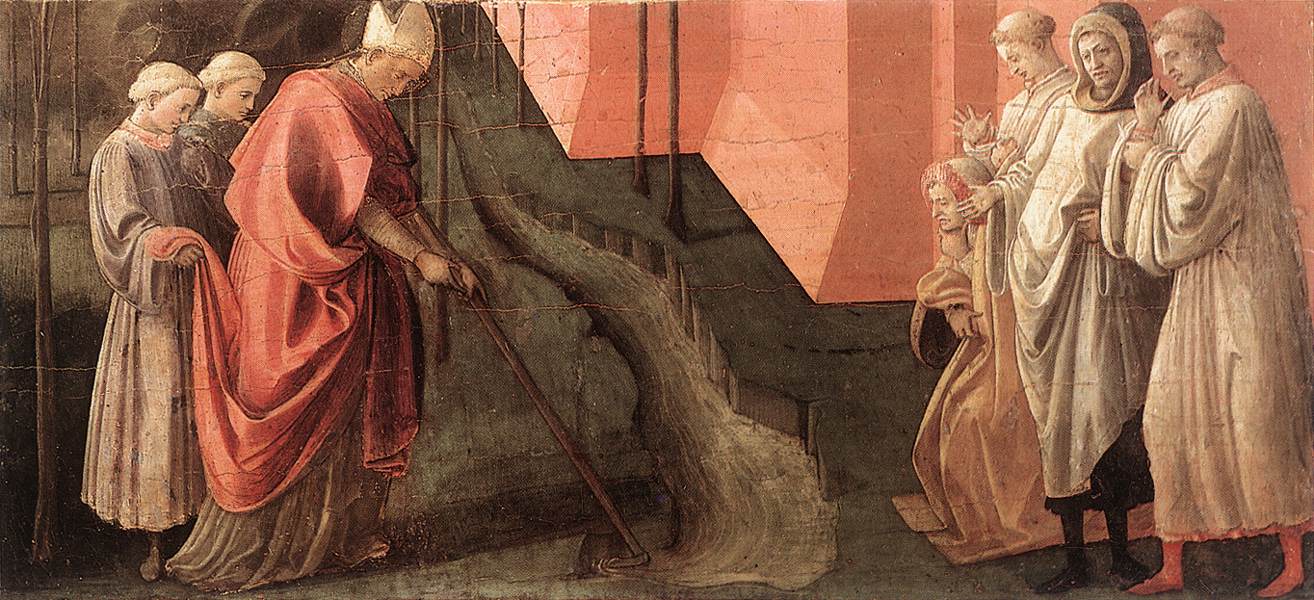
In some ways, you really can see a switch from the "hand" to "hand-free" Lippi. (Okay, in truth, his later paintings aren't "hand-free," but often there aren't as many hands.) Here are some earlier, "handy" paintings:
St. Fredianus Diverts the River Serchio, c. 1438
There are way too many hands in the group on the right. And look at the man who is standing on the left side of that group - his hands are awkwardly included in the composition to the point of distraction. It almost looks like that man is going to box the ears of the pious man who is kneeling down.
Madonna of Humility (Trivulzio Madonna), c. 1430
(with red circles added - click here to see a reproduction without circles)
I think this painting is pretty ugly, and the plethora of hands doesn't help the composition one bit. I circled sixteen different hands. Granted, there are a lot of figures in this painting, but sixteen hands seems a little extreme and unnecessary. Hands pop out in some of the strangest places, too. Check out some of the hands on the left-side of the Virgin.
In some ways, you really can see a switch from the "hand" to "hand-free" Lippi. (Okay, in truth, his later paintings aren't "hand-free," but often there aren't as many hands.) Here are some earlier, "handy" paintings:
There are way too many hands in the group on the right. And look at the man who is standing on the left side of that group - his hands are awkwardly included in the composition to the point of distraction. It almost looks like that man is going to box the ears of the pious man who is kneeling down.
Madonna of Humility (Trivulzio Madonna), c. 1430(with red circles added - click here to see a reproduction without circles)
I think this painting is pretty ugly, and the plethora of hands doesn't help the composition one bit. I circled sixteen different hands. Granted, there are a lot of figures in this painting, but sixteen hands seems a little extreme and unnecessary. Hands pop out in some of the strangest places, too. Check out some of the hands on the left-side of the Virgin.
Lippi's post-1445 (ahem, post-"handy") works still include hands, although he often (but not always!) toned down the number of hands and was a little more tactful.
Detail of Disputation in the Synagogue, 1452-65
Notice how Lippi covered up the figure on the left's hands with drapery? Smart move. There aren't any miscellaneous fingers or palms sticking out anywhere, either, which is an improvement.
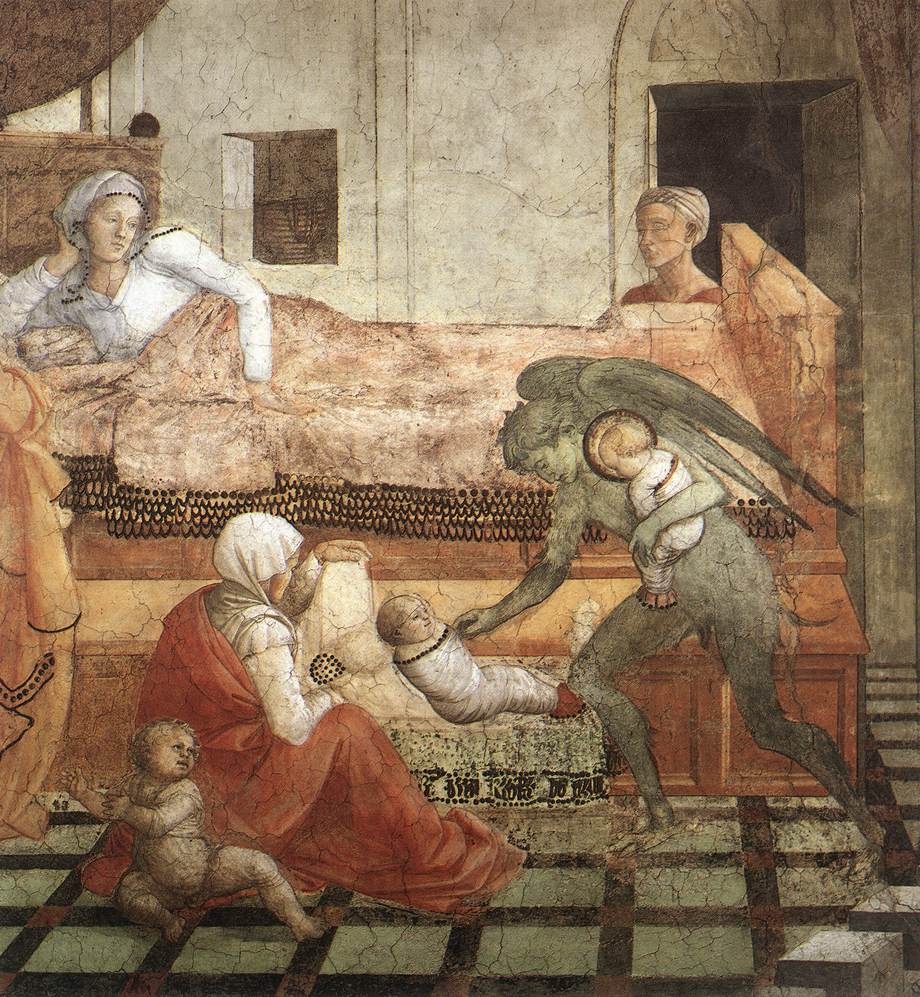
Detail of St. Stephen is Born and Replaced with Another Child, 1452-65
Lippi toned down the hands a bit in here - Stephen's mother covers up one hand with her head, and the seated woman covers up a hand with her knee (although I think her other hand is awkward in its position and placement). And you don't even see the hands of the figure behind the bed. I think, though, that the woman on the left's hand is poking out from behind her cloak - it's a little awkward since its the only part of the woman that we can see, but hey, this is an improvement for Lippi.
Notice how Lippi covered up the figure on the left's hands with drapery? Smart move. There aren't any miscellaneous fingers or palms sticking out anywhere, either, which is an improvement.
Lippi toned down the hands a bit in here - Stephen's mother covers up one hand with her head, and the seated woman covers up a hand with her knee (although I think her other hand is awkward in its position and placement). And you don't even see the hands of the figure behind the bed. I think, though, that the woman on the left's hand is poking out from behind her cloak - it's a little awkward since its the only part of the woman that we can see, but hey, this is an improvement for Lippi.
Do you know of a "handy" or "hand-free" work by Lippi? What do you think - did Lippi improve by toning down his inclusion of hands? I certainly think so.
1 Giorgio Vasari, The Lives of the Artists, translation by Julia Conway Bondanella and Peter Bondanella (London: Oxford University Press, 1991), 194.
2 Ibid.
2 Ibid.
Thursday, November 5, 2009
The Artist Had Never Seen a [Insert Animal] Before
It's always interesting to see how an artist depicts an animal that he/she has never seen. Vasari writes that Paolo Uccello wanted to depict a chameleon his Four Seasons, but since the artist had never seen a chameleon, he opted to draw a camel instead.1 I guess you can kind of see Uccello's logic in picking a camel, since camaleonte and camello are similar words in Italian (the two words are a little similar in English, too). I wish that Uccello's Four Seasons still existed; I'd love to see what that chameleon/camel looked like.
Durer attempted to depict a rhinoceros, even though he had never seen one. He really didn't do
too bad of a job (see woodcut print The Rhinoceros (1515) on the right), although the armor-like plates are a little funny. Durer became interested in the rhino after seeing a sketch and reading descriptions in a letter from Lisbon.2 The year that Durer made this print, 1515, was a big year for rhinoceroses in Europe. Both the king of Spain and king of Portugal were trying to win the favor of the pope by giving him rhinoceroses. The pope apparently liked the West African rhino (the gift from Spain) best, which allegedly answers why the pope gave more New World territory to Spain.3 I bet that Durer was trying to maximize on the interest in rhinoceroses during this year, since woodcut prints can be widely distributed, popularized, etc.
Durer attempted to depict a rhinoceros, even though he had never seen one. He really didn't do
There are other animal depictions which I think are amusing. When writing my thesis, I would often chuckle at Aleijadinho's depiction of a lion. Since the Brazilian artist had never seen a lion before, he sculpted this one with the face of a monkey:
And you have to love Aleijadinho's great attempt at a whale. I especially love the whale's two spouts (kind of like nostrils, I guess) and fins:
Medieval bestiaries are full of creative depictions of animals. I particularly like this depiction of a crocodile and this depiction of an elephant (check out those tusks and horse-like flanks!).
I know there are lots of other interesting/creative/bizarre depictions of creatures that have resulted from the artist never seeing the actual animal. What ones do you know? Do you have a favorite? Let's see who can give the most bizarre example...
1 Giorgio Vasari, The Lives of the Artists, translation by Julia Conway Bondanella and Peter Bondanella (London: Oxford University Press, 1991), 82.
2 "The Rhinoceros," in Web Gallery of Art, available from, accessed 5 November 2009.
3 Hemanta Mishra, Bruce Babbitt, Jim Ottaway, Jr., The Soul of the Rhino (Guilman, Connecticut: Lyons Press, 2008), 137. Available online here.
2 "The Rhinoceros," in Web Gallery of Art, available from
3 Hemanta Mishra, Bruce Babbitt, Jim Ottaway, Jr.,
Thursday, February 5, 2009
Savonarola and Botticelli
If you were/are an artist, what would induce you to destroy some of your completed art?A change in taste?
Embarrassment?
Anger?
I am continually surprised and saddened when I think of the Early Renaissance artist Sandro Botticelli and his decision to burn some of his paintings.
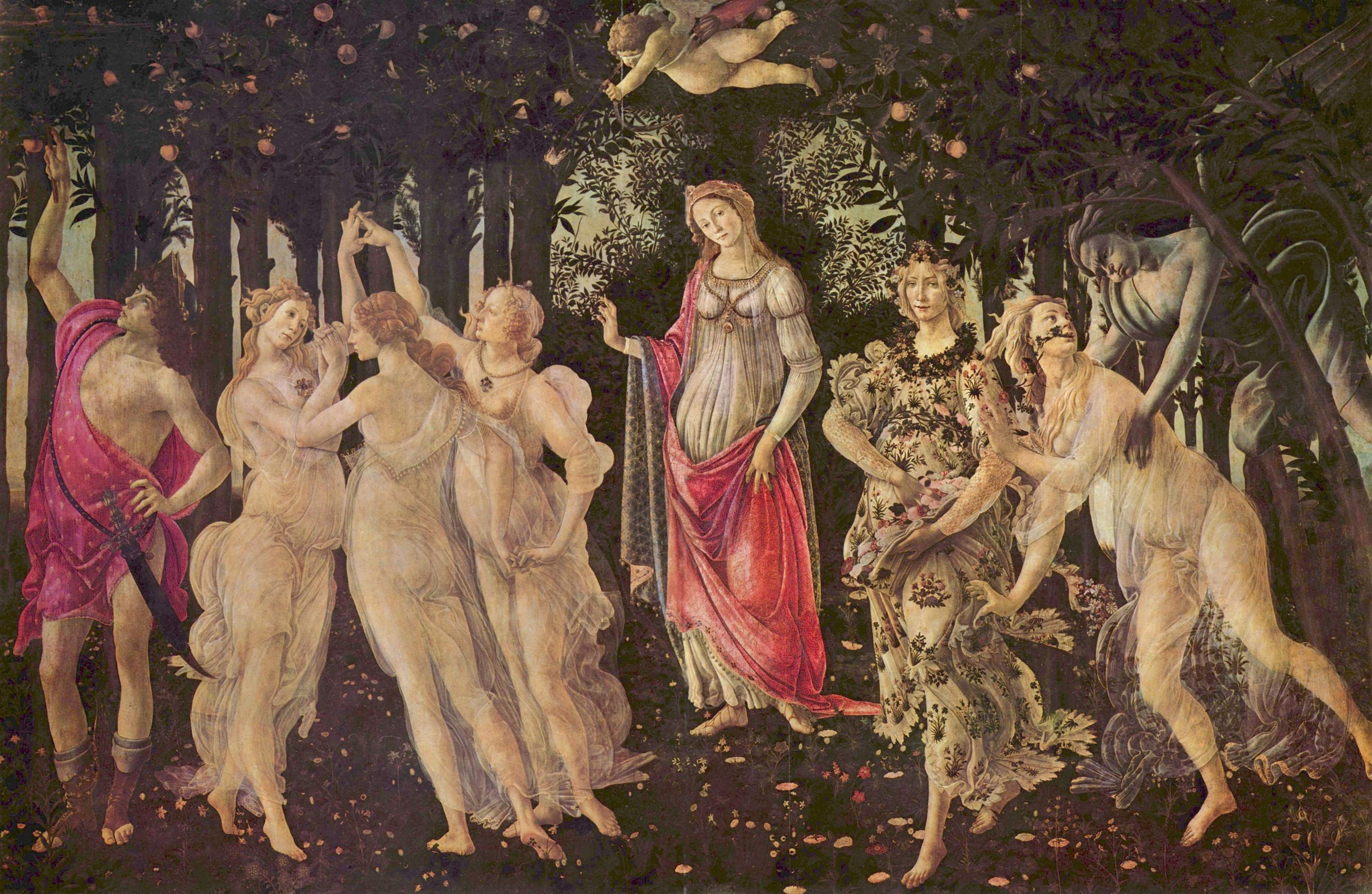
Sandro Botticelli is arguably the most famous painter of the Early Renaissance. Today, he is probably best known for his mythological paintings The Birth of Venus (c. 1485, shown to the right) and Primavera (c. 1478). These paintings were influenced by International Style, as shown by the ornamental patterns (e.g. Flora's dress on the right) and unrealistic stylization (e.g. the flat sea waves). Both paintings were completed during the beginning of Botticelli's career, when he was highly successful and enjoyed the patronage of important families such as the Medici and Vespucci.
However, it appears that Botticelli's career took an interesting turn with the rise of Girolamo Savonarola, an Italian friar and preacher. Savonarola's fundamentalist ideas regarding politics and religious art had considerable influence on Florence. In fact, many people in Florence considered Savonarola to be a prophet and type of savior for the city.1 In regards to art, Savonarola condemned the worldly character of religious paintings and criticized artists for using identifiable people as models for holy figures. Savonarola "complained that the images in the churches of the Virgin, St Elizabeth and the Magdalene were painted like nymphs in the likenesses of the young women of Florence, thundering: ‘You have made the Virgin appear dressed as a whore’. In his sermons he upbraided the young women of Florence for wearing such dress and castigated painters for representing them in sacred guise, urging everyone to burn their copies of the Decameron and all lascivious images."2 There is no doubt that Botticelli's mythological paintings would have been viewed as "lascivious" by Savonarola, particularly The Birth of Venus, which was the first painting of a Classical female nude since antiquity.
Savonarola convinced many people to burn their worldly items. He is particularly associated with two public burnings took place on 7 February 1497 and and 27 February 1498. These fires are known as the bruciamenti delle vanità (bonfires of the vanities). At these public bonfires, cosmetics, false hair, playing cards, profane books and paintings were destroyed. It's shocking to think of what precious works of art were destroyed at this time - especially works by the talented Botticelli. According to the biographer Vasari, Botticelli was affected by the teachings of Savonarola and reportedly threw some of his own paintings on pagan themes into the flames. How tragic! I have often wondered what those paintings were like and what type of contribution they might have made to the field of art history.
Of course, Savonarola did not condemn all types of art. He felt that art could be utilized as a type of moral instruction and encouraged his illiterate followers to ponder the life of Christ by looking at paintings (no doubt, paintings which met his level of standard). At this same time, and probably not coincidentally, Botticelli's artistic style began to change. He began to reject the courtly, ornamental style of his earlier paintings and turned to a more somber, simplistic style which mimicked the sentiment and style of earlier religious paintings. One such somber painting is Botticelli's Lamentation over the Dead Christ with St. Jerome, St. Paul and St. Peter (c. 1490). Not only is the extense grief and mourning observed in the faces of the figures, but the sweeping lines of the dead corpse and kneeling figures suggest to me an added level of heaviness, weight, and grief.3 I cannot help but conclude that this shift in style was influenced by Savonarola's apocalyptic preaching.4Unfortunately, Botticelli's career faltered near the end of his life, which is especially disappointing since the artist was originally one of the influential painters in developing the new Renaissance style. I find the demise of Botticelli's career partially linked to Savonarola and the artist's subsequent change in style.
I wonder if Botticelli held any regrets about burning his paintings or his change in artistic taste. Savonarola's followers were often referred to as piagnoni ("snivellers" or "weepers") because "they were given to loud and weepy repentence for their sins."5 It is known that Botticelli's brother was a piagnone and there is other evidence that Botticelli was also associated with this mournful group.6 If I were Botticelli and had burned some of my beautiful art, it seems like I'd have an additional reason to weep.
1"Savonarola, Girolamo." In Grove Art Online. Oxford Art Online, http://www.oxfordartonline.com.erl.lib.byu.edu/subscriber/article/grove/art/T076215 (accessed February 5, 2009).
2 Charles Dempsey. "Botticelli, Sandro." In Grove Art Online. Oxford Art Online, http://www.oxfordartonline.com.erl.lib.byu.edu/subscriber/article/grove/art/T010385 (accessed February 5, 2009).
3 For more analysis of this painting and Savonarola's influence on Botticelli, see Barbara Deimling, Botticelli, (New York: Taschen, 2000), 69-72. These pages can also be read online here.
4 Not all historians agree on Savonarola's influence on Botticelli. For some discussion on the art historical debate between Savonarola's influence on Botticelli, see Ingrid Drake Rowland, From Heaten to Arcadia: The Sacred and the Profane in the Renaissance, (New York: New York Review of Books, 2005), 80-81.
5 Ibid, 80.
6 Vasari records that Botticelli was "extremely partisan to [Savonarola's] sect." See Dempsey, "Botticelli, Sandro."
Subscribe to:
Posts (Atom)