Tuesday, September 28, 2010

Glowing Prehistoric Horns

It's always interesting to see what knowledge spews from the depths of my brain during lecture. Yesterday, while lecturing on cave paintings, I found myself telling the class about a theory I hadn't thought about for years.

Back when I was an undergraduate, one of my professors explained a theory about why bulls were important to the prehistoric people (and they were obviously important, since bulls are depicted in so many prehistoric caves. This example on the left comes from Lascaux Cave in France (c. 15,000 BCE)).

The theory presented by my professor revolves around the St. Elmo's Fire phenomenon. Basically, sometimes during electrical weather storms (i.e. storms with thunder and lightning), the tip of a bull's horns can have a soft glow. The glow often is accompanied with a hissing or crackling sound.

It is thought that this phenomenon would have impressed prehistoric people, which may account for the supposed veneration of the bull. It could have been seen as a mystical creature with supernatural powers, since its horns had the ability to glow.

Monday, September 27, 2010

Henry "Box" Brown's Moving Panorama

Have you ever picked up a book and pleasantly discovered that the reading was more interesting than you anticipated? I recently read The Unboxing of Henry Brown by Jeffrey Ruggles, and I ended up feeling that way. I'm very interested in issues of slavery/antislavery in the United States (and elsewhere), and for a long time I've wanted to learn more about Henry "Box" Brown. I didn't anticipate reading about art history when I picked up this book, though, but was excited to find a lot of discussion about the moving panorama, a popular form of art (and entertainment) in the mid-19th century.

Before reading this book, the only thing I knew about Brown was his escape from slavery: he climbed into a box and shipped himself from Virginia (a "slave" state) to Philadelphia (a "free" state). Various images of Brown's "resurrection" from his box (the one above is from Boston, 1850 (unsigned)) were used by abolitionists. One art historian commented that these images of the unboxing were "perhaps the most potent single metaphor [that abolitionists used] for the displacement of the traditional image of the 'runaway' slave in popular imagination."1

The thing that surprised me most about this book, though, was to learn how Brown decided to earn a living after escaping from slavery. Brown commissioned a moving panorama to be painted, which he titled Mirror of Slavery.2  Moving panoramas consisted of huge canvases (sewn together) which were displayed on a type of vertical spool. The paintings could then be scrolled in front of an audience, revealing a sequence of scenes. In some ways, the moving panorama was the predecessor to the slide show.  (If you like, you can get a sense of the moving panorama idea by watching the beginning of this scene from the film "Letter from an Unknown Woman," 1948).  During the middle of the 19th century, the moving panorama was an extremely popular form of entertainment. It's sad that few moving panoramas exist today. Those that do exist are never shown in their original format, either, largely due to conservation issues.

A good portion of Ruggles' book discusses the history of the moving panorama (as a type of art) and the scenes which appeared on Mirror of Slavery. Although Mirror of Slavery doesn't exist today, it was interesting to learn about the subject matter for the scenes. We also have a basic idea of the composition for some of the Mirror of Slavery scenes too, since it's obvious that Mirror of Slavery found inspiration in the illustrations for the Charles Green's book The Nubian Slave. Ruggles book is replete with lots of images that may have resembled the scenes from Mirror of Slavery.

Anyhow, for several years Brown traveled around the United States and England, giving presentations and lectures while exhibiting his moving panorama. I have to admit - while I was very interested to learn about Brown's life, I found it even more fascinating to learn more about the moving panorama. Although I was familiar with the idea of the moving panorama before, I didn't realize that such an artistic device helped to aid the antislavery movement.3

1 Marcus Wood, Blind Memory: Visual Representations of Slavery in England and America, 1780-1865 (Manchester, England: 2000), 103. (See text online here.)

2 Henry "Box" Brown's moving panorama was painted by three painters from Boston, with the primary artist probably being Josiah Wollcott. The other artists are described in an 1850 newspaper from Liverpool as "Rouse and Johnson." Ruggles suggests that these artists might have been Samuel Worcester Rowse and David Claypoole Johnston. See Ruggles, p. 75.

3 Henry "Box" Brown was not the only person to use the moving panorama to discuss slavery. Ruggles mentions a couple of others who also produced moving panoramas, including the black abolitionist William Wells Brown. See Ruggles, p. 72.

Thursday, September 23, 2010

Picasso on a Bicycle

I don't know how I've functioned as an art historian without seeing this Monty Python clip about Picasso on a bicycle:


I found this clip after coming across another art history blog, Art History Ramblings. The author Catherine lists as many artists as she was able to hear in the clip, and I couldn't decipher the others ones shouted by John Cleese.

So now I propose a game, readers. Do you know of any the artists mentioned in this clip which actually depict a bicycle in their art? (And I don't think that I heard Duchamp listed in the clip, so you can't choose his Bicycle Wheel (original of 1913). That's too easy, anyway.)  I'm not too savvy on bicycle art, but I do have one contribution:

Georges Braque, My Bicycle (Mon Velo), 1941-60
This painting is in a private collection, so I don' t know much about it. But it is briefly mentioned in this MOMA biography on Braque

Happy bicycle hunting! And happy weekend!

Monday, September 20, 2010

Boy Bitten by a Lizard: Posner vs. Gilbert

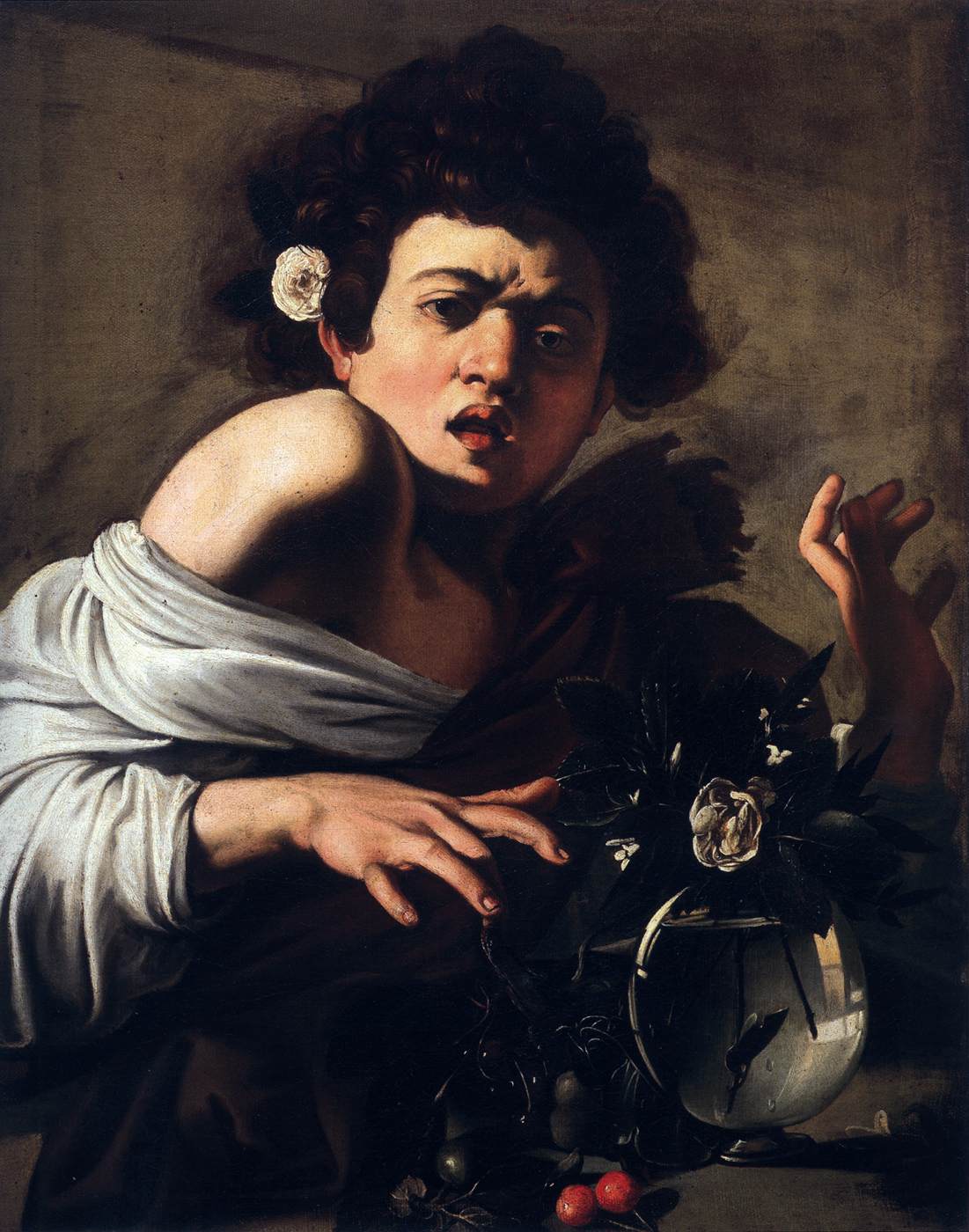
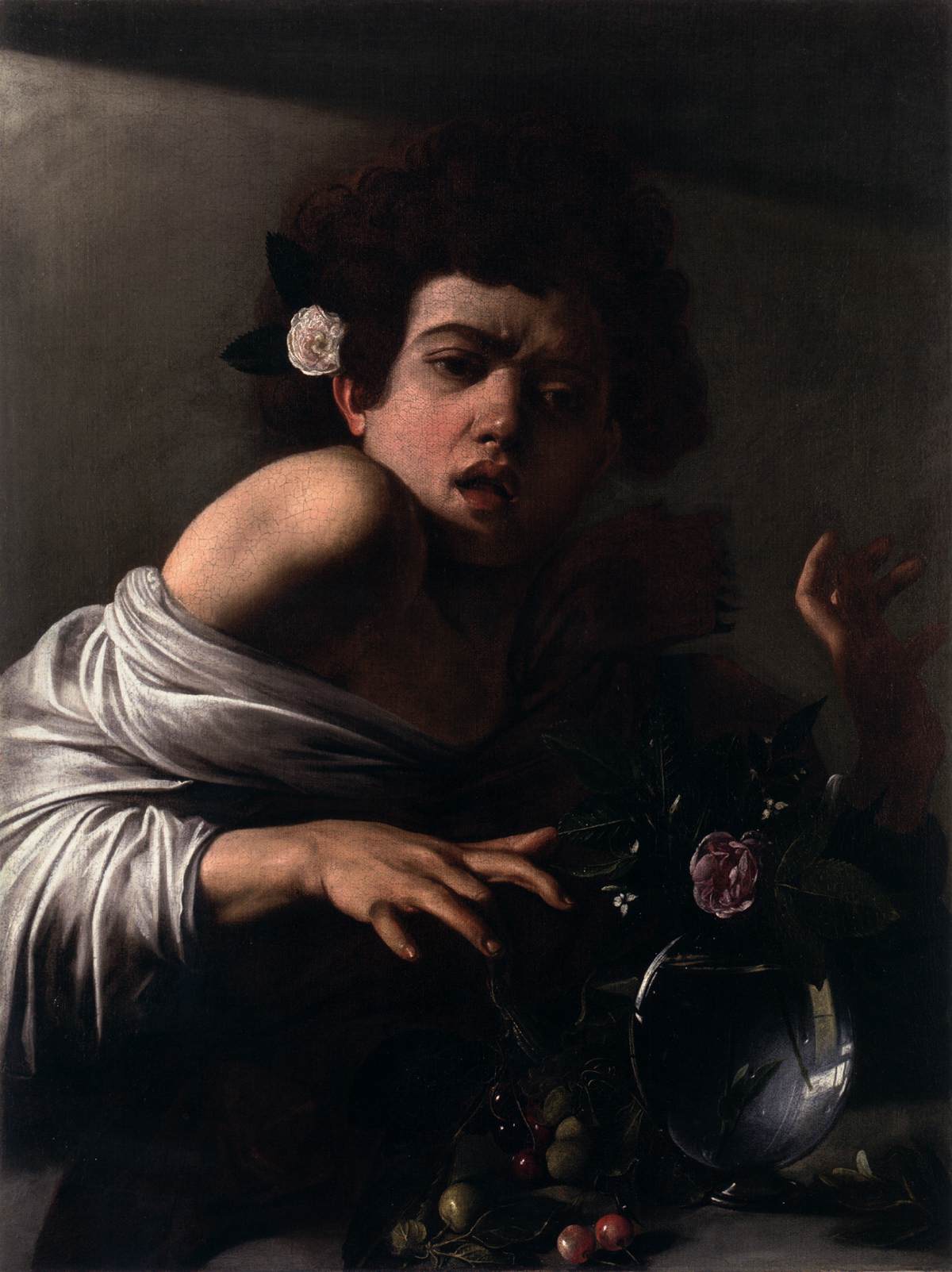
About this time of year, several years ago, I was assigned my absolute favorite project in graduate school. I was required to read every single published work about one work of art, in order to trace the artwork's historiography. I ultimately decided to research Caravaggio's Boy Bitten by a Lizard (c. 1594).

Soon after I began to research my topic, I discovered that there are actually two versions of this painting - and both are attributed to Caravaggio. One version (shown left) hangs in the National Gallery in London, and the other (shown below, right) is in the Fondazione Roberto Longhi in Florence.  Several connoisseurs argued over the authenticity of the paintings during the 20th century, but that debate essentially ended in 1992 (when Denis Mahon asserted that both examples are original, although he thinks that the Florence version was painted several years earlier than the London version).1

The most interesting thing I learned from my research project, however, was that one single article can forever change the shape of discourse (for better or for worse). In 1971, Donald Posner wrote a seminal article on the homo-erotic nature of Caravaggio's early paintings.2 Posner argued that Boy Bitten by a Lizard is one of the most pronounced homosexual characters painted by Caravaggio. He finds the boy in this painting to appear sensuous, androgynous, and seductive (as suggested by the off-the-shoulder robe). Since that 1971 article, just about everyone has latched onto this homo-erotic theory and it still remains (mostly) undisputed.

What is interesting to me, though, is that no one (not even Caravaggio's contemporary biographers) ever mentioned anything about homosexuality or effeminate characteristics until 1971. If this was such a key part of Caravaggio's work, why was it unmentioned (perhaps unnoticed?) for centuries? I think that "Posnerian" scholars have imposed a 20th century perspective on this painting, and we need to rethink some of the homo-erotic interpretations of Caravaggio's work. Creighton Gilbert also has come to this conclusion, arguing that the fair appearance of youthful men, was long celebrated in society.3 Gilbert argues that it was only during the nineteenth century, with the rise of capitalism, that men no longer wanted to be considered beautiful. The life of the artistocrat was not considered a social ideal anymore, for it was replaced by work ethic. With this change, men (particularly those of the middle class) began to insist on their difference from women, which not only changed clothing, but also changed other social norms (such as men kissing or crying).

From a historical (and historiographic!) perspective, I think that Gilbert's argument makes a lot of sense. I also like much of Gilbert's argument that this painting has roots in classicism. Gilbert finds that Boy Bitten by a Lizard was inspired by a Latin poem which was popular during the time of Caravaggio: O treacherous boy, spare the lizard creeping toward you; it wants to die in your fingers. The elements in this painting point towards this poem, including the bare shoulder, which recalls classical antiquity (instead of homosexuality, as interpreted by Posner).

What do people think? What was your immediate reaction upon seeing this painting for the first time? (Did you think that the subject was "effeminate" or merely "classical"?) Are we so entrenched in homo-erotic theory that it is difficult to examine this painting in any other way?

P.S. This post was indirectly inspired by the ongoing contest at Three Pipe Problem. People can submit a limerick about Caravaggio in order to win a copy of Andrew Graham-Dixon's new book, Caravaggio: A Life Sacred and Profane. Last night I was thinking up words that rhymed with "lizard," and decided I also better write a Boy Bitten by a Lizard post.


1 See Keith Christiansen and Denis Mahon, "Caravaggio's Second Versions," The Burlington Magazine 134, no. 1073 (August 1992): 502-04.

2 Donald Posner, "Caravaggio's Homo-Erotic Early Works," Art Quarterly 34 (1971): 301-324.

3 Creighton E. Gilbert, Caravaggio and His Two Cardinals (University Park, Pennsylvania: The Pennsylvania State University Press, 1995).

Friday, September 17, 2010

"La Bella Principessa" by Von Carolsfeld?

My longstanding readers may remember a short post that I did last year, expressing reservations that the painting nicknamed "La Bella Principessa" (shown left) was a work by Leonardo da Vinci. (You may recall that a fingerprinting method was used to attribute this painting to Leonardo.)  I question this attribution for a couple of reasons, including the fact that this painting was done on vellum, a medium which Leonardo never used. I'm not the only art historian or curator with reservations about this attribution, and now people are coming forward to suggest who the actual artist might be.

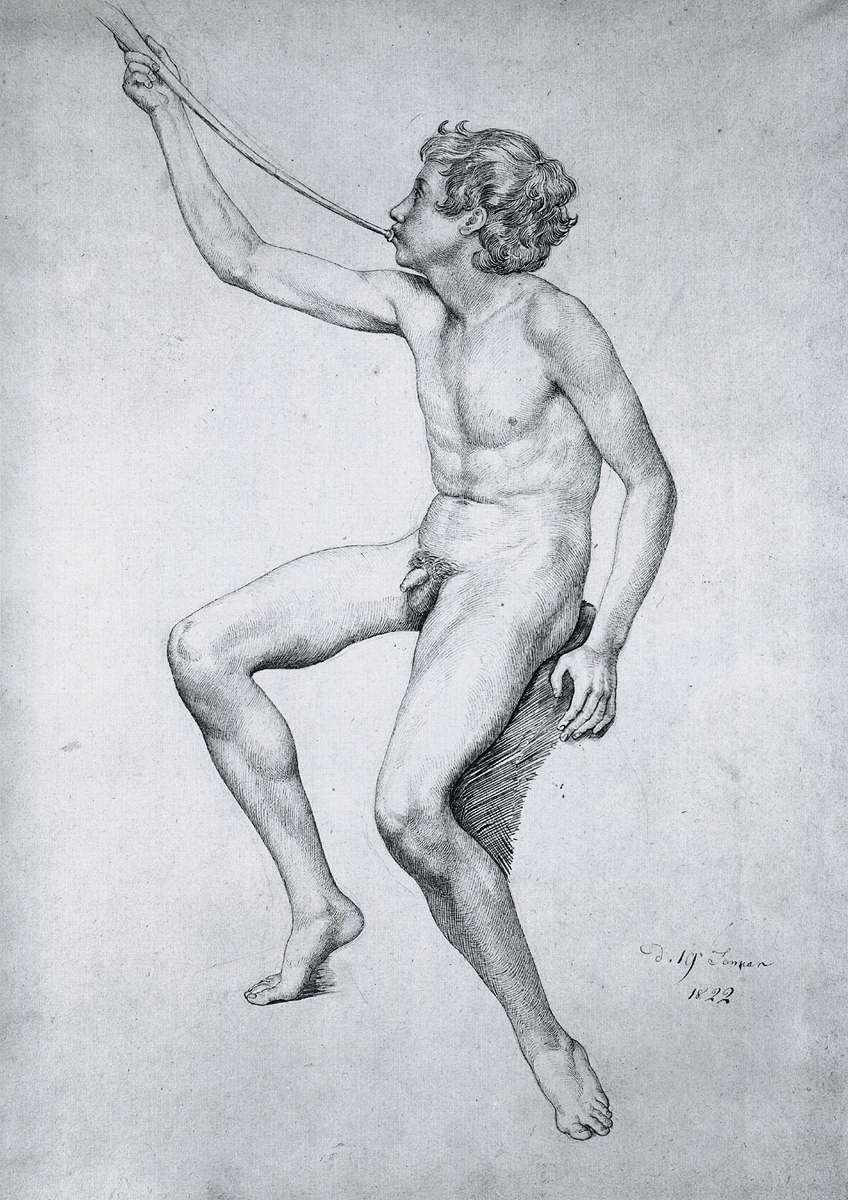
I just read this news release about a new attribution: Fred R. Kline (an independent scholar) has come forward to suggest that the actual artist is Julius Schnorr von Carolsfeld, a lesser-known 19th century artist who belonged to the Nazarene Brotherhood in Germany. Kline's argument is supported by a sketch called "Half-Nude Female" (shown below) which Klein discovered in the State Art Museum in Mannheim, Germany. Not only was this sketch created on vellum (just like "La Bella Principessa"), the model and braided hair are quite similar. Kline thinks that "La Bella Principessa" could have been a gift from Von Carolsfeld to this model.

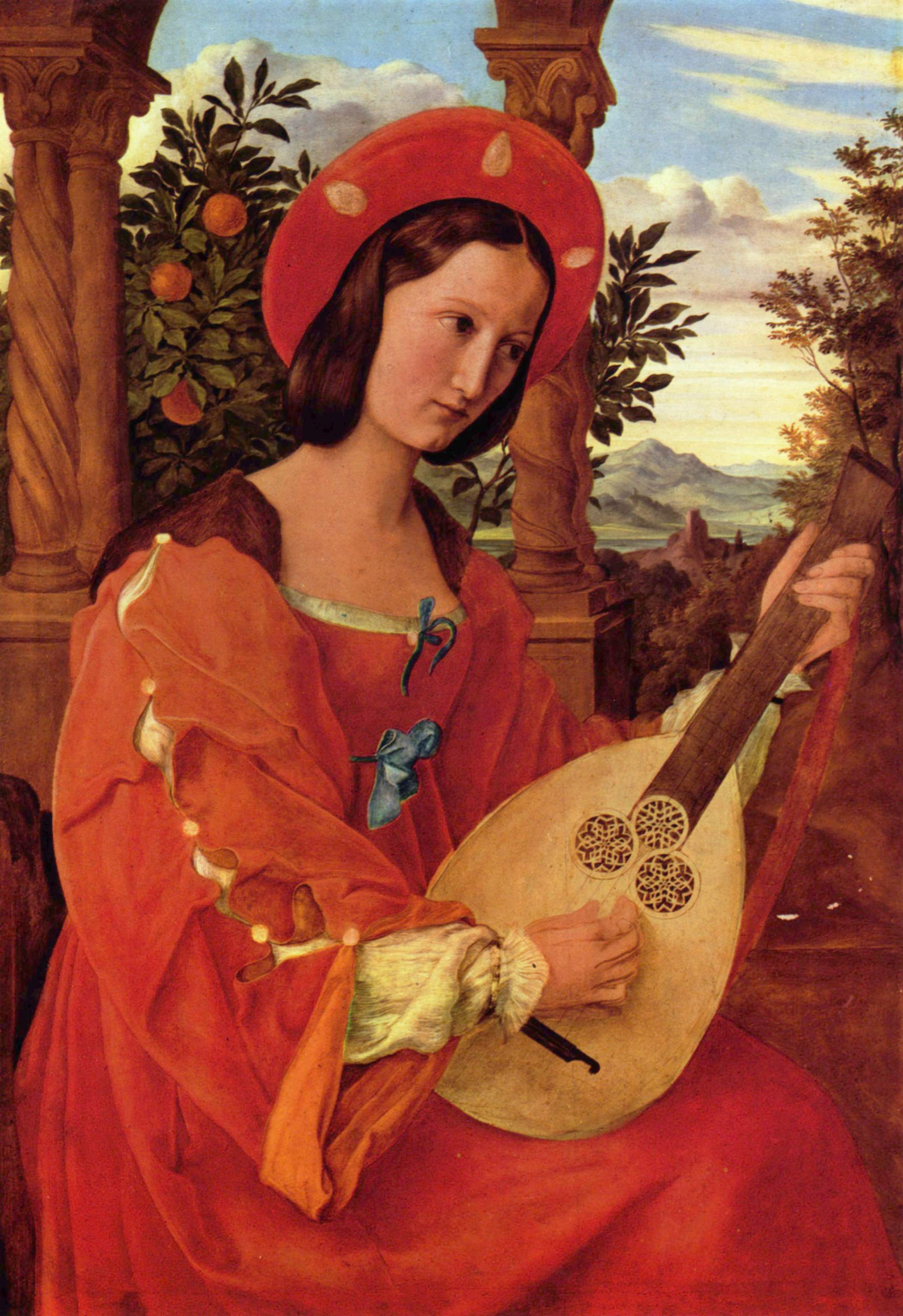
This is a really interesting idea, and I congratulate Klein on his sleuthing. If this painting is by Von Carolsfeld, "La Bella Principessa" would be one of the best paintings that he ever created. I'm not familiar with all of Von Carolsfeld's work, but I haven't been terribly impressed with the paintings that I have seen.1 I do really like Von Carolsfeld's sketches, though (for example, his sketches Seated Boy Playing a Pipe (1818) and Portrait of Victor Emil Jansen (n.d.) are very good). In my opinion, Von Carolsfeld was a much better draftsman than a painter, and I kind-of doubt he could create as fine of a painting as "La Bella Principessa."  Even though Von Carolsfeld's Klara Bianka von Quandt (1820) is an alright painting (despite the fact that the lute looks like it's been cut-and-pasted into the model's hands - sorry, I couldn't help myself), it lacks the sfumato and modeling that gives the Principessa's image a sense of depth and richness.

So, there you have it. We may have found a possible artist for "La Bella Principessa," but (yet again!) I'm still not quite sure. I wonder, though, if "La Bella Principessa" might have been painted by another person associated with Nazarene Brotherhood. Perhaps someone who used the same model as Von Carolsfeld's "Half-Nude Female" sketch, but also had more talent as a painter?  Does anyone know any information about Ludwig Schnorr von Carolsfeld (Julius' older brother)? I know that he was a painter too, but so far I can only find information about Julius' son, who was given the same name.

1 Let me explain some of my reasoning. I think a lot of Von Carolsfeld's painted figures seem a little too static. Consider The Family of John the Baptist Visiting Christ (1817), where the Christ child is awkwardly spread out like a lifeless doll. Or look at The Annunciation (1818): it seems strange that the Gabriel's drapery is flowing behind him (suggesting movement), when the angel appears absolutely frozen in its stance. I realize that "La Bella Principessa" doesn't allow for much comparative analysis in terms pose (since it is a bust portrait), but I still think that the face and upper figure of the "Principessa" seem much more relaxed and natural than any of the Von Carolsfeld paintings which I have seen.

Tuesday, September 14, 2010

I Heart Pliny the Elder

I've been reading snippets of Pliny the Elder's Natural History over the past few days, and I can't help but think that the ancient Roman and I would have been friends. I definitely feel as curious about the world as Pliny the Elder, but hopefully I am a little more practical (i.e. I wouldn't risk my life to observe the eruption of Mt. Vesuvius).

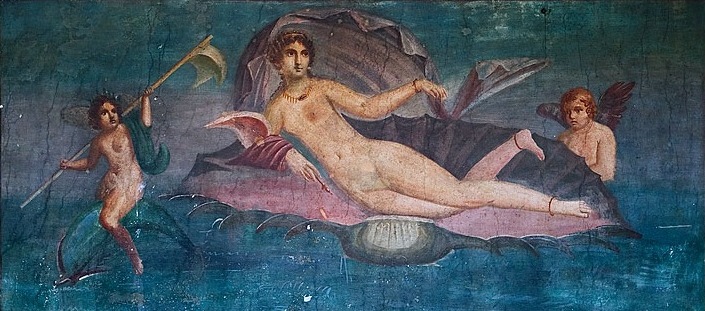
There are two things that I like about Natural History. For one thing, I like Pliny's little anecdotes about artists (I'm sure my penchant for anecdotes is no surprise, gentle reader!). Even though some of the stories seem a little too legendary and far-fetched (Vasari would have loved some of these stories for his Vite), they are still quite fun. For example, Pliny devotes a whole section to stories about the Greek painter Apelles of Cos (you can read some of the stories here). One such story involves speculation that Apelles painted Alexander the Great's mistress Pancaste for Aphrodite Rising from the Foam ("Aphrodite Anadyomene," shown above in a Roman mural from Pompeii (House of the Marine Venus, 1st century AD) which is thought to have been based on Apelles' original work). 1

I'm especially amused by this story about Apelles and a picture of a horse:

"There is, or at least there once existed, a picture of a horse by Apelles. It was painted for a competition in which he sought judgment not from men but from dumb animals. For, seeing that his rivals were getting the upper hand by devious means, he showed the pictures individually to some horses he had brought in, and they neighed only at Apelles' picture. As this frequently happened on subsequent occasions it proved to be a good test of the artist's skill." (Natural History XXXV:95).

The other thing I like about Pliny the Elder is his apparent passion and excitement for his subject matter. I love that he calls the pyramids "a pointless and absurd display of royal wealth." (Natural History XXXVI: 75) (Not that I agree with that statement, I just love his frank opinion.)

I also can relate to his awe regarding the Colossus of Rhodes (one of the Seven Wonders of the Ancient World, original c. 292-284 BC, shown left through a wood engraving reconstruction by Sidney Barclay, c. 1875). I'm always interested in how a sculpture's scale compares to that of a human being, and Pliny seems to have that same interest: "No statue has commanded greater admiration than the Colossus of Rhodes made by Chares of Lindos, the pupil of Lysippus. It was about 105 feet high. Sixty-six years after its erection the Colossus was toppled by an earthquake, but even lying on the ground it is amazing. Few people can make their arms meet round its thumb, and the fingers alone are larger than most statues." (Natural History XXXIV:42). (On a side note, it was announced about two years ago that the Colossus of Rhodes was going to be rebuilt as a giant light sculpture. Does anyone know if progress has been made on that project?)

Who here has read Natural History? Any likes or dislikes? If you haven't had a chance to get to know Pliny the Elder and his thoughts on art, I'd highly recommend those few chapters from Natural History. Pliny the Elder is witty, opinionated, and just all-around interesting.

1 Pancaste could really be labeled as Alexander the Great's ex-mistress. Pliny records that the ruler commissioned Apelles to paint Pancaste, and then Apelles ended up in love with his subject. In turn, Alexander gave Pancaste to Apelles, which Pliny noted was indicative of Alexander's magnanimity. (Natural History XXXV:86-87).

Friday, September 10, 2010

Lion's Head Doorknockers

This past weekend, my family and I traveled to visit the Washington State Capitol Building. It's always fun for me to identify the different architectural features on such buildings, and particularly to think of Western/European counterparts which may have inspired such features. But as we approached the bronze doors of the capitol (c. 1923-28, see detail on left), I paused. Bronze doors are a common feature in Western architecture, but what about the lion's head doorknockers? What's their history? I could think of earlier lion's head knockers, such as the Ottonian ones on the Hildesheim Cathedral, but I wasn't sure if there might be an earlier example.

After doing a little research, I found a really charming article from 1918 that discusses the history of doorknockers. I was surprised to learn that the doorknocker has existed since ancient Greece.1 At this time slaves were often assigned to answer doors, and they were chained to the door in order to prevent them from running away. The predecessor of doorknockers were short iron bars that attached to these chains, which were used as "rappers."

It appears that the lion's head design also existed for doorknockers in ancient Greece. In 1942 Sterling Dow mentioned some "heavy handsome lion's-head door knockers...which escaped the sack by Philip in 348 BC."2

So, what's the significance of lion's head doorknockers?  Did they symbolize anything, or were they just decorative? I haven't come across any speculation on the subject, but I think that there must have been some symbolism involved. Lions held symbolism in lots of ancient cultures, and often embodied power and strength. I have a theory that lion's head doorknockers were intended to serve the same symbolic function as the lion statues which decorated the gates of the Hittites (Hattusha Lion Gate, c. 1400 BCE, see above right) and the Mycenaeans (Lion Gate at Mycenae, c. 1250 BCE). In each case, these intimidating lions serve as guardian beasts for the city, as well as symbolize strength and power.  I think the same thing can be said for lion's head doorknockers, which rest on the doors (i.e. gates) as guardians of a building.

On a side note, though, it's interesting that not everyone today associates lion's head doorknockers with such ancient symbolism.  This fascinating study by Zachary McCune mentions a woman who selected a lion's head doorknocker for her home, but only because the same knocker was found on the door of the UK Prime Minister's house.  In this woman's case, it appears that she wanted her knocker (and her home) to have some connection and/or status with this association to the Prime Minister.

Do lion's head doorknockers have any particular meaning or symbolism for you? Can you think of an ornate doorknocker (of a lion's head or otherwise) that you particularly like?


1 "The Evolution of the Door-Knocker," The Art World 3, no. 5 (1918): v, vii-viii.


2 Sterling Dow, "Review: Excavations at Olynthus," The American Historical Review 47, no. 4 (July 1942): 824.

Thursday, September 9, 2010

Alberti's Window interview on 3PP

Three Pipe Problem has started a new series, Art&History@Web, which highlights different art history blogs (and bloggers).  I think this is a great idea, especially since it can help art history bloggers become aware of new blogs and ideas.  I am honored to be featured as the first interviewee for this new project.

So, if you've ever wondered who is the nerdy person behind all of these art history posts, here's your chance.  You can read my interview here, and even see a picture of me in my spectacled glory.

Thursday, September 2, 2010

Handel as Art Collector

George Frideric Handel (shown on right in a portrait (1726-28) attributed to Balthasar Denner) is one of my favorite Baroque composers. And it's not only his music that I like: the more I learn about things related to Handel (such as his passion for food (so much that he withheld fine food from guests in his home), or even seemingly unrelated things, like the fact that he and Jimi Hendrix could have been next-door neighbors), the more I am intrigued by him.

Hence, I became helplessly distracted this afternoon when JSTOR's unreliable search engine brought up Thomas McGeary's article "Handel as Art Collector: Art, Connoisseurship and Taste in Hanoverian Britain" (when I had typed in keywords to search for medieval illustrations of French queens).

It was interesting to learn that Handel was a prolific art collector.  He was recorded to have "taken great pleasure in contemplating the works of art" in his collection.1 I really enjoyed learning about the nature of his collection, too. Despite the fact that Victorians praised Handel for his biblical oratorios, the composer had few biblical works of visual art.2 Instead, Handel was drawn to more landscapes, Dutch/Flemish paintings, French classical painters (e.g. Poussin), and a handful of Italian artists. Handel didn't care too much for portraits of individuals (which is unusual, since portraiture was so popular in England at the time), and it appears that he even gave away all portraits of himself. He did, however, have two pictures of heads by Balthasar Denner, one of which may have resembled Denner's Portrait of an Old Woman (before 1721, shown above left).

It also is apparent that Handel bought works of art simply because he liked them; he doesn't give one the impression of a hard-nosed collector who is interested in owning works by all major artists and schools, nor was he interested in collecting works by the Old Masters. He also didn't follow the contemporary craze to purchase works by William Hogarth, even though Handel might have known Hogarth personally. Instead, Handel did "his own thing" when it came to art collecting, which (I think) indicates an aspect of his personality that translates into his musical compositions: instead of closely following musical trends, Handel created his own musical style (which I think is instantly recognizable). He wrote music that appealed to him, just as he collected art which he found appealing.

Thomas McGeary, "Handel as Art Collector: Art, Connoisseurship and Taste in Hanoverian Britain," Early Music 34, no. 7 (2009): 533. 

2 McGeary lists the few biblical works that Handel owned: Hagar and the angel, the finding of Moses, prints of rest on the flight into Egypt, a Guido Reni altar-piece and possible a pair of biblical prints.  McGeary suggests that the lack of biblical scenes could be due to a Protestant fear of idolatry. It is interesting to see McGeary's comparisons of Handel's collection with other collections, which have large numbers of biblical scenes (approximately 27-33% of the collections mentioned). See Ibid., 533-576.

Wednesday, September 1, 2010

Art History Carnival @ The Earthly Paradise

The Earthly Paradise blog (which is a great resource for those interested in Victorian culture and the Pre-Raphaelite Brotherhood) is hosting an art history blog carnival each month, and the first issue was released this morning. I was pleased to learn that one of my posts from Alberti's Window was selected for this month's issue. Hooray!

If you are an art history blogger, I'd strongly recommend that you submit a post to be considered in an upcoming issue of the blog carnival. Although I was familiar with many of the blogs and posts in this issue, I enjoyed becoming acquainted with new sites, writers, and ideas. We art history bloggers are so few; I think The Earthly Paradise could help us come together and strengthen our little blogging community.