Showing posts with label female artists. Show all posts

Monday, July 11, 2011

Kauffmann and Female Empowerment

This afternoon I've been thinking about Angelica Kauffmann's painting, Self-Portrait Hesitating between the Arts of Music and Painting (1791, shown left). I can relate to this painting quite well: during my first year and a half as an undergraduate, I couldn't decide whether to major in music or art history. I play the piano and studied classical voice for several years. At the beginning of college I continually felt compelled to study vocal performance, music education or choral conducting. In some ways, I still wish that I had kept up with my classical singing, especially when I listen to singers like Renée Fleming or Patricia Petibon (the latter is a recent discovery - she's fantastic!).

In the end, though, I decided to major in art history and minor in music. With only a minor in music, I felt like I could still learn and refine my singing skills but remain somewhat distant from the discipline. I've found that my enjoyment of music lessens if I focus on theory and technique too much; I end up overanalyzing musical scores and critiquing performances instead of just listening. However, my enjoyment and love for art (and art history!) doesn't ever seem to go away, despite how much I learn or how critically I think. So, in the end, I art history was the best choice for me.

Kauffmann was an accomplished musician; she played the zither and clavichord. She also was said to have an extremely beautiful, agile singing voice. Kauffmann had to choose between music and art as a career, and she depicts this decision in her painting. Obviously, Painting won her over. It appears that Kauffmann's career choice was influenced (at least in part) by a priest who convinced Kauffmann and her father that an operatic career on the stage would lead to a faithless, debased lifestyle.1 (On a side note, I wonder what Painting is pointing at in the distance, beyond the canvas of Kauffman's painting. Great heights? Achievement? Music seems much more passive of a figure, being seated on the left.)

Not only do I love this painting because I relate to Kauffmann's interest in music and art, but I also love the idea behind the painting's composition. Here, Kauffmann is shown in an empowering position between the two arts: she has the ability to choose either career path. Instead of the many depictions in art that show women in helpless or subordinate positions, Kauffmann advertises "publicly her ability as an individual to choose."2 Another painting by Kauffmann also hints at this same topic of female choice and empowerment: Venus Induces Helen to Fall in Love with Paris (1790, shown right) shows Helen contemplating the decision to fall in love. For Helen, love seems to be a conscientious choice and she has the ability to make that choice. What a dramatic departure this is from depictions of swooning women in art (see here and here and here), who are rendered as helpless subjects!

Do you know of other examples in art where a female figure is represented with agency or ability to choose? Or, do you know of any other examples of swooning and/or helpless women?


1 Frances A. Gerard, Angelica Kauffmann: A Biography (London: Ward and Downey, 1893), 18-21. Available online here. Gerard relates that a handsome, promising (male) musician was one of the individuals who actively tried to convince Kauffmann to study music. It is related that Kauffmann's depiction of Orpheus in Orpheus Leading Eurydice out of Hades (located in a private collection) is a portrait of the handsome musician.

2 David G. Wilkins, Bernard Schultz, Katheryn M. Linduff, Art Past Art Present, 6th edition, (Upper Saddle River, New Jersey: Prentice Hall, 2009), 406.

Thursday, March 17, 2011

Lavinia Fontana Post on 3PP!

Hello everyone! I wanted to let people know that I have written a guest post on Lavinia Fontana and self-portraiture at Three Pipe Problem. This fantastic art history blog is regularly featuring posts about women artists, and I was very pleased to contribute to the series.

This post was very fun for me to write; I regularly discuss Fontana's self-portraiture (including her Self-Portrait at the Spinet, 1577, shown left) with my Renaissance students. If you want to see a sneak-peek at some of the topics that I discuss in my classroom, check out the post!

Wednesday, February 16, 2011

Renaissance Art and Conception!

I hope the title of my post grabbed your attention! I've been reading a terribly interesting book this afternoon: Picturing Women in Renaissance and Baroque Italy. This book includes a chapter by Caroline P. Murphy, a scholar on 16th century artist Lavinia Fontana.1 Murphy's chapter discusses how art was used in conjunction with the conception and delivery of children, and it's absolutely fascinating.

To introduce this aspect of her argument, Murphy mentions how people in early modern Europe were both "appalled and fascinated by the birth of monstrous children" (e.g. children with severe birth defects).2 It was believed in order to avoid the conception of a monstrous child, a woman should look at pictures of beautiful figures. In essence, this beautiful image was supposed to have "a positive morphological effect on the child in [the woman's] womb."3 Consequently, some pictures with beautiful figures were designed so that they could be placed over a bed or attached to the bedframe (since the bed was the place where sexual intercourse would take place). In addition, a pregnant woman would spend much of her time resting on the bed, and she would have additional opportunities to look at the beautiful figures (and positively affect the growth of the child).

So what constituted a "beautiful figure" in 16th century Bologna, the city in which Lavinia Fontana worked? You may be think that such figures were mythological, such as Venus or Cupid. Actually, due to the Counter-Reformation and promotion of religious imagery, it is more likely that women looked at images of Mary and the Christ Child. Murphy mentions a few Holy Family paintings by Lavinia Fontana which were probably bought for married couples, one being The Virgin Adoring the Sleeping Christ Child (Boston Museum of Fine Arts).

However, I think there is one more painting by Fontana which should be added to Murphy's discussion. Given Murphy's emphasis on childbirth, I think it's surprising that she did not discuss Fontana's Holy Family with Saints Margaret and Francis (1578, shown right) in her article.* Not only do these beautiful figures fit with other Holy Family images that Murphy discusses, but this painting also includes a depiction of Saint Margaret: the patron saint of childbirth! (Saint Margaret is identified on the left, through her symbol of the dragon.)

Couldn't this image have been a source of comfort to pregnant women at the time? Murphy mentions how some images of the Holy Family include St. Elizabeth; the inclusion of St. Elizabeth would have been comforting for a female viewer, particularly a woman who was attempting to get pregnant (since Elizabeth conceived in old age). Although this painting does not depict Elizabeth, I think this inclusion of St. Margaret in this painting would have served as a source of comfort too (and it seems to be an even more appropriate connection, given St. Margaret's role and patronage!).

Interestingly, the Davis Museum and Cultural Center of Wellesly College (which has this painting on loan), does not make any mention of Murphy's argument in their webpage for this painting (and their bibliography does not cite Murphy). I'm going to have to write them - I think they need to slightly modify their discussion of this painting!

*Update: the comments section for this post discusses Murphy's reasoning for not including this painting in her argument.

1 Caroline P. Murphy, "Lavinia Fontana and the Female Life Cycle Experience," in Picturing Women in Renaissance and Baroque Italy, edited by Geraldine A. Johnson and Sara F. Matthews Grieco (Cambridge: Cambridge University Press, 1997), 111-138.

2 Ibid., 120.

3 Ibid., 121.

Wednesday, January 12, 2011

Strange and Unusual Portrait by Fontana

Yesterday I came across the strangest portrait I have ever seen. Take a look at Lavinia Fontana's portrait of Antonietta Gonzalez (also written as "Gonzales," c. 1595, on left). At first, I didn't know what to make of this painting. Was it a joke? Why would young girl be depicted with a hairy face?

This is no joke, my friends. In fact, it's a rather unusual story. Antonietta Gonzalez (as well as her father, two sisters and other family members) had hypertrichosis (also commonly called "werewolf syndrome"). This is a rare genetic disorder which causes an abnormal amount of hair on the body. (You can read more about the disorder and see some interesting images here.) Antonietta's father, Pedro (sometimes written as Pedrus) Gonzalez, was the first known person to be affected with this disorder. Given the rarity of the disease, it seems a little surprising that so many people within the Gonzalez family were affected by hypertrichosis. One writer noted that in terms of pathology, "the Gonzales sisters were one in a billion - all three of them."1

Luckily, though, Antonietta and her sisters were not shunned by society, but welcomed into the courts of Europe. Although I'm sure that these girls served as objects of curiosity to some degree, they also were subject to medical investigations and, obviously, portrait sittings. Antonietta explains a little of her personal history in the handwritten note which she holds in the portrait: "Don Pietro, a wild man discovered in the Canary Islands, was conveyed to his most serene highness Henry the king of France, and from there came to his Excellency the Duke of Parma. From whom [came] I, Antonietta, and now I can be found nearby at the court of the Lady Isabella Pallavicina, the honorable Marchesa of Soragna."2

Historian Merry Weisner-Hanks has speculated that Lavinia Fontana met Antonietta in Parma. I hope to find more information about the portrait in The Marvelous Hairy Girls: The Gonzales Sisters and Their World a relatively new book by Weisner-Hanks. It looks really interesting.

Okay, so here's my question: do you know of a portrait more unusual or strange than this one? Let's make it a little game; I'm curious to see what people might submit. And I'll let you, dear readers, decide what constitutes "unusual" or "strange" (e.g. the sitter, the artistic presentation of the sitter, the medium, etc.).

P.S. As I was finishing up this post, my two-year-old looked at the Fontana portrait and said, "Hey, is that you?" Ha ha! I didn't realize that I was having such a bad hair day!

1 Jason Zasky, "Hair Apparent," in Failure Magazine (n.d.), located here (accessed 12 January 2011).

2 Merry Weisner-Hanks, "Hairy Marvels and Beastly Sex," in National Sexuality Resource Center (1 October 2009), located here (accessed 12 January 2011).

Saturday, August 28, 2010

Painter + Sculptor Collaboration (and a Little about Luisa Roldán)

I thought I'd keep on the theme of polychrome sculpture this week, given my earlier post on painted classical sculpture.  Recently I've wondered whether classical artists would sculpt and paint their works, or if the work was divided between specialized painters and sculptors. Consequently, I began to think of polychrome baroque sculpture in Spain, Portugal, and Brazil; such sculpture is often painted (by a specialized painter) after the physical piece is created by a sculptor. (As a graduate student, my research on Brazilian art included the Passion sculptures at Bom Jesus dos Matozinhos (Congonhas do Campo), which were sculpted by Aleijadinho but later painted by Manoel da Costa Ataíde).

One striking example of painter and sculptor collaboration is St. Gines de la Jara (c. 1692, shown above). This work was sculpted by Spanish Baroque sculptor Luisa Roldán and then painted by Tomás de los Arcos (Roldán's brother-in-law).  Arcos did an amazing job creating lifelike appearance of veins on St. Gines de la Jara's hands, using a technique called "encarnacion." The technique involves applying thin layers of glue and gesso.  Arcos then painted layers of beige and blue oil paint to suggest veins. (You can see a great detail of the veins and hand here. Also, you can learn more about this sculpture here, since it is the centerpiece of an ongoing Getty exhibition about Luisa Roldán.)

Does anyone know more information about the Spanish/Portuguese tradition of having painters and sculptors collaborate?  Off the top of my head, I would guess that this practice may have come out of the medieval tradition of wooden sculpture, but I couldn't say for sure.  So much medieval sculpture was created by anonymous artists; it's probably difficult (or perhaps impossible) to know if medieval painters and sculptors collaborated on three-dimensional work.  Perhaps medieval artists were trained to both paint and sculpt, and there was no need for collaboration?

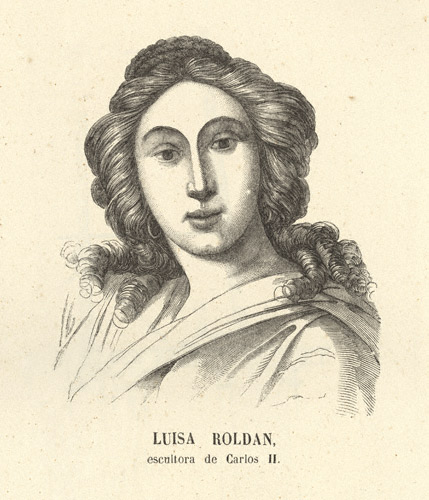
On a side note, I'm glad that my friend Shelley recently introduced me to Luisa Roldán (who is affectionately nicknamed "La Roldana," on the right is her presumed portrait by Antonio Rotondo, 1862).  I'd never even heard of La Roldana until a few weeks ago, but I immediately feel in love with her because 1) she's a Baroque sculptor, 2) she's Spanish (and Spanish sculpture often reminds me of the wooden baroque sculpture from Portugal and Brazil) and 3) she's a woman.

Like many other female artists from the Renaissance and Baroque eras, Roldán's father (Pedro Roldán) was also an artist. Roldán was an extremely successful artist (a great feat in the male-dominated profession) and worked as the court sculptor for Charles II.  (In fact, St. Gines de la Jara was probably a royal commission.)  Roldán was quite famous and successful during her lifetime, but seems to be relatively obscure today. Sigh - I wish she was discussed more in art history textbooks.

Friday, August 20, 2010

Lygia Clark: (Non)Interaction within the Museum

I was first introduced to the artist Lygia Clark by chance.  I was doing research in Brazil several summers ago, but arrived in Rio de Janeiro to find out that the Ministry of Culture was on strike.  All cultural institutions in the city were closed - including the National Library, where I had intended to do most of my research.  Argh!  Long story short: I discovered that the Museum of Modern Art in Rio de Janeiro was open (they must receive private funding and not be associated with the Ministry of Culture), I subsequently discovered Lygia Clark in the Tropicália exhibition, and luckily I was able to complete my research a few days later.

I think that Clark is a really interesting artist.  Much of her early work revolved around participation of the viewer.  In order to truly experience her art, Clark wanted people to touch, manipulate, and sometimes wear (!) her sculptures.  In one piece, Diálogo: Óculos ("Dialogue: Glasses", 1968, shown left), two people were supposed to wear a set of goggles.  The goggles constrained the individuals to maintain eye contact, and thus forced a type of dialogue to ensue between the two people.  It is the experience created by the goggles that is the work of art, and not the actual object itself.

Unfortunately, museum display and security don't allow Clark's work to be interactive (or even to function, really).  With art museums as a "no touch" zone, most of Clark's interactive work is stuck on pedestals and behind glass cases.  (Although, to be fair, in 2008-09 the SFMOA had an exhibition called "The Art of Participation" which allowed visitors to interact with works of art, including Lygia Clark's Diálogo: Óculos.)

But the mentality behind the "The Art of Participation" show isn't found everywhere.  Consider the particular irony of this clip from the Walker Art Museum, in which the curator explains and demonstrates how the sculpture is supposed to be experienced, but then shows the Bicho ("Bug," 1960) sculpture placed behind a glass case:


Obviously, I understand why works of art need to be placed behind protective glass.  I understand the element of preservation too, since constant handling of any sculpture will cause wear and tear on the piece.  And, to be fair, the SFMOA blog has some great reasoning about institutional limitations in regards to participation, which was posted in conjunction with "The Art of Participation" show. (This blog post also includes a link to this video of people turning Lygia Clark's Rede de elástico ("Elastic Net") into a jump rope within the gallery, which is kinda fun but obviously dangerous in the gallery space.)

Still, institutional limitations aside, I wish that there were more shows like "The Act of Participation" in the museum world. Then Lydia Clark's art would actually be able to function, instead just being a neat thing to talk about.

Monday, August 2, 2010

Judy Chicago's "Venus"

I guess it's pretty obvious that I've been researching prehistoric female figurines lately, huh?  I promise this will be my last post on the subject, at least for a while!  I just wanted to show everyone this cool Judy Chicago piece, Ceramic Goddess #3 (Study for Goddess Figurine on Fertile Goddess runner; 1977, shown above).  Pretty fun, huh?  It's funky, playful shape makes me think that this could have been the prehistoric statuette from Lewis Carroll's fictive "Wonderland."  Yep, that's it: this is the Venus of Wonderland.

The shape also reminds me a little bit of Henry Moore's anthropomorphic style.  (And speaking of Henry Moore, I've been thinking about how the replica of the prehistoric figurine "Venus de Lespugue" also reminds me Moore's work.)

Anyhow, it's neat to look at Chicago's work and see how a 20th century feminist identified with the prehistoric figurines.  Although today some question the prehistoric "goddess" theory, it's interesting to think about how feminist activists latched onto this subject matter in the 1970s and 1980s.  (You may be familiar with Judy Chicago's well-known feminist work, The Dinner Party (1974-79)).  You can read more about this female figurine and Judy Chicago here.

Saturday, May 22, 2010

Prendergast's "Lost"

In honor of the upcoming season finale for LOST, I thought it would be appropriate to highlight a work of art that shares the same title as the TV series.  Kathy Prendergast's Lost (1999) is a digital print that depicts a map of the United States.  The map points out all of the actual towns in the United States that contain the word "lost."  Every other city and place in the country has been excluded from this map, as you can see from a detail below:


Curator Mel Watkin pointed out that this interesting omission of every mappable location (and consequent focus on "lost" places) implies some interesting questions: "Are we lost?  Are they lost?  Or is [Prendergast]?"1

So, could we relate Prendergast's map to the TV show?  My only thought is that this map visually asserts why LOST has been such a popular show in the US - apparently we're obsessed with the idea of being lost, since so many places are named accordingly.  If you can think of other relationships between Prendergast and the TV show, feel free to post them in the comments section.  I'll crown the person with the wittiest answer (and accurate prediction for the finale) as the winner.

1 Mel Watkin, Terra Incognita: Contemporary Artists' Maps and Other Visual Organizing Systems (Saint Louis: Contemporary Art Museum, 2001), n. p. An exhibition brochure.

Thursday, April 22, 2010

Lorna Simpson's Two "Eyes"

Last week I had a student remark that the two circles in Lorna Simpson's Untitled (2 Necklines) (1989, shown left) look like a pair of eyes. I've been thinking a lot about this comment lately, particularly because I think it ties into Laura Mulvey's theories regarding the male gaze and fragmentation. Basically, the two circles eyes make the viewer especially conscious that he (the gendered pronoun is intentional) is fragmenting, cropping, and fetishizing the woman with his gaze.

It's interesting to note that these eyes detract attention from the fact that Simpson (and Simpson's camera) have actually done the fragmentation of the image. And there are other interesting parallels which can be drawn between human eyes and cameras: eyes have a limited amount of scope within their visual field and crop things naturally, just as a camera has to crop images because of the limitations of the camera lens.

I like that Simpson includes the word "eye" in one of the text boxes between the circles. I realize that this group of words also can also be associated with discrimination, slavery, and lynching - not just the objectification of women. But it's interesting to read the word "eye" and between two circular eyes.

And if you stare at this work of art too long (as I have been doing this morning), the column of words become the outline for a nose, the dark skin looks like pupils, and the white clothing looks like the whites of eyes. Could we say, then, that this piece is an actual visualization of the male viewer? Ha ha! Okay, probably not, but it is kind of interesting to see a little "face" emerge in Simpson's work.

Monday, April 19, 2010

Maya Lin and "Eleven Minute Line"

Last week, I heard Maya Lin speak at the university where I work. Her lecture was uncannily appropriate, since I had planned for my students to learn about Lin last week (before realizing that she was coming to speak). Minutes after the lecture began, I had two distinct impressions: 1) Lin is extremely tired of speaking about the Vietnam War Memorial and 2) Lin has a lot of flexibility in her career, since she established fame and recognition so early in life. Really, because Lin already has public attention and a fan base, she can create whatever she wants; she isn't like many other contemporary artists, who seem to feel the need to be shocking or controversial in order to get attention.

One of my favorite parts of the lecture was when Lin discussed her ideas behind her earth art Eleven Minute Line (2004). This squiggly line is 1600 feet long and 12 feet high. And here's the awesome part: it's located in a cow pasture in Sweden. The first time I saw Lin's piece, it immediately reminded me of the Serpent Mound (c. 1070 AD) in Adams County, Ohio (shown below). The Serpent Mound is the largest effigy structure in the United States, and it is thought to have been built by the the Fort Ancient people. (It was originally thought that the structure was built in prehistoric times, but carbon dating of the mound revealed a much later date.)

My suspicions regarding the connection between Eleven Minute Line and the Serpent Mound were confirmed during Lin's lecture. The artist is from Ohio, and she has always been struck with the story of the Serpent Mound. When Europeans came to America and discovered the Serpent Mound, they concluded that an earlier group of Europeans must have made the structure and then traveled back to the Old World. Basically, these European explorers could not conceive that Native Americans could have built something so complex and monumental. Lin decided add a subtle element of irony with Eleven Minute Line by turning the tables a bit: she brought a design that was inspired from the New World back to the Old World (i.e. Sweden).

It was a real privilege to hear such a well-known artist speak. I was glad that she discussed her more recent art, too. Are you familiar with Maya Lin's work (aside from the Vietnam War Memorial)? I think her interests in environmental/landscape issues are really interesting.

Wednesday, April 7, 2010

Morisot and Manet

It has taken me forever to work through Sue Roe's The Private Lives of the Impressionists, and I'm still not quite finished. I've had various obligations and nonrenewable library books that have consumed my time over the past three months. Hence, Private Lives has had to sit on my nightstand for quite awhile. I'm really interested in the subject matter, though, and hope to finish the book soon.

Anyhow, I have read far enough in the book to learn more about the relationship between Manet and Berthe Morisot, a female Impressionist painter. Morisot posed in several of Manet's portraits, and it is often thought that the two were romantically interested in each other (although Manet was already married and Morisot eventually became engaged to Manet's brother). Manet's painting on the left, The Balcony (1868-69) was the first painting for which Morisot posed (she is seated in the foreground). Since I am interested in this Manet/Morisot relationship, I was excited to see that today heidenkind mentioned an interesting article on this topic (see her fun post which "interviews" Manet).

The article, "Unmasking Manet's Morisot" by Marni R. Kessler visually analyzes portraits of Morisot by Manet. Kessler points out that the "crucial significance of Manet's depictions of Morisot lies in...continual shifting identity: [Morisot] looks different from canvas to canvas."1 It is especially interesting to see how Morisot's portraits morph over time, especially as Morisot's relationship progressed with Manet's brother. Morisot's features continually become harsher in the paintings, and she is depicted with increasingly violent brushstrokes. Take a look at these following paintings, which are posted chronologically:

Manet, Le Repos (Portrait of Berthe Morisot), 1870

Manet, Berthe Morisot with a Bouquet of Flowers, 1872

Manet, Berthe Morisot with a Fan, 1872

Manet, Berthe Morisot with a Veil, 1872
Manet paints this veil so that it simultanously reflects lace, a skull, and even a beard.2 Not a very flattering portrait, is it?

Manet, Berthe Morisot in a Mourning Hat, 1874
This painting was created shortly after Morisot's father died. Also, by this time, Morisot was engaged to Manet's brother. Not surprisingly, Manet abruptly stopped painting Morisot after her marriage.

Pretty interesting, huh? It seems that the depictions of Morisot don't reflect changes in her actual appearance too, since she also painted self-portraits at the time. Instead, one can visualize Manet's frustration and sense of loss as Morisot becomes engaged to Manet's brother. I would really recommend that you read Kessler's detailed analysis of these paintings - they are quite fascinating.

This article explores a lot of other interesting ideas, such as Kessler's argument that a sense of artistic rivalry is manifest in these same portraits: interestingly, Manet never chose to depict Morisot in the act of painting. Instead of a reference to her accomplishments as a painter, all of these portraits emphasize Morisot's gender and femininity in one way or another.3

Anyhow, this is an interesting article, and I wholeheartedly recommend it.

1 Marni R. Kessler, "Unmasking Manet's Morisot," The Art Bulletin 81, no 3 (September 1999): 475.
2 Ibid., 482.
3 Ibid., 477-478.

Monday, December 7, 2009

Vasari and Female Artists

I'm in a state of shock. Vasari is best known as the biographer for the great (male) artists of the Italian Renaissance - Michelangelo, Donatello, Raphael, Leonardo, etc. But did you know that Vasari mentioned four females in his Lives of the Artists? I had no idea, until I discovered Vasari's chapter on Properzia de'Rossi the other night. I seriously was dumbfounded - I stared at the word "sculptress" for at least ten seconds.

But don't get too excited, my feminist art historian friends. Vasari only mentions Rossi in a few paragraphs, and then taps on a few short sentences about three other female artists: Sister Plautilla, Madonna Lucrezia, and Sofonisba Anguissola. You've never heard of these artists, you say? Let me show you a sampling of their work:

On the right is Properzia de'Rossi's Joseph and Potiphar's Wife (1520s). Vasari mentions that the subject matter of this panel can parallel the unrequited love that Rossi experienced in her own life. I think this comparison is telling about Vasari's views on women and feminine nature. The editor of my Lives edition also echoed my thoughts, saying that "while male artists execute works without regard to their personal feelings throughout the Lives, Vasari seems unable to imagine a woman creating a work of art without sentimental or romantic inspiration."1

On the left is Lamentation with Saints (16th century) by Sister Plautilla (Plautilla Nelli). Vasari mentions that Plautilla was an extremely prolific painter, but surprisingly (or perhaps not-so-surprisingly), only three works are definitively attributed to her today. In an effort to bring public awareness to this artist, the Florence Committee of National Museum Women in the Arts paid to have Lamentation restored in 2006 (see news article here).

I think it's especially interesting that Vasari doesn't make any statements about Plautilla's divine role as an artist or God-given talent (which he makes about the male artists in his book). Instead, he stresses that Plautilla and the other ]female artists learned and acquired artistic skill. Futhermore, Vasari wrote this about Plautilla: "But best among her works are those she imitated from others, which demonstrates that she would have created marvellous works if, like men, she had been able to study and work on design and draw natural objects from life."2 Plautilla was alive when Vasari wrote her biography, and I wonder if she cringed to know that Vasari thought her best works were those that she copied from the divinely inspired, male artists.

Sofonisba Anguissola is the only female artist with whom I was familiar before reading Vasari. I read about Anguissola when I was doing research on Caravaggio's Boy Bitten by a Lizard. Several scholars think that Caravaggio's two versions of this subject were influenced by Anguissola's Boy Bitten by a Crayfish (also called Boy Bitten by a Crab, c. 1554, on right). Mary Garrard has discussed Anguissola's drawing in depth. She mentioned how Anguissola painted a picture of a laughing girls, which Michelangelo saw and commented that "the image of a crying boy would have been better."3 Garrard finds that Michelangelo's statement implied that boys are better artistic subjects than girls, and tragedy is better than comedy.4 Upon hearing this, Anguissola sent Michelangelo the drawing of Boy Bitten by a Crayfish. However, instead of showing the crying male in a tragic, noble position (and follow Michelangelo's inferred suggestion), Anguissola shows the boy in an ignoble state with an amused female standing nearby. Wasn't Anguissola a little sassy? I wonder what Michelangelo thought of the drawing.

Madonna Lucrezia is the other female artist mentioned by Vasari. Unfortunately, there isn't any (known) surviving art by her. In fact, we know little about Lucrezia beyond that she was active around 1560 and her teacher was Alessandro Allori. It's sad to think that her work and life is lost to history, most likely because she was a female. I'm glad that Vasari made the effort to mention her and these other females in his Lives, but also disappointed that most females didn't receive artistic opportunity or art historical attention at the time. It makes me wonder what other female artists have been unappreciated and obscured by historical biases.

Is anyone else shocked that Vasari mentioned female artists in his text?

1 Giorgio Vasari, The Lives of the Artists, translation by Julia Conway Bondanella and Peter Bondanella (London: Oxford University Press, 1991), 565.

2 Ibid., 342.

3 Mary D. Garrard, "Here's Looking at Me: Sofonisba Anguissola and the Problem of the Woman Artist,” Renaissance Quarterly 47, no. 3 (Autumn, 1994): 611.

4 Ibid., 612.

Monday, June 1, 2009

Candida Höfer's Brazil

I first became familiar with the photographer Candida Höfer through her solo exhibition "Architecture of Absence." Höfer is particularly interested in photographing public interiors at times when they are devoid of people. I think it's interesting to see a public place when it is public-less. I really like how the space is magnified within the photographs. In a kind of oxymoronish way, Höfer's work makes absence become a presence.

Anyhow, while I was looking for some images on a Brazilian Baroque church, I stumbled across a few photographs from Höfer's Brazilian series. The image above, Teatro Nacional de São Carlos Lisboa I (2005), is another Brazilian photograph by Höfer. Since I found out that Höfer is interested in Brazilian architecture and public spaces, she's a million times cooler to me. (And she was cool already.) Nice.

Wednesday, October 1, 2008

Tara Donovan's Genius

Yesterday J introduced me to the work of Tara Donovan, a contemporary installation artist who uses everyday materials (e.g. straws, adding paper, scotch tape) for her art. The installation shown in the image is made out of styrofoam cups and hot glue.

Donvan was among the recipients for the 2008 "Genius Grant" given by the MacArthur Foundation. You can see some of her work here. I think it's really stunning. I think my two favorites are this styrofoam cup installation and another installation made of adding paper.

What do you think? Which installation do you like?

Thursday, September 25, 2008

Cindy Sherman and Madonna

Quatorze asked me to do a post on Cindy Sherman, a photographer whose work I find very interesting. Beginning in the late 1970s, Sherman created a series of photographs which are reminiscent of Hollywood stills - however the "stills" are generic enough in setting and composition that they resist attribution to any specific film.

Sherman appears in her own photographs, often dressed in a wig and costume. She takes the photographs herself, using a shutter release cable that she holds in her hand.

These photographs can be seen as a commentary on typical feminine post-war stereotypes of the 50s and 60s. Shown in opposition to the stereotypes that were encouraged by the (male) film industry during these decades, Sherman takes control of her image by chosing and creating her identity within the photograph. Therefore, although her image is still the object of the viewer's gaze, Sherman is in control of her image and identity and not the viewer.

These photographs are (postmodernly) ambivalent, which has led to many different interpretations by feminists. While many find Sherman's work to be in resistance to the male gaze and masculine order, others think that she is still working under the masculine construct of society.

I can see valid reasoning for both arguments; my personal opinion of Sherman's work relating to both male and female paradigms was reaffirmed when I learned that Sherman's complete set of Untitled Film Stills was exhibited in the Museum of Modern Art (1997) under the sponsorship of Madonna. Yep, that's right, the self-made sex symbol of the music industry sponsored the whole exhibition of a photographer who has been interpreted as resisting the male gaze! Given Madonna's interest in Sherman's work, it is obvious to see that her photographs are subject to multiple interpretations.

I find it completely fascinating that Madonna likes Cindy Sherman's work. This image of Madonna and Cindy Sherman appeared in the Rolling Stone in 1997 (sorry for the poor reproduction - it's a scan of a microfilm printout!). An interesting interpretation of the photograph appeared in this article in Afterimage, saying Sherman has experienced a role-reversal - instead of playing a starring role in the photograph (as she does in all of her own photographs), she is given second billing to the superstar Madonna. The article then continues to give an fascinating comparison and contrast of Madonna and Sherman, while also discussing the role that Sherman's work plays in relation to media culture. One thing I found especially interesting was that Madonna is indebted to Sherman in some aspects - apparently many of Madonna's photographs in Sex: Madonna look similar to Sherman's film stills.

What do people think about this connection between Madonna and Cindy Sherman? For me, this reasserts that Sherman's work really can be interpreted beyond a mere resistance of the male gaze. Plus, given Sherman's interest in fashion (particularly outside of her film stills series), I can understand how she is interpreted as working within a masculine dominated society. But again, I can see her work being interpreted both ways. Just like the Untitled Film Series images resist attribution to a specific film, I guess that Sherman herself resists attribution to a single art interpretation.

Tuesday, August 12, 2008

Kruger, Mulvey, Feminism, and the "Male Gaze"

I think Barbara Kruger is a really fascinating artist. Most of her work deals with the idea of the female in art, particularly as a commentary on how culture affects the reception of the female image in art. Kruger focuses on empowering her female images as "subjects" instead of "objects." In this image shown to the right, Kruger empowers her subject by resisting the gaze of the viewer of the work.

This resistance of the viewer's (specifically, a male viewer) gaze is in direct opposition to how females were portrayed in art for centuries. Since ancient times, the passive female image, particularly the nude female, has served as an "object" for the active male viewer in art.1

Kruger's work and feminist art historical practice became especially interesting to me during graduate school. As an undergrad, I thought that feminist art historians were rather "angsty" and whiny. I think I came to this conclusion mainly because I was only briefly introduced to a few feminist art historical works, primarily Linda Nochlin's essay, "Why Have there Been No Great Women Artists?" Although I thought Nochlin made some really good points in this essay, I still came away with the overall impression that feminist art historians just liked to stamp their feet, pout, and demand equality. You have to admit, the title of Nochlin's essay can come across as sounding a bit whiny...

Anyhow, thanks to two die-hard feminist art historians at my university, I was able to change my opinion. One of my favorite articles that I read in graduate school was by Laura Mulvey, entitled "Visual Pleasure and Narrative Cinema."2 Mulvey discusses how the female image in visual culture, particularly the cinema, encourages the male voyeur. Specifically, the way that the camera functions in film encourages the voyeur, particularly in the way that the camera captures close-ups of women. (Ha - the word "captures" is really appropriate here!). Think of close-ups in an movie - they will focus on the lips, or eyes, or legs, etc. of the female actress. The actress is not viewed as an individual or human being, rather she is reduced (physically cropped on the film screen by the camera lens) and thus fetishized.

This work by Kruger exhibits well how the fetishization and "to-be-looked
-at-ness" of women occurs in the film industry (how 'bout Marylin's super-glossy-lips! Don't they just grab your attention!). And the same thing can be said of many other works of art. In regards to painting, I think that the invention of the photograph (which influenced "cropped" subject matter and compositions on the canvas) also helped support this idea of female reduction and fetishization. During my second semester in grad school, I wrote a paper about how some paintings by Gauguin can fall into this study of cropping and fetishization.

Mulvey's article is really fascinating. It was probably the first article that truly convinced me that feminist art historical/visual culture studies can be a very scholarly and engaging practice. It's not just about angst or anger - although I'm sure that one can find bitter-men-haters in any feminist paradigm, if you look hard enough...

1Obviously, not every single image of a nude female has held erotic purpose (for example, representations of Eve in Medieval art).
2 See Mulvey, "Visual Pleasure and Narrative Cinema". Screen 16, no. 3 (1975): 6–18.