Wednesday, March 31, 2010

Kehinde Wiley and His Inspiration

I love when contemporary artists use historical art for inspiration. Kehinde Wiley is one such artist, who often creates portraits of African-American men in poses that mimic specific portraits from the 17th-19th centuries. Since Wiley's portraits show African-American in the latest hip hop street fashion, the portraits provide interesting commentary on fashion, identity, and propaganda. It's also interesting to see how issues of identity (and the creation of identity via portraiture) have existed for centuries, especially when examining the historical paintings which inspired Wiley. Here are two of my favorite Wiley paintings (and the paintings that inspired them):
Kehinde Wiley, Prince Tommaso Francesco of Savoy-Carignano, 2006
See the portrait which inspired Wiley below:

Anthony Van Dyck, Prince Tommaso Francesco of Savoy-Carignano, 1634

Kehinde Wiley, Equestrian Portrait of Philip II, 2009
This portrait by Wiley is a little different, in that he doesn't depict Michael Jackson wearing hip hop street clothes. Jackson actually commissioned this portrait in 2008, but never saw the completed work. J thinks that the inclusion of the cherubs (instead of the angel in the Ruben's painting which inspired Wiley, as shown below) is fitting, given that Jackson was accused of sexually abusing children. I really doubt that Wiley intended to make that reference, but it's an interesting thought. The painting was finished after Jackson's death in 2009 and sold that same year to German collector for $175,000. My favorite thing about this portrait is that it depicts Jackson at the height of his career. I think the armor and pose totally scream "I'm bad, I'm bad, you know it!" Man, you can't help but love MJ's early stuff. He was the Prince of Pop, and a royal equestrian portrait is fitting. Anyhow, you can read more about this portrait here and here.
Rubens, Philip II on Horseback, c. 1628-29
I have to admit, I think Rubens has created a lot more powerful horses than the one in this painting. Wiley's horse has a lot more presence than the one shown here. Maybe the puny horse accounts for why this portrait is not very well-known. Anyhow, if you're interested, the Prado Museum has some discussion about the restoration of this portrait here.

You can see more of Wiley's work on his website and read a little bit more about him on this page of the National Portrait Gallery's site. What do you think of Wiley's portraits? Do you think they raise interesting questions about identity and personal image?

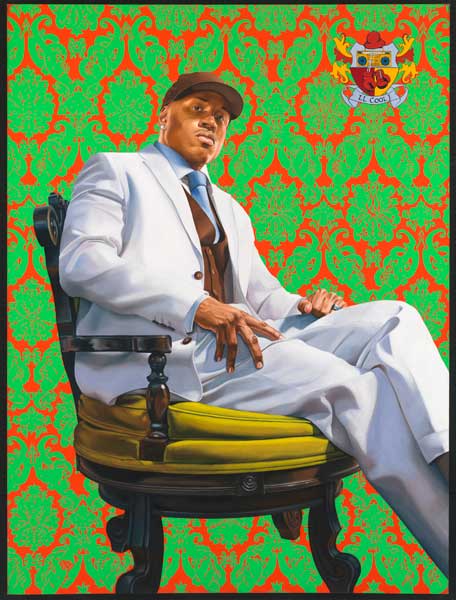
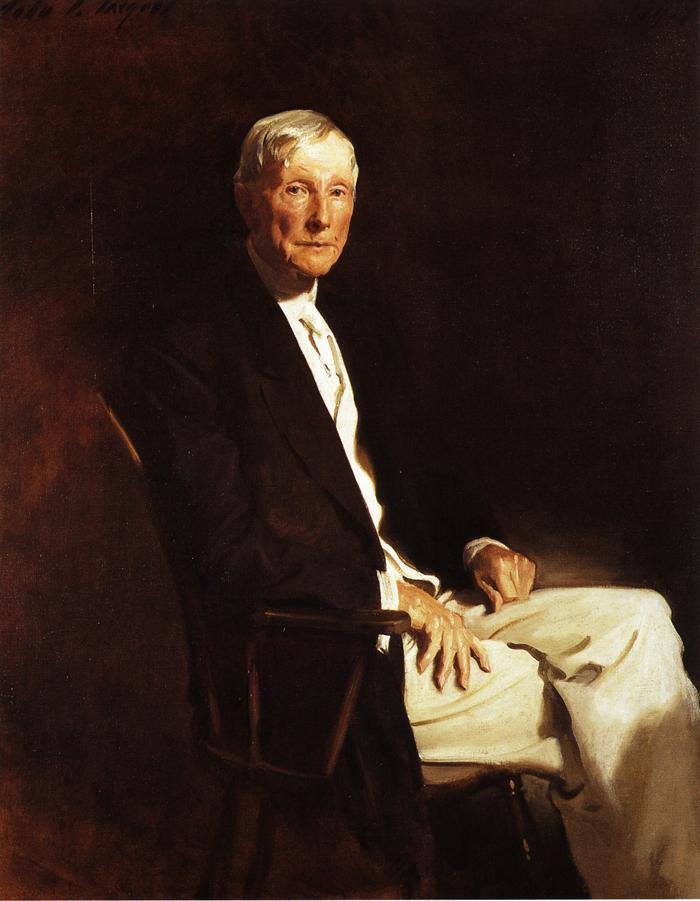
(e, do you remember when you saw L L Cool J's portrait by Wiley (2005) in the NPG? I found out this evening that both L L Cool J and Wiley wanted the portrait to recall John Singer Sargent's portrait of Rockefeller (1917). Pretty cool, huh? Who would have guessed that L L Cool J was familiar with Sargent? Even though I think the green and red pattern in the Wiley portrait is a a little too visually aggressive, I love that the painting recalls a Sargent portrait.)

Saturday, March 27, 2010

Turner Painting to be Sold!

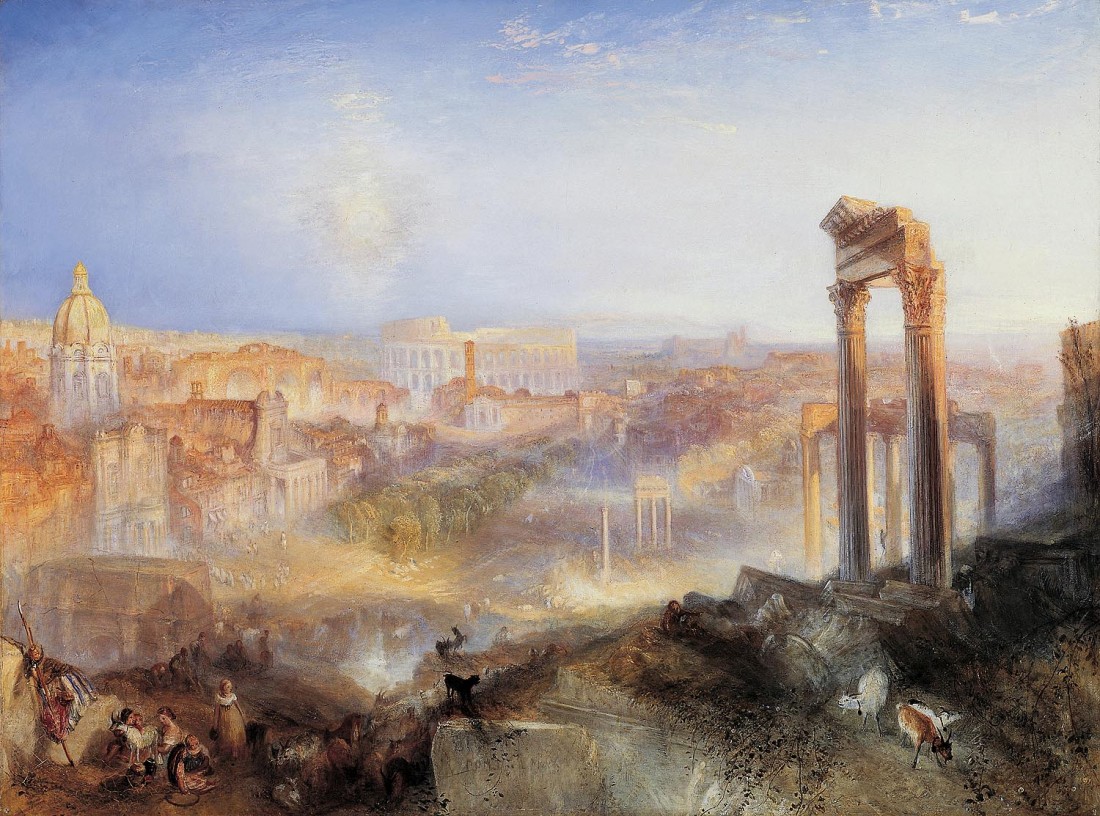
J. M. W. Turner, Modern Rome - Campo Vaccino, 1839

This July, Turner's painting Modern Rome - Campo Vaccino (1839, shown above) will appear on auction at Sotheby's in London.  This auction news has attracted quite a bit of attention as of late - and for good reason.  First of all, this painting is absolutely stunning (don't you agree?).  Second, this is the last painting of Rome that Turner ever made.  Turner traveled to Italy multiple times in his life, and even exhibited a small group of his work in Rome. Therefore, this last painting of Rome is historically important in regards to Turner's career.  And finally, this upcoming auction is significant because this painting has only been on the market one other time, back in 1878.  Sotheby's projects that the work to reach somewhere between $18 million and $27 million in the upcoming auction. 

I sure wish I had that kind of cash lying around.  I can only hope that this work will be purchased by a museum (or bought by a collector who permanently lends the painting to a museum).  It is such a beautiful painting and so representative of Turner's interests in light and color - it doesn't seem right for the canvas to end up in a private collection.  I think lots of people should have the chance to enjoy this painting.

For more links and commentary on the auction, see here (Art History Today), here (The History Blog), and here (New York Times article).

P.S.  I discovered the Art History Today blog this past week.  It's really interesting and I highly recommend it.

Thursday, March 25, 2010

Libera's LEGO Concentration Camp

Zbigniew Libera's LEGO Concentration Camp, 1996

Next week my new students will learn a little bit about Zbigniew Libera's project LEGO Concentration Camp (1996). Libera worked with the LEGO corporation to create a seven box set of different buildings within a concentration camp. Although much of the set contained LEGO materials, some of the faces of the guards and prisoners were manipulated with paint (to suggest expressions of sadness or glee). The last box of the set was full of personal objects and possessions, inspired by the loots that were taken from prisoners during the period.

Unsurprisingly, there was a lot of controversy around this project. You can read a little bit more about the controversy and background of the project in this article (start about 1/3 of the way down the page). Even LEGO launched legal complaints against the artist.

In some ways, it seems like "anything goes" in relation to contemporary art, especially when it comes to readymade/found objects. Today artists seem to scramble for any kind of readymade/found object that hasn't been used (or hasn't been used in a certain way). Libera's work is an example of how nothing can be considered taboo in the contemporary art scene, not only in its readymade medium but also in subject matter.

What do you think of Libera's work and idea? To be honest, I haven't completely made up my own mind. I fluctuate between being offended and feeling that Libera is bringing attention to the Holocaust in a creative way. The thing I don't like to envision, though, is the possibility of little children playing with a LEGO set like this one. And I think that reminder of childhood innocence is part of Libera's point.

(e, I know that Libera's sets were only available in a limited edition. Does the Holocaust Museum own any of the sets?)

Tuesday, March 23, 2010

Supersizing the Last Supper

I haven't had much chance to think about art over the past two days - which is ironic, because I'm busy prepping for an online course in contemporary art. Instead of thinking about Jeff Koons and Damien Hirst, though, I've been battling with my computer over technology/formatting issues for my recorded lectures. Bah.

Anyhow, today two friends sent me variants of the same article (see here and here), and I welcomed the distraction (thanks, Kiersten and Rachsticle!). The articles discuss an unusual study which revolves around the food portions, particularly those in depictions of the Last Supper. Two brothers, Brian and Craig Wansink, analyzed and compared Last Supper scenes over the course of 1,000 years (including one of my favorite paintings, Last Supper by Tintoretto (1592-94, shown above)). The researchers used the heads of the figures as a basis for comparison, and then measured the size of plates and entrees accordingly. As a result, it was discovered that the portions for meals increased gradually over 1,000 years: entrees increased by 70% and bread grew by 23%. Incidentally, the size of plates also grew by 65.6%.

Pretty interesting stuff. It looks like industrial farming and fast food chains are not solely responsible for the size of today's food portions. Instead, portions seem to be a product of history. And hooray that art could help with the research for this project! Once again, art comes to the rescue!

Thursday, March 18, 2010

Gardner Art Heist Anniversary

Twenty years ago today, two armed men entered the Isabella Stewart Gardner Museum and performed one of the biggest art heists in history. In a little over an hour, these two men stole an estimated $300-500 million by grabbing thirteen works of art. Some of the stolen paintings included Vermeer's The Concert (1658-1660) and Rembrandt's Storm on the Sea of Galilee (1633, shown right). This Rembrandt painting is especially of interest, since it is the only known seascape by the artist.

And now, twenty years later, investigators are making another effort to try and get the stolen art back. The Associated Press reported this week that two billboards have appeared on Interstates 93 and 495, advertising the $5 million reward.

I bet there aren't a lot of crimes which receive billboard attention twenty years after the fact. Although I kind of doubt that billboard signs are going to help recover these famous works of art, who knows? I hope that the Gardner museum gets its collection back one day.

*The Isabella Stewart Gardner Museum has been in the news recently, due to a controversial modern wing that will be built onto the museum. You can read my take on the subject here.

Monday, March 15, 2010

Exhuming Caravaggio

Keeping up with the Caravaggiomania theme, I wanted to bring attention to some recent news stories (brought to my attention by heidenkind). Currently, two groups are working together to exhume the possible remains of Caravaggio:

- Silvano Vinceti, a television producer, believes that he narrowed down the possible remains of Caravaggio to fragments of nine different bodies. These remains have been sent to the Professor Giorgio Gruppioni (University of Ravenna) for carbon dating. Vinceti has exhumed the remains of other prominent historical figures, including Petrarch and Pico della Mirandola. However, Vinceti has long been susceptible to criticism, largely because he isn't a trained historian or scholar. You can read the recent news article here. (There is also an interesting picture in the article that shows Gruppioni and Vinceti displaying an open box that may contain Caravaggio's remains - it's kind of creepy but also really cool.)

- Mr. Gruppioni and the University of Ravenna, in tandem with the University of Bologna, are furthering this testing by performing DNA tests on possible descendants of Caravaggio. See the Associated Press release here. (I think it's interesting that this article doesn't mention Mr. Vinceti's involvement in the project. Are the universities are somewhat embarrassed about their association with the controversial television producer?)

Even though Vinceti isn't a trained scholar, I'm glad to see that he is utilizing the knowledge of scholars for this research project. It will be interesting to see what findings come from these studies! Wouldn't it be neat to find out that you were a descendant of Caravaggio?

Friday, March 12, 2010

Caravaggiomania

Caravaggio, Medusa, 1598-99

One of my students brought my attention to this recent article in the New York Times. The article highlights a new argument by Philip Sohm, an art historian at the University of Toronto. Sohm believes that people aren't as interested in the Renaissance artist Michelangelo anymore - instead, people have shifted their interest to Caravaggio. Sohm has charted interest in Caravaggio and Michelangelo through the number of scholarly publications over the past fifty years, and the number of writings about Caravaggio have gradually overtaken those about Michelangelo. Sohm calls this new phenomenon "Caravaggiomania" - and as a Baroque scholar who loves Caravaggio, I think that term is awesome.

Sohm thinks that art history doctoral students are having difficulty finding new and innovative things to say about Michelangelo. I don't doubt this is the case. Michelangelo and the Renaissance period have been beaten to death for centuries in terms of research - but I do think that new interpretations and fresh scholarship can still rise up in the 21st century. I just wonder where Renaissance scholarship can go for new and fresh ideas. I've been thinking about this quite recently, actually, ever since I read heidenkind's post about her difficulty in finding great publications about Donatello.

Sohm's Caravaggio argument is timely, particularly since this year celebrates the 400th anniversary of the artist's death. There are a lot of huge celebrations and events taking place to honor Caravaggio this year, including a major exhibition that is currently on display at the Scuderie del Quirinale in Rome. This exhibition is bringing together Caravaggio paintings from all over the world - you can see a list of the paintings at the bottom of this Italian website. Other events have also taken place in preparation for this show, such as the public restoration of Adoration of the Shepherds. How I wish that I could go to Rome and celebrate this summer!

Anyhow, because of these celebrations, there undoubtedly has been Caravaggiomania over the past couple of months and years. Here's the question that I would pose to Sohm: How many publications and writings have occurred recently because of the preparations for this celebration? Is it possible that we will see a decline in Caravaggiomania next year, once all of the celebrations have ended?

Thursday, March 11, 2010

MOMA Breaking from the White Cube

I just read this interesting blog post by a curatorial assistant at the MOMA. It looks like the major museum is slowly breaking away from the "white cube" ideology by painting some of the walls. Now, granted, light grey isn't an extreme departure from the white cube space, but hey, it's a start. (You can see a photograph of the color change within the MOMA blog post.)

Any opinions on the color choice? Do you think that there are new associations brought about by the changes to wall color? For me, the light gray seems to give the modern paintings a feeling of history - gray evokes the passage of time, emphasizing that these works are not brand-spanking new.

Do you think that gray walls seem to historicize these works more than the neutral white color? Maybe historicizing these modern works is a good thing - after all, in the 21st century, modern art is a thing of the past.

Dolley Madison and the Lansdowne Portrait

When I was in elementary school, I had to give a report on Dolley Madison. I was fascinated with Dolley's life, and poured over a children's version of her biography. I remember being particularly interested in how the first lady had to flee from the White House during the War of 1812.

One thing that I didn't learn from my project (or at least, I don't remember learning), was that before Dolley Madison's flight from the White House, she ensured that a portrait of George Washington would be kept safe from the British soldiers. This portrait by Gilbert Stuart (1796, shown right), is often called the "Lansdowne portrait," since at one point it was given as a gift of appreciation to William Petty, the Marquess of Lansdowne (Great Britain). The portrait depicts a significant point in American history, showing Washington renouncing a third term as president.

Dolley Madison called this portrait "iconic" and delayed her flight from the White House until she was able to arrange for the painting's safekeeping. She wrote to her sister, "I insist on waiting until the large picture of Gen. Washington is secured." This month's edition of Smithsonian magazine has a very interesting article that gives more details about Dolley Madison's flight and the portrait.

Ever since my elementary school report, I've always admired Dolley Madison. But now knowing the fundamental role she played in preserving an important work of art, I like her even more.

Friday, March 5, 2010

Elizabeth I and a Snake?

I've always liked royal portraits. It's always fun to see how a monarch decides to visually assert his/her power, prestige, wisdom, wealth, etc. In portraiture, these attributes and characteristics of the sitter are emphasized through various signifiers (e.g. lavish, expensive clothing signifies that the wearer of the clothes is rich). What what if the signifier (or symbol) isn't clear or easily understood?

That seems to be the case with this portrait by Elizabeth I (anonymous artist, 16th century, shown left). The final product of this painting showed Elizabeth I holding a bunch of roses in her hand. I haven't seen what the painting looked like with roses (this Telegraph article described the roses as a "decorative" element), but it seems to me that roses could have also been been an easily identifiable symbol for Elizabeth I, since roses were a symbol of her family, the house of Tudor.1

But whether these roses were symbolic or decorative, they were obviously added at the last minute. Deterioration of this painting has revealed that the monarch originally was holding a snake in her hand. Based on the remaining visual evidence, an artist has recreated how the snake probably appeared in the original portrait (see below). It is thought that the snake was repainted with roses because of the "ambiguity" of the serpent symbol (again, see Telegraph article).

Well, "ambiguity" is right. The well-known symbolic associations with snakes are the Fall, sin, death, and Satan. And I'm pretty sure Elizabeth I wasn't going for those associations. Once in a while you hear about snakes being associated with wisdom, so maybe that explains why the snake was originally included? Can you think of any other symbolic reasons why Elizabeth I would be depicted with a snake?

On another note, deterioration of this painting has also caused a strange ghostly appearance on Elizabeth I's forehead. This portrait was painted over another unfinished portrait, and the eyes and nose of the previous woman face have become visible. It appears that the painter of Elizabeth I decided to reuse the unfinished panel, a common practice at the time.

Poor Elizabeth. As was suggested on The Corinthian Column, Elizabeth I doesn't appear to have been the most attractive of monarchs. And having an extra nose and pair of eyes in your forehead is not going to improve your looks.2

1 You can see other portraits of Elizabeth I with Tudor roses, such as "The Pelican Portrait" by Nicolas Hilliard (c. 1575-1580).

2 This Elizabeth I portrait is part of the National Portrait Gallery (London) collection. It has not been on display for almost a century, but will soon be exhibited as part of the show "Concealed and Revealed: The Changing Faces of Elizabeth I." The show runs from March 13 to September 26.