Saturday, February 27, 2010

Van Gogh News!

What immediately comes to your mind when you think of paintings by Van Gogh? Sunflowers? Starry nights? Creepy self portraits with bandages that cover up a mutilated ear? Well, my friends, it looks like you can add new subject matter to Van Gogh's oeuvre: a windmill and tricoleur flag. This painting on the right, Le Blute-Fin Mill (1886) was recently authenticated as a Van Gogh painting. Honestly, I never would have considered this to be by Van Gogh, mostly because of the human figures: not only are the uncharacteristically large, but there are a lot more bodies than you normally see in Van Gogh's work. But I really like the use of color, and that does remind me of Van Gogh. I especially like the red highlights of the woman's dress in the foreground. What do you think? Do you like this painting?

This authentication is pretty exciting - Le Blute-Fin Mill is the first Van Gogh to be authenticated since 1995. However, admittedly, the painting has long been disputed as by Van Gogh - an eccentric art collector bought the painting and always claimed it to be by the master, but no one took the collector seriously. You can read more about the story and authentication here.
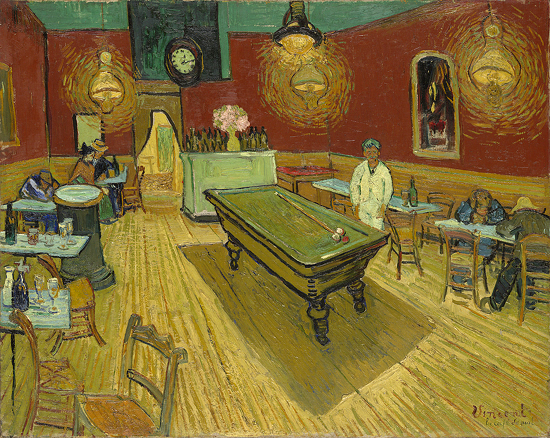
In other Van Gogh news, the famous The Night Cafe (1888, shown left) is involved in a dispute regarding ownership. This painting has hung for almost fifty years in the Yale University Art Gallery, but now Pierre Konowaloff, the great-grandson of the previous owner, is trying to claim the painting back. It seems like a pretty sticky situation: Konowaloff's great-grandfather bought the painting in 1908, but it was subsequently nationalized and sold by the Soviet government during the Russian Revolution. Therefore, Konowaloff believes that the painting classifies as "stolen" and feels justified in claiming it back.

I personally don't think that Konowaloff has a very good chance of getting The Night Cafe back, but what do other people think?

Thursday, February 25, 2010

Update on "Victorious Youth": The Getty's Response

Last night I received an email from Ron Hartwig, the Vice President of Communications from the J. Paul Getty Trust. After reading Pamelia Brown's guest post on this blog, Mr. Hartwig wanted to clarify some of the facts regarding the "Victorious Youth." He has given me permission to repost the text of his email, and you'll find it in the comment section for the "Victorious Youth" post.

Tuesday, February 23, 2010

Guest Post: Trouble for the "Victorious Youth"

Today I'm pleased to feature a guest post by Pamelia Brown. Pamelia writes for Associate Degree [dot] com, and has a written a couple of entries there that might be of particular interest to people who read this blog.

For today's post, Pamelia is writing about the Getty Museum's "Victorious Youth," a sculpture which has seen a lot of news coverage this past month:


Victorious Youth, 300-100 BCE, Getty Museum

For a work of art whose creator isn't identified, the Victorious Youth gets a lot of press.

The Greek bronze statue was discovered in international fishing waters by Italian fishermen in 1964. However, instead of revealing the discovery to the Italian government, or even returning it to Greece, the men who discovered it hid it and sold it, leading to the statue eventually being smuggled out of the country and sold at auction. J. Paul Getty, the billionaire oilman, made plans in 1972 to buy the statue despite protests from the Italian government. He died in 1976, and the Getty Museum bought the statue the next year, after the seller's Italian attorneys made assurances that the sale was legal. That was just the beginning of the trouble.

Earlier this month, an Italian judge ordered that the Victorious Youth be seized from the museum and returned to Italy. It's a follow-up to a 2007 agreement in which the Getty, acknowledging that many of its pieces were likely acquired illegally, announced it would return 40 of its pieces to the Italian government, though not the statue. It's not clear how effective the order could be enforced here, but it does open the door for further negotiations with the Getty Museum. While the museum did issue a statement saying the order was "flawed both procedurally and substantively," the following week saw the Getty announce a renewed partnership with Italy by working with Sicily on object conservation, and that decision also stemmed from the 2007 agreement.

I think it's a shame that a sculpture has been reduced to a prize being quarreled over by an angry government and a museum that's probably resorted to off-the-book practices to acquire art. It makes me wonder how many times we let art be swallowed by a different story. Perhaps some kind of share or trade could be worked out, where the statue spent part of its time in the Getty Villa in Malibu and the rest of the area in Italy. I know it's not a perfect solution, but it's surely better than courtroom showdowns.

This guest post is contributed by Pamelia Brown, who writes on the topics of associates degree. She welcomes your comments at her email Id pamelia.brown@gmail.com .

Saturday, February 20, 2010

Howard Hodgkin

Apparently I'm out-of-touch with the British contemporary art scene. Last night I was watching a clip from Simon Schama's "Power of Art" series (don't hate me, heidenkind!), and Schama mentioned that the artist Howard Hodgkin is of Van Gogh's "progeny" (in terms of Expressionism).

I had to rewind the DVD - Howard who?

Howard Hodgkin. You know, one of the foremost British painters today. [Silence.]

So, in order to educate myself, I looked up some of Hodgkin's work this evening. Part of me wonders if I have seen his stuff before, since he has painted scenery for the Mark Morris Dance Group. Anyhow, here are some of Hodgkin's paintings that I particularly liked:

Howard Hodgkin, Night and Day, 1997-99
This painting was exhibited in 2006 with an exhibition of Hodgkin's work at the Tate Modern


Howard Hodgkin, Memories, 1997-99
You can read more about this painting here. I think it's particularly interesting that Hodgkin often paints his frames (in addition to the canvas). I think this can tie into interesting ideas about objecthood and subjecthood, particuarly since the frame is no longer "containing" or "highlighting" the painting - it is part of the painting itself.


Howard Hodgkin, Curtain, 2002-07
I like this painting because it makes me think, "What would happen if you combined a Rothko painting with Edward Munch's The Scream?" And I also like the bits of blue that peek out from underneath the black swath of color.

Have you heard of Hodgkin before? Which of his works do you particularly like?

Tuesday, February 16, 2010

Equality Leading the People

Delacroix, Liberty Leading the People, 1831

Last night I was reading a little bit of Théophile Thoré's review of the 1848 Salon exhibition. The year 1848 was a very important year in European history. It was the year that Marx's Communist Manifesto was published, and the year that socialist revolutions broke out all over Europe. Thoré was commenting on the contemporary political sentiment and fervor, and implied that similar political fervor is found in Liberty Leading the People (a painting by Delacroix that was made earlier, around the time of the national French revolution in 1830). Thoré wrote, "It is said that [Delacroix] has just begun an Equality Leading the People, for our recent revolution is the true sister of that national one to which he paid homage eighteen years ago. . . . One can only hope that Delacroix makes haste, and that both paintings will soon be on display, hanging side by side."1

From what I can tell, Delacroix never made Equality Leading the People, and Thoré may have been discussing only hearsay. Nonetheless, this got me thinking. What type of figure would Delacroix have picked to represent Equality? Given the context of the 1848 socialist revolutions, I'm guessing that he would have picked some type of proletarian (member of the working class).

I think that Equality Leading the People would have contained an interesting idea that is still relevant with current issues. What if Equality Leading the People was being painted today? What figure would you pick to represent Equality? My first thought was Martin Luther King, Jr. or Rosa Parks. What person (or generalized type of figure) would you choose?

1 Théophile Thoré, "Salon of 1848" in Art in Theory: 1815-1900, edited by Charles Harrison, Paul Wood and Jason Gaiger, (Oxford: Blackwell Publishing, Ltd., 1998), 181. (Is available online here).

Friday, February 12, 2010

Valentine's Day Quiz: Famous Couples in Art

At a Valentine party earlier this week, I took a quiz to test my knowledge of famous couples in history. As a group, the party members did pretty well - except we missed one question about Aspasia and Pericles.

The quiz got me thinking about some famous couples that are depicted in art. So I decided to make a quiz of my own. See if you can name any of the famous couples in the following works of art:


This one is a little tricky. Hint: look at the knife in the woman's foot. You might be more familiar with another variation of this story, where this woman slashes her thigh to show her loyalty to her husband.

How many couples did you guess? Check your answers in the comments section of this post. You get extra points for every artist that you can name, too.

Happy Valentine's Day!

Tuesday, February 9, 2010

Mathematician Helps with Art Attribution

I sometimes start my lectures by talking with students about art that has recently been in the news. Tonight, though, it was a student who shared an interesting news item. She had overheard people discussing this NPR story about Daniel Rockmore, a math professor at Dartmouth College.

Rockmore is using his mathematical skills to help determine if drawings are correctly attributed to Pieter Bruegel the Elder, a Northern Renaissance artist. Bruegel used various pen strokes which art connoisseurs have noted to be especially characteristic of the artist's work. Nevertheless, connoisseurs have had difficulty in concretely identifying some of Bruegel's work (e.g. the above image of an Alpine landscape (Morgan Library and Museum) was attributed Bruegel until recently). In order to help determine which strokes are Bruegel-like and which ones are not, Rockmore used his math skills to create a computer program that analyzes the pen strokes.

It sounds like an interesting program. It makes me wonder more about how computers and technology will affect the future practice of connoisseurship. Could future art attribution be left completely in the hands of technology, instead of actual connoisseurs? I imagine that couldn't happen, but it's an interesting/scary thought.

Rockmore made an interesting point at the end of the article, explaining that this program is a way to deconstruct art and determine what it means to be Picasso-like or Bruegel-like. In a way, I think that's true, but I also think that an artist's "hand" and styles can never be completely, concretely deconstructed. Even if an artist is relatively consistent in a technique, stylistic approach or color scheme, artists are subjective to change and variation. Although I think Rockmore has an interesting and useful idea, I don't think it can find all of the answers to explaining an artist's style.

Saturday, February 6, 2010

My CAA Wish List

You might be aware that the annual conference for College Art Association (CAA) is starting next week (February 10-13). I wish I could go, but a) I can't afford to fly to Chicago and b) I have to teach. Nonetheless, I have poured through the conference catalog (see online list here) and have marked the sessions that I wish I could attend:

- "Women, Femininity, and Public Space in Nineteenth Century Visual Culture." Chairs: Heather Belnap Jensen (Brigham Young University) and Temma Balducci, (Arkansas State University)

- "Sculpture and Race, 1750 to the Present." Chair: Linda Kim, Smith College

- "Representations of Brazil and Shifting Identities." Chairs: Aleca Le Blanc (University of Southern California); Elena Shtomberg (University of Utah). (*This session was MADE for me to attend! Why am I not going to be there?!?! I'm especially intrigued by Rebecca Parker Brienen's topic, "Frans Post's Brazilian Landscapes.")

- "Thinking about Colonial Latin American Art." Chair: Elizabeth Hill Boone, Tulane University. (*Again, this session perfectly aligns with my interests! Bah! I really wish I could hear "The Politics of Competing Visualities in Early Colonial Latin American Art" by Jeanette Favrot Peterson with Thomas DaCosta Kaufmann.)

- "'Classicisms,' 'Mannerisms' and 'Baroquisms': Sixteenth - and Seventeenth-Century Visual Culture in Europe and Other Cultural Centers." Chairs: Larry Silver (University of Pennsylvania) and Lynette M. F. Bosch, State University of New York, Genesco.

Are you going to CAA? What sessions will you/did you attend? Does anyone else have a wish list with no possibility of attendance (and want to commiserate with me)? I just hope that some of these lectures are recorded or later published. For now, though, it looks like I'll just be able to follow the conference blog so I can feel part of the action. Sigh.

Monday, February 1, 2010

Louis XIV as the Rising Sun

Up until this past weekend, my favorite portrait of Louis XIV was this infamous portrait by Rigaud (1701):

One of the reasons I love this portrait is because it captures the ostentatious, over-the-top personality of the absolute monarch. With all of that ermine fur, there is no question that this guy is a big spender. And how many people at age sixty-three have enough self-confidence to show off their legs (while wearing high-heels?). You have to admit, Louis Quatorze had guts.

Anyhow, while doing research this past weekend, I came across a new favorite depiction of Louis XIV. I present to you the king, costumed in his role as Apollo, the "Rising Sun" (part of the court ballet Royal Ballet of the Night (c. 1650, see here for more information)):

I knew that Louis XIV performed in ballets, but I didn't realize that any extant depictions of the costumed monarch existed. Don't you love his peacock-feathered skirt? And the wavy, golden sun rays that extend from everywhere (even his shoe buckles!)? It's no wonder that Louis XIV was given this role in the ballet, since he continually compared himself to Apollo and even called himself the "Sun King."

I know that Louis XIV was a incredibly selfish person that did a lot of horrible things to upkeep his vanity and image. But I have to admit, I think this guy is absolutely fascinating. Who can't be fascinated with someone who wears outfits like this?