Wednesday, December 30, 2009

"Déjeuner sur L'Herbe" by Monet (NOT Manet)

I'm preparing a lecture on the Impressionists, and I've been completely distracted by Monet's Déjeuner sur L'Herbe ("Luncheon on the Grass"). Yes - that's not a typo. I meant to write "Monet," not "Manet."

Maybe you're saying "What?" just like I did fifteen minutes ago. Don't get too bewildered: Manet DID a very seminal painting that is called Le Déjeuner sur L'Herbe (1863). And Manet's painting is infinitely more well-known than Monet's early work with the same title. But allow me to bring Monet's painting out of obscurity:

Monet, Le Déjeuner Sur L'Herbe, 1865-66

It's interesting to see a painting by Monet that includes human figures. (You can see a figure study for this painting here.) I'm so used to seeing Monet paintings with haystacks and Rouen Cathedrals and water lilies and train stations - it's so nice to see something different. You also might have noticed that this painting was made just about two years after Manet completed his painting with the same title. A coincidence? Definitely not. There's no question that Monet was influenced by Manet.

Other painters were also influenced by Manet's 1863 painting. Cezanne did his own picnicking painting with the same title, and Picasso did several versions that were directly inspired by Manet. In fact, the Musee d'Orsay did an exhibition (which ended in February 2009) that revolved around Picasso's variations of Manet's Le Déjeuner sur L'Herbe. Here's one Picasso example:
Picasso, Le Déjeuner sur L'Herbe after Manet, 27 February 1960

So, what do you think? Did you know that Monet painted a Déjeuner sur L'Herbe? (I really hope that I'm not the only one who was unaware of that fact.) Which version of the subject matter do you like the best?

Saturday, December 26, 2009

Devéria and the Lion King?

Here's my latest art historical hunch. Take a look at the two images below. Does anyone else think that the opening scene of Disney's cartoon "The Lion King" (1994) was influenced by Eugène Devéria's Birth of Henry IV (1827)?


I wonder if Disney has ever written about artistic influences for their films. It would be fun to see if there is a statement by Disney that could support my hunch...

Thursday, December 24, 2009

Favorite Christmas Art

Christmas art = a smorgasbord. There is so much art associated with Christmas. I would bet there there are over a million different depictions that are associated with the biblical Christmas story. Here are a couple of pieces of Christmas art that I particularly like:

Jan van Eyck, The Annunciation, c. 1435
My favorite thing about this painting: the awesome rainbow wings on the angel Gabriel. I also love the that Gothic and Renaissance references are combined in the same architectural setting, references the Old and New Testament.

Georges de la Tour, Adoration of the Shepherds, c. 1644
I particularly love the hand on the right which covers up a candle. Sigh - tenebristic lighting is awesome. I also love the adoring expression of the man on the right.

Brian Kershisnik, Nativity, 2006
You HAVE to click on the image above to see all of the details in this painting. I saw Nativity a few years ago, soon after it was completed. This painting is HUGE (about 7' x 17'), and the viewer can't help but feel swept into the swarm of angels that swoop around the Holy Family. It's quite moving.

Do you have a favorite piece of Christmas art?

Merry Christmas and Happy Holidays!

Monday, December 21, 2009

The Awakening Conscience

Although my mom was never really into art (she said that nude figures made her "embarrassed"), there are a couple of 19th century artists and artistic movements that she liked. It was my mom who first introduced me to the Pre-Raphaelite Brotherhood when I was in high school (or perhaps a freshman in college?). She excitedly pulled me aside, held out a reproduction of The Awakening Conscience (1853, see left) and asked, "Have you heard of the artist William Holman Hunt?"

Mom liked Hunt's art because it was highly religious and moralistic. She liked The Awakening Conscience because it explored the theme of redemption. This painting depicts a prostitute or mistress who is sitting on the lap of her lover. They are playing the piano together, and it appears the lyrics of the song have pricked the conscience of the young woman. The painting captures this woman's precise moment of enlightenment and realization. I especially like looking at her expression and knowing that she is staring out an open window (which you can see reflected behind her in a mirror).

There are many moralizing references that are included in the painting. Here is a list of some objects which give clues to the story and moralistic tone of the painting:

- Music on the piano: "Oft in the Stilly Night" is a nostalgic song in which a the singer reflects upon childhood innocence and missed opportunities. (On a side note, this song is mentioned in A Portrait of the Artist as a Young Man by James Joyce - you can listen to the song by going here.)
- Music on the floor: "Tears, Idle Tears" is Edward Lear's musical adaption of Tennyson's poem. The sad poem seems to express sorrow over the woman's predicament. (You can read the poem here).
- Rings: The woman wears rings on all of her fingers except her "wedding finger."
- Hat and glove: The clothing objects are hastily cast aside, which indicates an abandonment of decorum. Because the hat is placed on the table, it shows that this man is a visitor and not a permanent resident in the house.
- Unraveled threads: A reference to the woman's wasted life.
- Cat and bird: The cat is chasing a small bird underneath the table. This vignette is a reference to the woman's predicament (the man = the cat, the woman = the bird).
- Light on the floor: Suggests enlightenment and potential redemption for the woman.

I especially like the inclusion of the cat and bird. Is there any specific object that you like?

The Awakening Conscience will forever remind me of my mother. Did a friend or relative ever introduce you to a work of art? Do you remember the experience?

Friday, December 11, 2009

Liu Bolin, the Invisible Artist

Look closely at this photograph - can you see the man who blends into the background? That man is the artist Liu Bolin. He paints himself to "hide" within his photographs. I just watched this interesting newsclip about Bolin and his work. I think it's pretty creative stuff. You can read more about the ideology that underlies Bolin's art (and see more pictures of his work) in this article.

I like how these photographs emphasize the idea that a person is affected by his/her surroundings. I latch onto that idea more than any of the political ideas that influence Bolin, although I think that his artistic/political protest makes sense.

What do you think?

Thursday, December 10, 2009

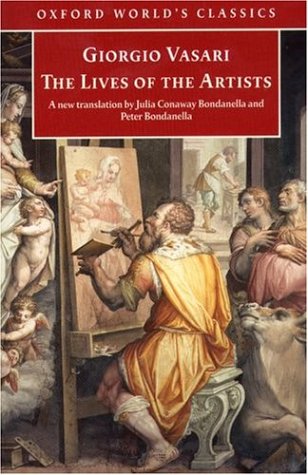
Book Review: Vasari's "The Lives of the Artists"

Well faithful readers, I'm sure that you're tired of hearing about Vasari in my posts. I don't blame you. I've been writing Vasari-inspired posts for the past several weeks, as I've slowly worked my way through the Lives of the Artists text. The funny thing is, I never intended on reading the whole book this fall. I checked out Lives so that I could verify a couple of quotes, but then I just kept reading. And reading. And reading. And now, 500+ pages later, I've finally finished! So, this review will probably be my last Vasari-centric post, at least for a while. Here are my final thoughts on Vasari's Lives:

-
This book is simultaneously boring and fascinating. It's difficult to read Vasari's lengthy passages which describe works of art, especially since there were no reproductions available in my text. (This website, however, promises to display illustrations with each biography, although I don't know if all extant reproductions will be provided for every description in the text.) However, many of Vasari's anecdotes and short stories are really fascinating. I especailly found the story of Brunelleschi and Ghiberti's rivalry to be quite riveting.

- Vasari's hyperbolic writing style is a little silly. He is over-the-top in his praise for the majority of artists in the book. Likewise, much of art in the book is described as the most beautiful thing in the world - those descriptions become old after a few paragraphs. Vasari also opens many chapters with generalized, broad statements about life, happiness, or art (a type of "Happy is the man who..." statement), and that also gets a little annoying.

- I can see why Vasari is sometimes called "The Father of Art History." His methodology of verifying multiple sources for information helped set a precedent for the discipline. He also offers critiques for works of art, and it's easy to see how he helped to set the standard for art criticism. Even though his writing is prolix and dull at times, it's quite interesting to see his methodology and ideological influences.

- I would recommend this book to a serious art historian. I think anyone with a mild interest in art would get bored quite easily: the interesting anecdotes and stories are embedded deep within Vasari's text. If you want to know more interesting stories without reading the book, just let me know. I took notes!

* I am counting this book as part of Heidenkind's Art History Challenge.

Wednesday, December 9, 2009

Raphael Copy Discovered in Apartment!

My cousin just sent me this post, and I'm so excited/jealous about the news that I have to post right away. The story sounds like a dream-come-true: an Italian couple decided to remodel their apartment and found a 16th century fresco behind their plastered wall! Although Tarcisio and Teresa de Paolis found the fresco in the 1970s, they only recently decided to announce their find to the public (it appears they were worried that they would lose their home because of this discovery).

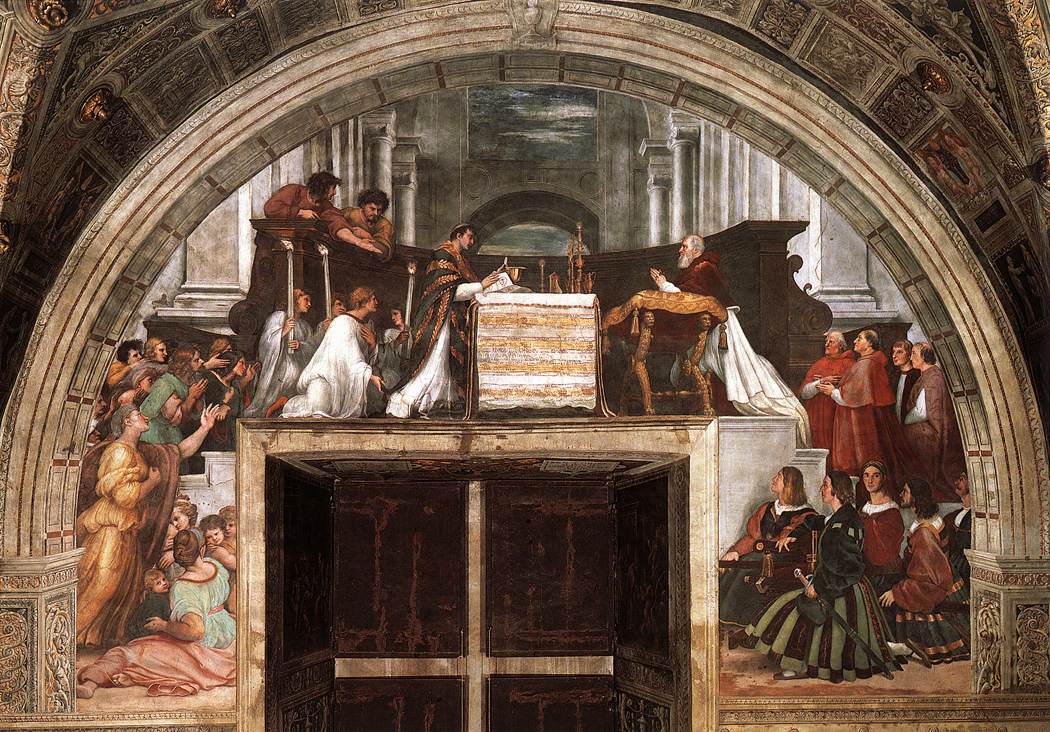
The fresco appears to be by Ugo da Scarpi - it is a miniaturized copy of frescoes from Raphael's "Room of Heliodorus" (1512-1514; located in the Vatican - you can take a virtual tour of the room here). The detail on the right is from Raphael's fresco The Mass at Bolsena; you can compare this detail with the da Scarpi copy (located in the photograph with the de Paolis couple).

What an amazing find! I'm green with envy. I have a secret hope that one day I'll discover a masterpiece that was hidden away in an attic or antique shop.

Do you know of any other amazing art discoveries?

Monday, December 7, 2009

Vasari and Female Artists

I'm in a state of shock. Vasari is best known as the biographer for the great (male) artists of the Italian Renaissance - Michelangelo, Donatello, Raphael, Leonardo, etc. But did you know that Vasari mentioned four females in his Lives of the Artists? I had no idea, until I discovered Vasari's chapter on Properzia de'Rossi the other night. I seriously was dumbfounded - I stared at the word "sculptress" for at least ten seconds.

But don't get too excited, my feminist art historian friends. Vasari only mentions Rossi in a few paragraphs, and then taps on a few short sentences about three other female artists: Sister Plautilla, Madonna Lucrezia, and Sofonisba Anguissola. You've never heard of these artists, you say? Let me show you a sampling of their work:

On the right is Properzia de'Rossi's Joseph and Potiphar's Wife (1520s). Vasari mentions that the subject matter of this panel can parallel the unrequited love that Rossi experienced in her own life. I think this comparison is telling about Vasari's views on women and feminine nature. The editor of my Lives edition also echoed my thoughts, saying that "while male artists execute works without regard to their personal feelings throughout the Lives, Vasari seems unable to imagine a woman creating a work of art without sentimental or romantic inspiration."1

On the left is Lamentation with Saints (16th century) by Sister Plautilla (Plautilla Nelli). Vasari mentions that Plautilla was an extremely prolific painter, but surprisingly (or perhaps not-so-surprisingly), only three works are definitively attributed to her today. In an effort to bring public awareness to this artist, the Florence Committee of National Museum Women in the Arts paid to have Lamentation restored in 2006 (see news article here).

I think it's especially interesting that Vasari doesn't make any statements about Plautilla's divine role as an artist or God-given talent (which he makes about the male artists in his book). Instead, he stresses that Plautilla and the other ]female artists learned and acquired artistic skill. Futhermore, Vasari wrote this about Plautilla: "But best among her works are those she imitated from others, which demonstrates that she would have created marvellous works if, like men, she had been able to study and work on design and draw natural objects from life."2 Plautilla was alive when Vasari wrote her biography, and I wonder if she cringed to know that Vasari thought her best works were those that she copied from the divinely inspired, male artists.

Sofonisba Anguissola is the only female artist with whom I was familiar before reading Vasari. I read about Anguissola when I was doing research on Caravaggio's Boy Bitten by a Lizard. Several scholars think that Caravaggio's two versions of this subject were influenced by Anguissola's Boy Bitten by a Crayfish (also called Boy Bitten by a Crab, c. 1554, on right). Mary Garrard has discussed Anguissola's drawing in depth. She mentioned how Anguissola painted a picture of a laughing girls, which Michelangelo saw and commented that "the image of a crying boy would have been better."3 Garrard finds that Michelangelo's statement implied that boys are better artistic subjects than girls, and tragedy is better than comedy.4 Upon hearing this, Anguissola sent Michelangelo the drawing of Boy Bitten by a Crayfish. However, instead of showing the crying male in a tragic, noble position (and follow Michelangelo's inferred suggestion), Anguissola shows the boy in an ignoble state with an amused female standing nearby. Wasn't Anguissola a little sassy? I wonder what Michelangelo thought of the drawing.

Madonna Lucrezia is the other female artist mentioned by Vasari. Unfortunately, there isn't any (known) surviving art by her. In fact, we know little about Lucrezia beyond that she was active around 1560 and her teacher was Alessandro Allori. It's sad to think that her work and life is lost to history, most likely because she was a female. I'm glad that Vasari made the effort to mention her and these other females in his Lives, but also disappointed that most females didn't receive artistic opportunity or art historical attention at the time. It makes me wonder what other female artists have been unappreciated and obscured by historical biases.

Is anyone else shocked that Vasari mentioned female artists in his text?

1 Giorgio Vasari, The Lives of the Artists, translation by Julia Conway Bondanella and Peter Bondanella (London: Oxford University Press, 1991), 565.

2 Ibid., 342.

3 Mary D. Garrard, "Here's Looking at Me: Sofonisba Anguissola and the Problem of the Woman Artist,” Renaissance Quarterly 47, no. 3 (Autumn, 1994): 611.

4 Ibid., 612.