Tuesday, November 24, 2009

Thanksgiving: Rockwell and Lee

Happy Thanksgiving! I don't know too many works of art about Thanksgiving; I usually associate this holiday with Norman Rockwell's Freedom From Want (1943, shown above). Last week, though, I learned about another Thanksgiving painting while listening to Linda Nochlin's lecture at the SAAM. Nochlin talked about how Doris Lee's painting Thanksgiving (1935, shown below) has been described as "Rockwell-esque" and similar to Freedom From Want. Nochlin doesn't see too many similarities, and neither do I. Historically, the comparison doesn't make much sense, because Lee's painting precedes Rockwell's work by eight years. (I guess that if one was determined to make a comparison, it would be more correct to argue that Rockwell's painting is "Lee-esque.")

I like Lee's depiction because it shows all of the behind-the-scenes work that goes into the Thanksgiving feast. Perhaps I'm drawn to this painting because I'm cooking the turkey for the first time this year. (Gasp!) Nochlin pointed out that the food appears to miraculously appear on Rockwell's table, whereas Lee stresses the preparation that goes into a Thanksgiving meal. Nochlin also pointed out that all of the people in the painting are women, except for one lazy boy who stands aloof and watches everyone else work!

Although I think that these two paintings are dissimilar in style and subject matter, I do think that they both capture the excitement and sense of anticipation that is part of Thanksgiving. The bustling movement and energy of Lee's women is related to the energetic interactions between the people at Rockwell's table. And the man in Rockwell's foreground invites us to join in the fun, gazing outward with his twinkling eyes and excited expression. I think it is this sense of excitement that I like best about these paintings, and it's one of the things that I love about the Thanksgiving holiday.

Do you know of other depictions of Thanksgiving? What's your favorite part about the Thanksgiving holiday?

Thursday, November 19, 2009

Linda Nochlin Lecture at SAAM

Last night I watched a live webcast of Linda Nochlin's lecture at the Smithsonian American Art Museum. Nochlin is one of the forefront feminist art historians today (she practically created feminist studies in art history with this article). She has influenced a lot of my thinking in regards to feminism and postcolonialism, and I was really excited to hear her speak. Nochlin spoke about female American artists, ranging from Mary Cassatt to the contemporary period. (On a side note, don't you think it's interesting how both the Americans and French want claim the ex-pat Cassatt as belonging to their country/art movements? Is she a French Impressionist or an American Impressionist?)

There were two things in Nochlin's lecture that I thought were especially interesting. I liked how Nochlin compared Mary Cassatt to the compositional devices in Little Girl in a Blue Armchair (c. 1878, shown above on right). Nochlin pointed out that Cassatt was extremely aware of childhood and its discontents, as is evidenced in the painting and subject matter. The little girl is slumped in her chair - it's obvious that she is annoyed with the convention of portraiture and having to sit still (for a long time!) while her portrait is painted. The girl's resistant attitude is emphasized by her angular body within the composition: there's an interesting contrast between the angular body of the girl and the soft, circular body of the dog.

Nochlin paralleled this painting to the discontent that Cassatt felt in her own life. Like this little girl, Cassatt was also resistant to convention and tradition. As a suffragist and avant-garde artist, Cassatt defied the standards that were upheld by 19th century society. Cassatt's disregard for the tradition of painting is even emphasized in the unconventional perspective of Little Girl in a Blue Armchair; the viewpoint has been lowered so that the scene is viewed from the perspective of a child, not that of an adult.

Nochlin also made a passing comment that I thought was interesting. She was discussing Dorothea Lange's Migrant Mother (1936, shown on right) and mentioned that she liked that the photograph was black and white. Nochlin feels like there is a true feeling of "documentation" when a photograph is black and white - there is a refusal of the decorative, emotional quality that comes with color. In terms of facts and documentation, the idea of "black and white" is extended to the newspaper and media paradigm, since people say "I read it in black and white." Interesting, huh?

Did anyone else have a chance to hear Nochlin's lecture? What do you think of the two ideas I mentioned?

Tuesday, November 17, 2009

Dürer's Temperaments of the Four Humours

I got distracted today by Dürer's Adam and Eve (1504). I'm preparing a lecture on how Dürer's engraving Melencolia I is influenced by the doctrine of the four humours, and then I remembered how Dürer also included references to the four humors in his Adam and Eve.
Let me explain a little bit about the doctrine of the humours. It a very complex notion about how humankind was linked to the natural world. The doctrine of the humours has largely been disproved by modern medicine, but it's interesting to think about, especially since the doctrine was upheld for thousands of years. One interesting aspect of the doctrine discusses how basic elements of the earth are transformed into food for humans. Depending on the nature of the element, the food will then create four different bodily fluids (that in turn create different character types). Are you following me? The four character types or temperaments are: the melancholic, the phelgmatic, the choleric, and the sanguine.

Okay. Now to Adam and Eve. Dürer included four animals which represent these four different temperaments of the humours. To emphasize the character types, I'm also including Panofsky's further explanations for each animal in parentheses:

Cat = Choleric (cruelty, pride)
Rabbit = Sanguine (sensuality)
Elk = Melancholic (gloom)
Ox = Phlegmatic (sluggishness, sloth)1

It's interesting to see how these animals are still kind-of associated with these character types today. Doesn't the phrase "Breed like rabbits!" still tie into sensuality? And aren't oxen typically associated with slow, sluggish movements?

Dürer's depiction of the four temperaments is fitting, given the subject matter. It was believed that the four temperaments were held-in-check while in Paradise. After the Fall (notice Eve is holding the forbidden fruit), the balance was lost and the the soul of man became "contaminated" by the humours.1

Are there any symbols or animals that you particularly like in this engraving? I'm always intrigued by the ibex in the far background (standing on the top of a mountain). I like the interpretation that the ibex is a represention the Adam and Eve, who figuratively stand on a spiritual precipice because of the Fall.

1 Erwin Panofsky, The Life and Art of Albrecht Dürer, Princeton University Press (1955), p. 120 and pp. 84-84. Citation also available online at http://www.csus.edu/indiv/v/vonmeierk/4-05BEAU.html, accessed 17 November 2009. If you're interested in reading more about the iconography/symbolism for the other animals and objects in this engraving, I'd recommend that you read Panofsky's interpretation.

2 Ibid.

Friday, November 13, 2009

Watteau = Not Exactly Flemish

I'm still thinking about Watteau this week. On the left is a portrait of Watteau by Rosalba Carriera (1721).

Just in case you're wondering, it's not completely accurate to say that Watteau was a Flemish artist. Okay, I know what you're thinking: "Of course he's not Flemish - he was a French Rococo artist!" You're right. But I bet I'm not the only person who once learned that Watteau was Flemish. To clarify: Watteau was born in the town of Valenciennes, which originally was a Flemish town. However, the French took over the town about seven years before Watteau was born.1

Does this change my belief that Watteau was influenced by the Flemish master Rubens? Of course not! There's no doubt that Watteau was interested in the Flemish masters, and I'm quite sure that Valenciennes maintained many Flemish customs and traditions, even after the French gained control.

I guess it's possible that Watteau considered himself to be Flemish, since his father was of Flemish descent. Watteau's interest in Flemish art suggests that the artist was interested in his heritage, to say the least. But if one wants to get technical, I think it would be most correct to say that Watteau had Flemish ancestry, but he was born on newly-acquired French soil.

In my mind, that means Watteau was French.

1 Emma Barker, Nick Webb, and Kim Woods, eds., The Changing Status of the Artist (London: Yale University Press, 1999), 233.

Wednesday, November 11, 2009

"Fête Galante" and Demeaning Terms

In my earliest art history classes, I remember learning that Watteau was associated with the "fête galante" genre from the Rococo period. The "fête galante" includes depictions of feasts or celebrations of gallantry, and it usually showed idle aristocrats in outdoor settings.

Today, Watteau is hailed as the master of the "fête galante." However, it appears that the term intially was used in a more demeaning sense. I just learned today that "fête galante" was first applied to Watteau's art by the Academy, so that Watteau would be separated "from the scholarly and morally serious narratives of the history genre."1 The Academy renamed Watteau's painting Pilgrimage to the Island of Cythera (shown above, 1717) to Un Feste Galante.2 I guess that Watteau's title and allusion to semi-mythic subject matter was troubling for the Academy; they didn't want this painting to be associated with the history/mythological paintings that were considered the "highest" form of art at the time. Therefore, "by admitting Watteau [to the exhibition], but not as a history painter, the Academy both welcomed and snubbed him."3

It's interesting to see that several demeaning or derogatory terms have been associated with art initially, and then the term ends up sticking to the art/artist in a positive way. The Fauvists received their name after an art critic compared the group's paintings to "fauves" or wild beasts. Likewise, the term "impressionists" was coined by the art critic Louis Leroy as a demeaning way to mock the art of Claude Monet (and others that exhibited in the Salon des Refuses in 1874).

Can you think of any other instances when a demeaning term has become a badge of honor for an artist or movement?

1 Emma Barker, Nick Webb, and Kim Woods, eds., The Changing Status of the Artist (London: Yale University Press, 1999), 229.

2 Ibid.


3 Ibid., 232.

Monday, November 9, 2009

Fra Filippo Lippi's "Handy" Work

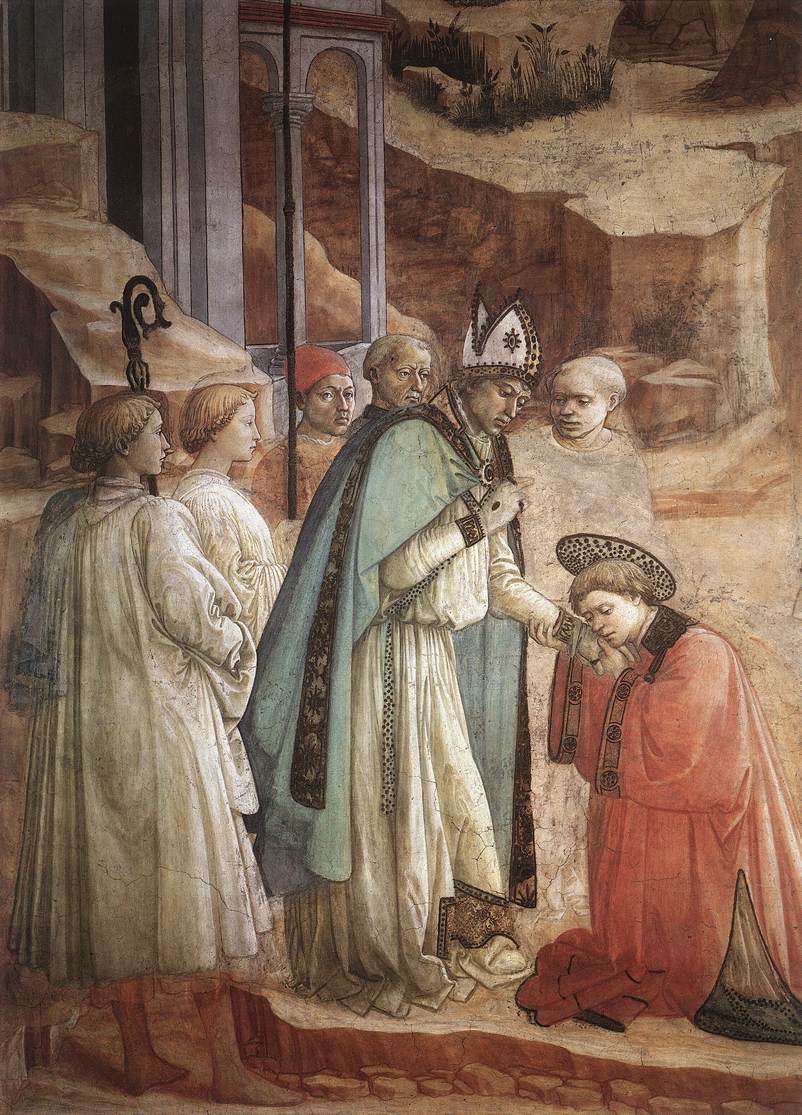
Vasari writes that Fra Filippo Lippi made a conscious decision to stop including a lot of hands in his paintings. Apparently, Lippi had been criticized for including too many hands in his compositions, and someone advised him to be aware of that fact.1 Lippi received this sound advice around 1445, and Vasari writes that in later paintings Lippi "covered [the hands] up with draperies or some other invention in order to avoid such criticism."2

In some ways, you really can see a switch from the "hand" to "hand-free" Lippi. (Okay, in truth, his later paintings aren't "hand-free," but often there aren't as many hands.) Here are some earlier, "handy" paintings:

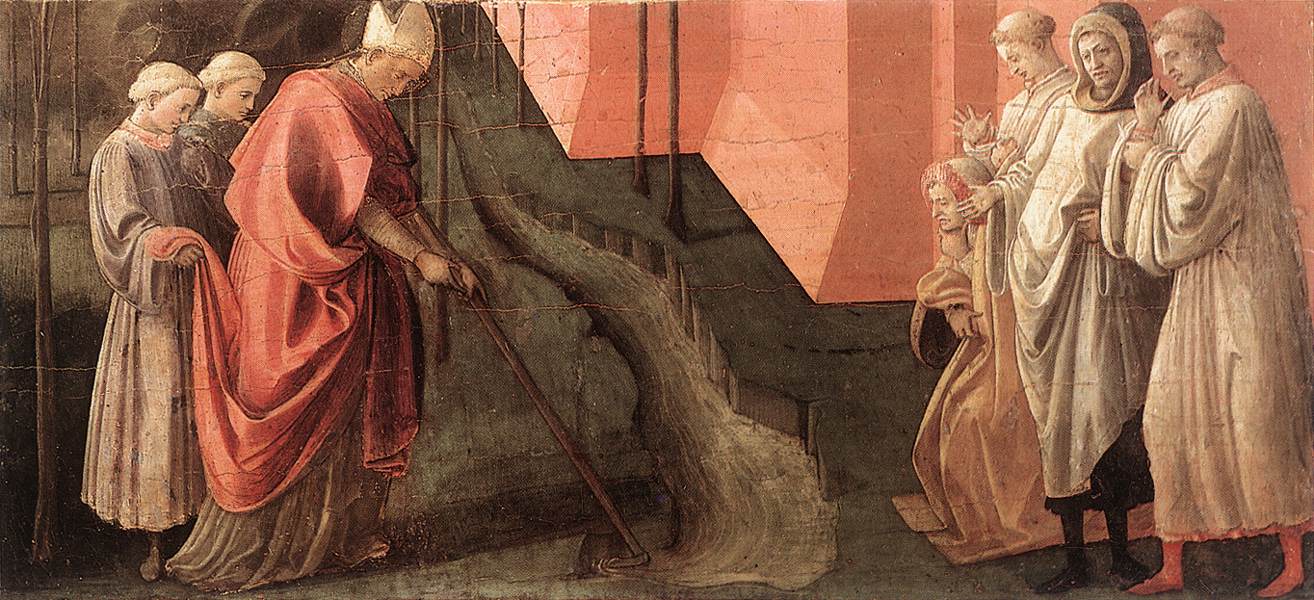
St. Fredianus Diverts the River Serchio, c. 1438
There are way too many hands in the group on the right. And look at the man who is standing on the left side of that group - his hands are awkwardly included in the composition to the point of distraction. It almost looks like that man is going to box the ears of the pious man who is kneeling down.

Madonna of Humility (Trivulzio Madonna), c. 1430
(with red circles added - click here to see a reproduction without circles)
I think this painting is pretty ugly, and the plethora of hands doesn't help the composition one bit. I circled sixteen different hands. Granted, there are a lot of figures in this painting, but sixteen hands seems a little extreme and unnecessary. Hands pop out in some of the strangest places, too. Check out some of the hands on the left-side of the Virgin.

Lippi's post-1445 (ahem, post-"handy") works still include hands, although he often (but not always!) toned down the number of hands and was a little more tactful.

Detail of Disputation in the Synagogue, 1452-65
Notice how Lippi covered up the figure on the left's hands with drapery? Smart move. There aren't any miscellaneous fingers or palms sticking out anywhere, either, which is an improvement.

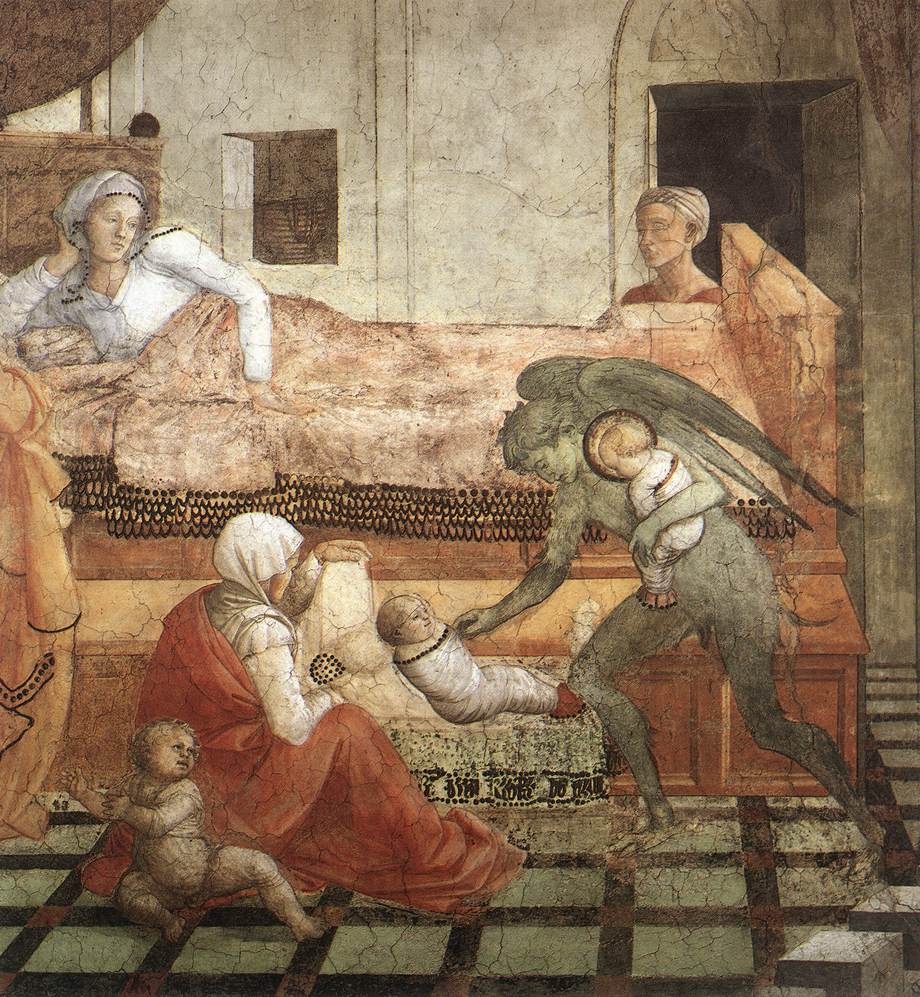
Detail of St. Stephen is Born and Replaced with Another Child, 1452-65
Lippi toned down the hands a bit in here - Stephen's mother covers up one hand with her head, and the seated woman covers up a hand with her knee (although I think her other hand is awkward in its position and placement). And you don't even see the hands of the figure behind the bed. I think, though, that the woman on the left's hand is poking out from behind her cloak - it's a little awkward since its the only part of the woman that we can see, but hey, this is an improvement for Lippi.

Do you know of a "handy" or "hand-free" work by Lippi? What do you think - did Lippi improve by toning down his inclusion of hands? I certainly think so.

1 Giorgio Vasari, The Lives of the Artists, translation by Julia Conway Bondanella and Peter Bondanella (London: Oxford University Press, 1991), 194.
2 Ibid.

Thursday, November 5, 2009

The Artist Had Never Seen a [Insert Animal] Before

It's always interesting to see how an artist depicts an animal that he/she has never seen. Vasari writes that Paolo Uccello wanted to depict a chameleon his Four Seasons, but since the artist had never seen a chameleon, he opted to draw a camel instead.1 I guess you can kind of see Uccello's logic in picking a camel, since camaleonte and camello are similar words in Italian (the two words are a little similar in English, too). I wish that Uccello's Four Seasons still existed; I'd love to see what that chameleon/camel looked like.

Durer attempted to depict a rhinoceros, even though he had never seen one. He really didn't do too bad of a job (see woodcut print The Rhinoceros (1515) on the right), although the armor-like plates are a little funny. Durer became interested in the rhino after seeing a sketch and reading descriptions in a letter from Lisbon.2 The year that Durer made this print, 1515, was a big year for rhinoceroses in Europe. Both the king of Spain and king of Portugal were trying to win the favor of the pope by giving him rhinoceroses. The pope apparently liked the West African rhino (the gift from Spain) best, which allegedly answers why the pope gave more New World territory to Spain.3 I bet that Durer was trying to maximize on the interest in rhinoceroses during this year, since woodcut prints can be widely distributed, popularized, etc.

There are other animal depictions which I think are amusing. When writing my thesis, I would often chuckle at Aleijadinho's depiction of a lion. Since the Brazilian artist had never seen a lion before, he sculpted this one with the face of a monkey:

Aleijadinho, detail of lion next to the prophet Daniel, 1800-1805

And you have to love Aleijadinho's great attempt at a whale. I especially love the whale's two spouts (kind of like nostrils, I guess) and fins:

Aleijadinho, detail of whale next to the prophet Jonah, 1800-1805

Aleijadinho, side-view of Jonah's whale, 1800-1805

Medieval bestiaries are full of creative depictions of animals. I particularly like this depiction of a crocodile and this depiction of an elephant (check out those tusks and horse-like flanks!).

I know there are lots of other interesting/creative/bizarre depictions of creatures that have resulted from the artist never seeing the actual animal. What ones do you know? Do you have a favorite? Let's see who can give the most bizarre example...

1 Giorgio Vasari, The Lives of the Artists, translation by Julia Conway Bondanella and Peter Bondanella (London: Oxford University Press, 1991), 82.

2 "The Rhinoceros," in Web Gallery of Art, available from , accessed 5 November 2009.

3 Hemanta Mishra, Bruce Babbitt, Jim Ottaway, Jr.,
The Soul of the Rhino (Guilman, Connecticut: Lyons Press, 2008), 137. Available online here.

Monday, November 2, 2009

New Portrait of Caravaggio (Only You Can't See It)


If I asked you what was in this detail of Caravaggio's Bacchus (1597), and you answered "A carafe of wine," you would only be given partial-credit for your answer. Sorry. This detail, my friends, has been found to contain an early self-portrait of Caravaggio at his easel, shown as a reflection in the glass carafe.

You're aren't seeing it, you say? To tell you the truth, me neither. In actuality, you can't see this detail with the naked eye. It used to be visible, however, since it was mentioned by an Italian restorer in 1922. However, poor restoration efforts and the gradual darkening of this image have obscured this small portrait over time. Only recently did the portrait "resurface" through reflectography, and the image results were revealed last Friday at a conference in Florence.

You can kinda-sorta see the portrait of Caravaggio in this Telegraph article, which posted the reflectography results and circled where the portrait is located. I'm still not seeing too much, but I'm trusting that one can actually see a young Caravaggio, paintbrush in hand, with his arm extended toward a canvas on an easel.

Pretty cool, huh? I wonder if restorative efforts can make this self-portrait visible again to the naked eye.