Thursday, July 30, 2009

New Ear Theory for Van Gogh

One of the most famous stories surrounding Van Gogh is that the artist cut off his own ear in December of 1888, shortly after a violent argument with his friend and fellow artist Paul Gauguin. Reportedly, Van Gogh then gave the ear to a local prostitute, a woman named Rachel. Due to the popularity of this story, I think that Self Portrait with Bandaged Ear (c. 1889, shown left) is one of the painter's best-known self portraits.

An interesting (and rather incredulous, in my opinion) theory came out earlier this year about Van Gogh's ear cutting. You may have caught wind of this new theory - in May it was picked up by all different newspapers and sites. Hans Kaufmann and Rita Wildegans' new book, In Van Gogh's Ear: Paul Gauguin and the Pact of Silence argues that Van Gogh did not cut off his own ear, but rather Gauguin was the culprit. Kaufmann and Wildegans believe that Van Gogh and Gauguin were fighting about Rachel (the prostitute). According to this theory, the men agreed to invent the story of self-mutilation so that Gauguin would not get in trouble with the authorities. Gauguin eventually moved to Tahiti and Van Gogh committed suicide in 1890. You can read more about this new theory in these articles by the Daily Mail and BBC News.

Personally, I have a hard time accepting everything put forth by Kauffman and Wildegans. I kind of like the idea that Rachel was the source of the argument, especially since we know that Van Gogh gave Rachel the infamous ear afterwards. However, I'm not sure that Gauguin would have been the one to slice Van Gogh. I agree with what Jonathan Jones wrote to attack this theory. After Gauguin left, he wrote Van Gogh and asked for the Sunflowers painting a parting memorial gift. I don't think Gauguin would have had the gall to ask for a momento if he had recently cut off his friend's ear. That doesn't make sense to me.

What do you think about this theory?

Monday, July 27, 2009

What Do You Think of Dalí?

I have to admit that when it comes to aesthetics, Salvador Dalí's art doesn't do much for me. And honestly, I don't think I know anyone who finds Dalí's work to be aesthetically-pleasing. Most people I know have described Dalí's art as cerebral, Freudian, or just plain weird.

Don't get me wrong, I think that Salvador Dalí's art has a significant place when it comes to art history. I think it's great that most art history students are introduced to The Persistence of Memory (1931, shown above). I enjoy comparing Dalí's work to other Surrealists and seeing how it fits in the grand trajectory of art.1 I also think it's interesting to apply a Freudian interpretation to Dalí's art.

Aesthetically, though, I am drawn to the work of other Surrealists, like Miró and Magritte. Dalí really doesn't do anything for me.

I wonder about how important aesthetic was to Dalí. He obviously produced a distinct style - but I wonder if this wasn't due to aesthetic taste but more-so for emphasizing an artistic statement (or perhaps so he could better market himself as an artist and commodity).

Matthew Kieran wrote about how Dalí's film, Un Chien Andalou, is completely incoherent (which really was the purpose of the film). The film was not created to display aesthetically pleasing shots for the viewer. Kieran argues that people (or at least some people), "seem to [place] value in art images or music which are assumed to fall outside the sphere of aesthetic value because they are ugly, grotesque or incoherent and that is their very point."2

I think I agree with Kieran - Dalí seems to be valued because of the incoherence and cerebral nature of his art, not because of aesthetics.

I know that people have varying opinions on what makes something aesthetically pleasing or constitutes an aesthetic response (and Kieran even discusses this fact in hist article). In your opinion, do you think Dalí is "outside the sphere of aesthetic value?" C'mon Dalí fans, speak up and defend yourselves! There has got to be someone out there who is aesthetically drawn to Dalí's style, and I'd like to hear their reasoning.

What do you think?


1 Although Dalí was part of the Surrealist movement, he was expelled from the official group in 1934
.

2 Matthew Kieran, "Aesthetic Value: Beauty, Ugliness, and Incoherence," Philosophy 72, no. 281 (July, 1997): 386.

Friday, July 24, 2009

Portraits of Mariana Alcoforado

I have been reading Letters of a Portuguese Nun, a collection of 17th century letters that purportedly were written by a Portuguese nun to a French army officer. These letters were published and republished many times in the 17th and 18th centuries; they were very popular because of their alleged authenticity. It was thought that the letters were written by the nun Mariana Alcoforado to her lover Noel Bouton, the Marquis de Chamilly. Since the 20th century, however, the authenticity of the letters has been debated (although Miriam Cyr recently wrote a book arguing that Mariana is the author - you should look at this entertaining customer review that proclaims Simon Schama's affinity for Cyr's book.).

Anyhow, I was surprised to learn that Mariana inspired a handful of 20th century artists. Modigliani and Matisse each created portraits of Mariana (even though it isn't known what Mariana looked like). Matisse even illustrated a 1946 publication of Lettres d'une religieuse portugaise (Letters of a Portuguese Nun). Here's some of their portraits of the enigmatic Mariana:

Modigliani, Portrait of Mariana Alcoforado, 1930

Matisse, Mariana Alcoforado, 1946
This went on sale at Christie's this week. See the lot description here.

Matisse, Mariana Alcoforado, c. 1950

I have read in multiple sources that Braque also painted a picture of Mariana, but I haven't been able to find a reproduction anywhere. If anyone knows where I can see a copy (or the original!), please let me know.

Wednesday, July 22, 2009

Perseus = Bronze + Pewter Tableware

The first time I heard about Cellini was not in an art history lecture, but while watching How to Steal a Million (1966, starring Audrey Hepburn and Peter O'Toole). Even though there really isn't a Venus sculpture by Cellini, this film is really fun - especially if you like stories about art crime and forgery.

I recently was reading more about Cellini, and came across an interesting fact about his Perseus statue (1545-54, shown left). Perseus was intended to be placed in the same location as other major statues, specifically ones by Michelangelo and Donatello. Cellini undoubtedly felt pressure to compete with the skill of these canonical artists. Consequently, Cellini made the figures and design of this statue extremely complex (which is so typical for Mannerist art, don't you think?), and it seemed unlikely that the work could be cast in a single piece. However, Cellini prevailed in creating a near-perfect cast, even though he almost burned down his studio in the process. My favorite thing about this story, though, is that Cellini was forced to throw pewter tableware into his furnace as an emergency precaution (in order to increase the liquidity of the molten metal)!1

Technically, I guess the media listing for this statue should be: "Pewter [tableware] and bronze on marble base."

You can read Cellini's dramatic account of casting Perseus here.

1 Emma Barker, Nick Webb, and Kim Woods, eds., The Changing Status of the Artist, (London: Yale University Press, 1999), 99.

Monday, July 20, 2009

What Old/Castaway Object Embodies You?

I think it's cool that Jean Shin's sculptures and installations are made out of castaway objects. Her work on the right, Chemical Balance (2005), is made with prescription bottles, mirrors, and epoxy. Other sculptures are made out of broken umbrellas, old lottery tickets, worn shoes, etc. You should check out Shin's work on her website - it's really neat. I really like her Sound Wave (2007, made out of records) and Worn Soles (2001).

This month's edition of Smithsonian has an interview with Shin (to promote the show "Jean Shin: Common Threads" that is at the Smithsonian American Art Museum until this coming Sunday (July 26)). During the interview, Shin mentioned how she collects objects from people, starting with her friends and family members. The interviewer brought up the point that Shin's sculptures can be seen as group portraits. Shin mentioned how she views each object as part of an individual's history and identity, and she wants her work to "embod[y] people's lives."

I really like the idea of Shin's work as group portraits. It made me think about what kind of objects could be considered as my own portrait. I thought of all the buttons in my sewing box. They are all of the extra buttons that came with the different shirts, pants, and shorts that I have owned. Some of the clothing has been long-gone, but I've never taken any of the old buttons out of my stash. I guess if there was a Jean Shin-esque sculpture made as my portrait, it could be of buttons.

What about you? What old/castaway objects could be your portrait? What works by Shin do you like?

Thursday, July 16, 2009

Rethinking Manet's "Olympia"

This post introduced me to this interesting article in Nineteenth-Century Art Worldwide on Manet's Olympia (1863, shown left). Phylis A. Floyd examines why Manet was so upset at the critical reception of his painting in the Salon of 1865. Floyd believes that Manet would not have been upset if he had intended this painting to be controversial (a belief widely held by modern art historians).

Floyd posits some interesting ideas about why Manet was upset. Instead of the popular belief that Manet was portraying a prositute (who brazenly and defiantly stares at the viewer of the painting), Floyd thinks that Olympia is a depiction of a mistress. She points out some interesting details like Olympia's bracelet (which may be a gift from her lover) and flower (which she identifies as a camellia - a flower associated with a woman who is faithful to a single lover). In addition, Floyd mentions that Olympia was originally posed in a more modest position (see a red chalk Study for Olympia below). If Olympia was originally intended to be in a more modest position, it seems to me that Manet did not intend his painting to be so brazen and confrontational (at least when the painting was in its early, conceptual stages).

In addition, Floyd argues that the physiognomy and body type of Olympia were intended to portray Marguerite Bellanger, the mistress of Napoleon III at the time. According to Floyd, Manet was trying to gain favor with the emperor by painting a portrait of his mistress. Although it is known that Victorine Meurent posed for Olympia, Floyd points out that the facial features are blank in the study, which Floyd thinks is an indication that Manet intended to paint the facial details of Bellanger from a photograph.

I think that Floyd has some really interesting ideas. However, I'm not sure if I would base so much of my argument on the assumption that the flower is actually a camellia (which ties into the connection with Bellanger, whose relationship with Napoleon III made her "the most famous camélia of the day.").1 Is there really enough detail in the painting for one to correctly identify the flower? It doesn't seem like it to me. Overall, though, I think that Floyd brings up some interesting questions. They've made me rethink and question some of the popular interpretations of this painting.

1 Phylis A. Floyd, "The Puzzle of Olympia," Nineteenth-Century Art Worldwide 3, vol. 1 (Spring 2004); available from http://www.19thc-artworldwide.org/spring_04/articles/floy.shtml; Internet; accessed 16 July 2009. See also [Léopold Stapleaux ?], Les courtisanes du Second Empire, (Bruxelles: Office de Publicité, 1871), 56.

Tuesday, July 14, 2009

Pietro Lorenzetti's Kitchen Scene

Pietro Lorenzetti, The Last Supper, c. 1315-19

I think that the kitchen scene on the left of Lorenzetti's The Last Supper is really interesting. This scene shows a man washing dishes, and it looks like he might be scraping food off of the dish to give to a dog. I read this morning that there is no biblical source to justify the inclusion of this domestic scene.1

I realize that this may be true. This may be just a domestic scene. However, this scene made me think of the biblical story of the woman of Canaan, who asks Jesus to bless her daughter. Since this woman was a Gentile, Jesus answered that he couldn't extend a blessing and metaphorically "cast it to dogs" (Matthew 15:26), because Christ's mission was to the house of Israel. This woman persists in asking for a blessing, and tells Jesus that "the dogs eat the crumbs which fall from their master's table." (Matthew 15:27). Would the 14th century Italians (i.e. Gentiles) have been interested in this story? I imagine that they would have viewed themselves as the Gentiles who were beneficiaries of Christ's sacrifice (as symbolized in the sacrament of the Last Supper). I wonder if Lorenzetti's kitchen scene and depiction of the dog eating scraps could allude to this passage.

Any thoughts?

1 Emma Barker, Nick Webb, and Kim Woods, eds., The Changing Status of the Artist, (London: Yale University Press, 1999), 52.

Monday, July 13, 2009

Chuck Close's Wheelchair Painting

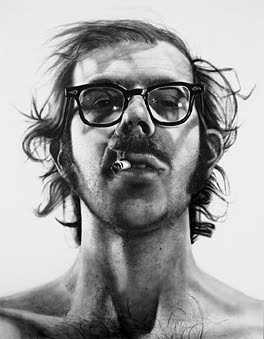
Many art history students are introduced to Chuck Close's art with this painting:

Big Self Portrait, 1967-1968

Close is really interesting because of his painting theories and technique. Instead of just transferring a photograph into paint on a canvas, Close thinks that painting is a systematic and intellectual exercise. His work is not just about transferring images - he is transferring "photographic information into painted information").1 I think it's especially interesting that this systematic approach can be further seen in Close's choice of large-scale canvases - they are basically same size (9' x 7').2 Although he is best described as a photorealist, this interest in systematic and intellectual art makes Close a little different from his colleagues.

Anyhow, a conversation last night reminded me that Close's later work is stylistically different from his early portraits. In 1988, a collapsed spinal artery left Close nearly paralyzed. Luckily, he has been able to continue painting from his wheelchair with a brush strapped to his partially mobile hand. Although Close was veering towards a more lively style before 1988, his current condition ensures that he cannot paint in the meticulous manner required for his early style. Personally, though, I really like Close's later work. It's dynamic and interesting. I also think that it's fun to zoom in on Close's later paintings until the portraits are unrecognizable; they become a myriad of colorful, stylized swirls and whorls.

You can see how much Close's style has changed by looking at this self portrait:

Self Portrait, 1997

I think it's really awesome that Close has been able to continue his career and artistic vision (he even continues to paint on large-scale canvases!). You can watch a video of him working below (and read more of the CBS story here).


Watch CBS Videos Online

Pretty impressive stuff, huh? Which Chuck Close style do you like more? His early style or later style? Or neither?

1 Fred S. Kleiner and Christin J. Mamiya, Gardner's Art Through the Ages, 12th ed., vol. 2 (Belmont, CA: Wadsworth, 2005), 1056 (italics added for emphasis).

2 Ibid.

Thursday, July 9, 2009

Women Who Read = Dangerous

My mother-in-law owns a really great book called Women Who Read Are Dangerous. The book is a compilation of artwork (mostly paintings) that depict women reading (or holding books). I think that the idea of this book is really fun, and it made me (jokingly) think about the plausibility of creating a Washer Women Are Dangerous book!

I particularly am struck by how many of these paintings fit into the idea of rejecting the male gaze. There are so many paintings that depict women actively involved in the act of reading. Instead of inviting a (male) viewer of the painting to look at them, these women are completely absorbed in their books. They deflect the gaze of the viewer and move the focus of the painting to the book or letter. Curiously, a lot of the reading women appear in profile view, which is similar to Barbara Kruger's Your Gaze Hits the Side of My Face (I've written more about Kruger's work and the male gaze here). Fun stuff. It's also fun to think about the male gaze and think about another photograph in this book: Eve Arnold's 1952 photograph Marilyn Monroe Reading Ulysses (yes, Marylin actually was reading that classical piece of literature!). In some ways, I think one could argue that the pin-up actress was rejecting the male gaze in this photograph.

Anyhow, here are a couple of fun pieces that also appear in the book:

Carl Larsson, Karin Reading, 1904
(Not only is she rejecting/deflecting the male gaze by being in profile, but her hand is covering part of her face!)

Pieter Janssens Elinga, Woman Reading, 1668-70

Tomb of Eleanor of Aquitaine, c. 1204

Johannes Vermeer, Woman Reading a Letter, c. 1663-64

Edward Hopper, Hotel Room, 1931

Rembrandt van Rijn, The Prophetess Anna (Rembrandt's Mother), 1631

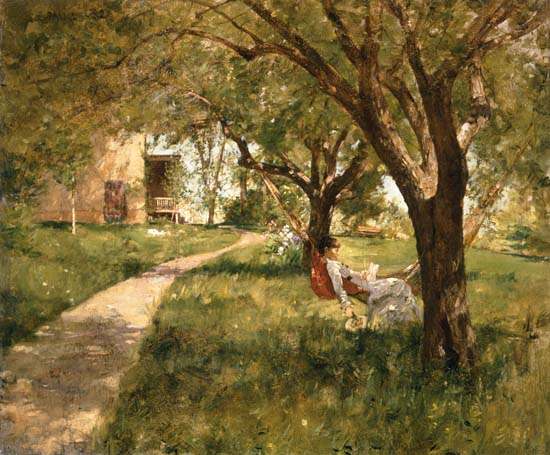
Walter Launt Palmer, Afternoon in the Hammock, 1882
(FYI - The greens in this painting are a lot more vibrant than in this reproduction)

There are a lot of other great paintings in this book that don't have reproductions online, since they belong to private collections. You should get this book and check these paintings out, whether you are or aren't a "dangerous woman" that likes to read!

What do you think about the idea of the male gaze in connection with these paintings? Do you have other favorite works of art that depict women reading?

Monday, July 6, 2009

Taweret, Egyptian Childbirth, and LOST

It's no secret that I love the TV show LOST. During the past couple seasons, ruins of a four-toed statue have been shown on the LOST island, but a full depiction of the mysterious statue was not shown until last season - and it can be deduced that the original statue on the island is a depiction of Taweret, the Egyptian goddess.

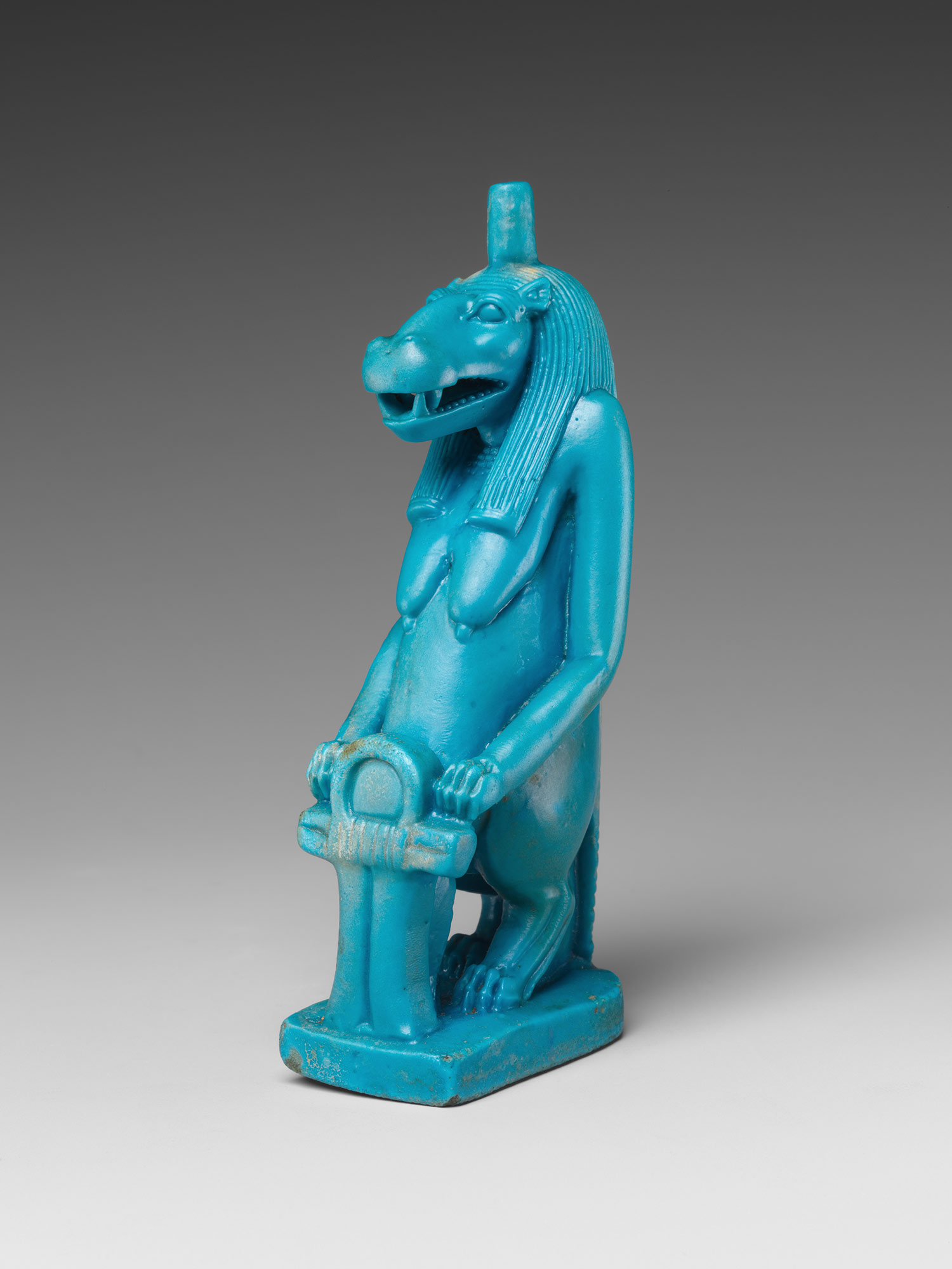
I know that I just barely did a post on ancient female fertility figurines, but I'm going to continue in this vein and talk about Taweret statues too. Taweret is the goddess who protects women who are pregnant or in childbirth. (If you watch LOST, you can see how the destruction of this statue ties into the problems women experience with pregnancy on the island.) The figurine on the left (assumed to be Taweret) is from the Ptolemaic Period (ca. 332-30 BC).1 The combination of human, crocodile, lion and hippopotamus features create a fearsome combination - Taweret was supposed to scare off demons and other deadly creatures that posed a threat to the mother and baby during childbirth.

Egyptian women also wore Taweret amulets to protect them during childbirth. I particularly like this one.

And sorry if you don't like depictions of childbirth, but I had to include this interesting relief from the Temple of Hathor at Dendera (ca. 304-30 BC; Egyptian Museum, Cairo). This relief shows a squatting woman in childbirth (using a birth stool), while being assisted by two goddesses (possibly Hathor and Taweret, although I don't think either figure distinctly looks like Taweret). It's an interesting relief, though, huh? It's thought that this birth position was an alternative, possibly less-frequent method that the ancient Egyptian woman used for childbirth.2

Anyhow, back to Taweret. So far, I have not found any information regarding the depiction of Taweret's breasts in art. Since Taweret also is linked to fertility, are the breasts a connection to that? I haven't read anything that specifically makes this connection, but perhaps that just can be assumed? Or perhaps the breasts were depicted to emphasize that this was a female goddess? What do people think?

From what I can tell, it seems like most depictions of Taweret are small figurines or amulets. I kind of doubt that there were any monumental statues created of this goddess (like the one shown in LOST). However, if you know of any monumental Taweret statues, let me know. I'd be interested to see them and find out why they were created on a monumental scale.

1 This statuette is part of the Metropolitan Museum of Art's collection. You can read more information about it here.

2 Eugen Strouhal, Evžen Strouhal, and Werner Forman, Life of the Ancient Egyptians (Vigo, Spain: Editorial Galaxia, 1992), 16-17. Since I have some friends who are fascinated by childbirth (cough, Pamy, cough), here is the link to these pages in a Google Book preview, in case you want to read more.

Thursday, July 2, 2009

Venus of Willendorf's Sister

Apparently I am behind-the-times in regards to recent prehistoric discoveries. I heard that the world's oldest instrument was recently discovered in Hohle Fels, Germany - it's a flute (carved from the bone of a griffon vulture) that is at least 35,000 years old. (You can read more about this flute here and can listen to a replica of the flute played here). I didn't know, though, that this flute was discovered in sediment next to a female statuette (the discovery of which was announced last May).

This nude, buxom female figurine, the Venus of Hohle Fels, is at least 35,000 years old (shown above). It is one of the oldest known examples of figurative art. The exaggerated emphasis on the female genitalia and breasts are a common feature in prehistoric art, as can be observed in statuettes like the Venus of Willendorf (ca. 28,000-25,000 BC, shown below). It is thought that statuettes like these were used for some type of fertility ritual.

However, there is one major difference between these two statuettes. The Venus of Willendorf has a head full of tight, stylized curls, whereas the Venus of Hohle Fels is headless. Intentionally headless. Instead of a head, there is a carved ring at the top of the figurine, supposedly so that the statuette could be dangled from some type of string. I think it's especially interesting that the head is missing - this reinforces the fact that these statuettes were not intended to represent specific individuals (which is also the reasoning for why the Venus of Willendorf does not have any facial characteristics).

If you're interested, you can read more about the Venus of Hohle Fels here.

What do you think of these new discoveries?

Wednesday, July 1, 2009

Hans Christian Andersen as Artist

It's fun to find out that a famous musician/writer/playwright/poet/actor also liked to create visual art. It makes sense that creative minds like to have more than one artistic outlet. My friend Miss B just pointed out that the writer Hans Christian Andersen was also an artist - he made paper cuts (one example, Bouquet (n.d.) is shown on the left). They're quite fun. You can see more examples of Andersen's paper cuts on Miss B's post, and you can also see the Royal Library's extensive collection here.

I knew that Andersen had a lot of diverse interests, but I didn't know that he dabbled with the visual arts. Apparently, Andersen was a very popular paper cutter. He would make these cuts to amuse friends and their children. Andersen would work on a paper cut when storytelling,and then end the tale by opening up the paper cut and showing the final product to his audience.1

I really like the Odense City Museums' interpretation of Andersen's fascination with paper: "To Hans Christian Andersen paper was not meant to be media for the written word only. Paper - it seems - represented the basis for his imaginative expressing. Through out his life Hans Christian Andersen was an addict to paper. He wrote on it, he drew on it - and he used it to cut in."2

Now I'm interested in learning more what Andersen's writing and editing style was like. Would he constantly edit and deconstruct the papers that he filled with words, just like he frequently cut away bits of paper to make visual art?

1 Odense City Museums, "Papercuts by Hans Christian Andersen"; available from http://museum.odense.dk/andersen/klip/billedstart.asp?sprog=engelsk; Internet, accessed 1 July 2009.

2 Ibid.