Monday, June 29, 2009

St. Paul: His Remains and a Catacomb Painting

I just read this post which informed me that a new catacomb painting of St. Paul has been found in Rome. This is the oldest extant fresco of St. Paul, which dates to the 4th century AD. Plus, this discovery is also exciting because of all of the images of St. Paul from the Early Christian period, this one is in the best condition.

This fresco was discovered in the Catacomb of St. Thekla. The catacomb is near the place where Paul was reportedly buried (the Basilica of St Paul's Outside-the-Walls in Rome). This fresco was instantly recognized as St. Paul since the thin face and dark beard were typical iconographic features for the saint in the 4th century.

You can read more about the fresco's discovery in yesterday's Telegraph article. Along these same lines, today's Telegraph article discusses test results which confirm that the remains located in St. Paul's Outside-the-Walls belong to St. Paul. (Well, probably. The remains have been confirmed to date from the first or second century.) It appears that the finding of this fresco prompted officials to test the remains inside the sarcophagus.

Pretty cool stuff. I think it's especially interesting that this fresco was restored using a laser. Technology is helping archaeologists and restorers do some amazing stuff. If lasers were never invented, do you think this fresco would have been lost forever?

N. S. do Rosário dos Pretos and Peterskirche

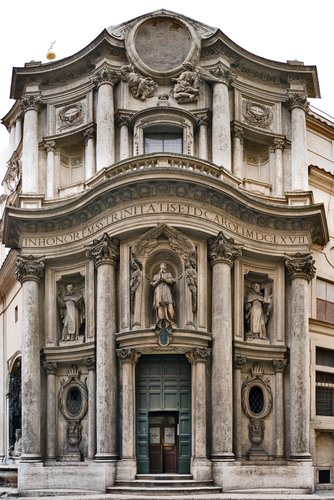
When I went to do research in Brazil a few years ago, this was my favorite church that I visited. Nossa Senhora do Rosário dos Pretos (shown right, dates from the latter 18th century) was built in colonial Brazil as a place for the African slaves to worship. One of the reasons I like this church so much is that it is based on an oval floorplan. It seems to me that somehow this church was indirectly influenced by the oval floorplan that was popularized by Borromini in Italy (click here to see the floorplan of Borromini's church San Carlo alle Quattro Fontane. This is one of my absolute favorite buildings. I love the undulating facade, the oval floorplan, and the oval dome. It's so awesome and unique.)

John Bury has also written a little about how this Brazilian church is "Borrominesque," but he can't seem to pinpoint any concrete influence.1 So far, I haven't been able to find a concrete influence for N. S. do Rosário dos Pretos either. One interesting thing I have found, though, is that this church might have been indirectly influenced by the Peterskirke in Vienna.2 Some Portuguese rulers and leaders (i.e. Pedro II, João V, and the Marquis do Pombal) were married to Austrian ladies. Perhaps the Austrian design trickled through Portugal and then down to Brazil.

The Peterskirche in Vienna (shown left, 1733) is a beautiful church that is also based on an oval floorplan. It seems to me that this church is also Borrominesque in design, although I read here that the design was actually based off of St. Peter's Basilica in Rome. I'm a little skeptical of that information (not only because it's from Wikipedia, but because it just doesn't make sense - the floorplan of St. Peter's Basilica isn't even oval (and none of the earlier floorplans were oval either)).3 Borromini's style was copied and emulated internationally, and it seems more likely that he affected the floorplan and design of Peterskirche. (Don't you think that the lil' curves in the facade could have been influenced by Borromini?)

Anyhow, I hope that I can do more research and find out the connections between Borromini, the Peterskirche, and N.S. do Rosário dos Pretos. If anyone has leads, suggestion, or information, I'd be happy to hear them.

1 John Bury, "The 'Borrominesque' Churches in Colonial Brazil," (The Art Bulletin 31, no. 1):43- 44.

2 Murillo Marx, "Brazilian Architecture in the XVIII and Early XIX Centuries," in History of South American Colonial Art and Architecture by Murillo Marx and Damián Bayón, eds., (New York: Rizzoli, 1989), 361. Marx also cites Pal Kelemen, Baroque and Rococo in Latin America (New York: Macmillan, 1951).

3 I do recognize, though, that the Wikipedia article could be referring to some aspect design other than the floorplan. In general, though, I have not observed any other striking similarities between the designs of Peterskirche and St. Peter's Basilica. If anyone knows specific architectural connections between the two buildings, I would be interested to know them.

Friday, June 26, 2009

Guessing Game with Art and Film Stills

It's Friday and I think we should play another fun guessing game. I got the idea for this post after coming across a blog which points out an "art history shout-out" in a TV show. There are a lot of references to art in pop culture (I'm specifically thinking of television and movies, but it extends beyond that). Can you name the famous works of art that are referenced in these film stills? (The answers are in the comments section of this post.)

LOST, "Fire + Water," Season 2

Home Alone (1990)

Alfred Hitchcock's, "Psycho" (1960).
This one is a little tricky. Don't pay attention to the scene, but the architecture of the house.

Tideland (2005)

And I couldn't find a film still for my last one, so I'll just give you the answer. A scene from Forrest Gump (1994) is directly inspired by Norman Rockwell. Here's the painting:

Girl with Black Eye (1953)

To see the film scene inspired by the painting, scroll to 0:33 on this clip:


Can you think of any other movies or films inspired by art? (Note: I purposefully did not mention the Thomas Kinkade painting which inspired a movie last year.) Also, if you're interested, I found a webpage called Art History in the Movies, which lists films about art and some films inspired by art.

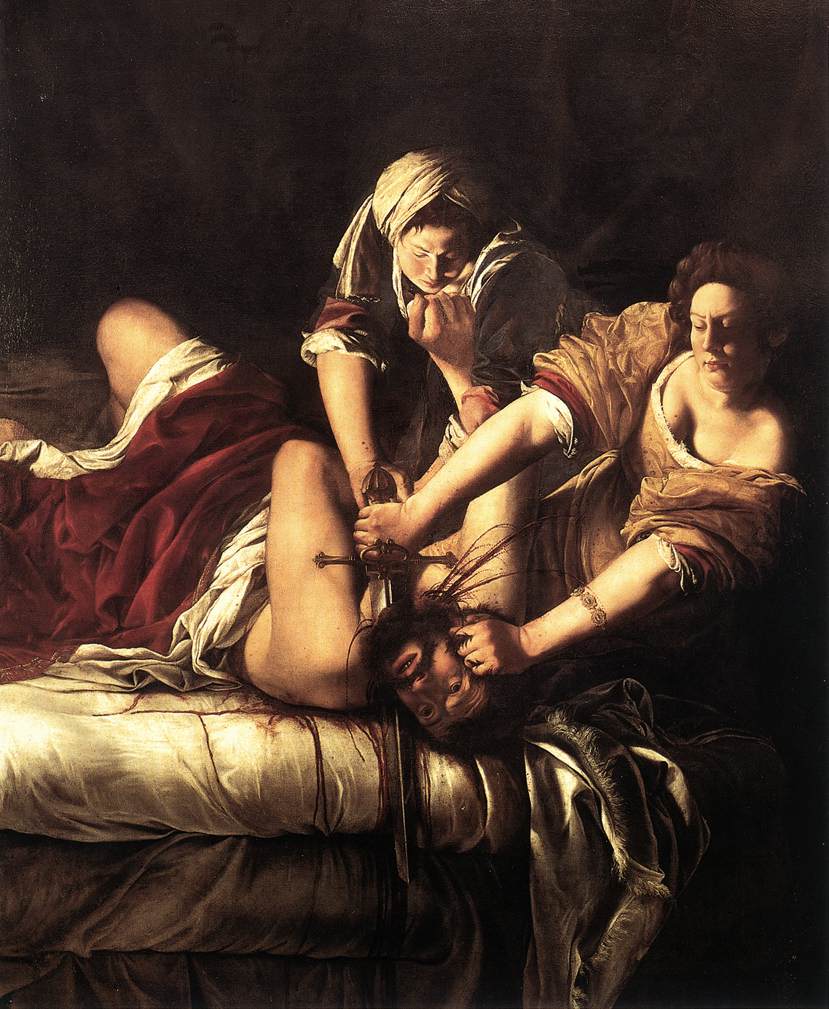
And can you think of any paintings that should be turned into movie scenes? Tyler Green suggested five. I think that Renoir's Le Moulin de la Galette (1876) would make a good scene in a film. And if it was a murder mystery, then perhaps one of Gentileschi's versions of Judith Slaying Holofernes (the one linked is from the Uffizi Gallery and dated 1614-20)?

Tuesday, June 23, 2009

William Blake's "The Pilgrim's Progress" Series

I am in the middle of reading John Bunyan's The Pilgrim's Progress. I know the plot of this book quite well, having read the children's version Dangerous Journey and watched its accompanying film a bigillion times. But, being a historian and purist, I wanted to read the original book (first published in 1687).

Although I know the story well, I didn't know that William Blake created illustrations of this famous allegory. It doesn't surprise me that Blake would be interested in The Pilgrim's Progress; as a nonconformist artist that was interested in mythical and prophetic subject matter, this story is right up his alley.

Blake began this The Pilgrim's Progress series in 1824, but it was never finished (I assume because Blake died in 1827). The completed illustrations weren't put into a book until 1941 by the Limited Editions Club, over 100 years after Blake died.

I haven't been able to find a lot of information or discussion about this series in art history databases. I also haven't been able to find a lot of images of the series. Perhaps this series has been ignored because it is incomplete?

I'm curious to see what the other illustrations look like. I might have to buy this 1942 edition (Heritage Press) off of eBay, which includes twelve of the watercolor illustrations by Blake. But I'm a little skeptical as to why this book is only for sale for $29. Doesn't that seem a little low for an old book with watercolors by William Blake?

Saturday, June 20, 2009

The Answer is: Giulio Romano

I had another art history dream the other night. I dreamed that I went to go visit my the AP art history teacher from my old high school. She was a really fantastic teacher and really influenced my decision to study art history. In my dream, I wanted to prove to Mrs. W that I had learned a lot from my art history training and schooling, so I went to go visit her class. However, I arrived on a day that an exam was scheduled. Mrs. W had set up the test so that we would travel to her house and then give a stylistic analysis of the house's architectural features. When we arrived, I realized that Mrs. W expected me to take the exam too. The facade of her dilapidated house was a mumbo-jumbo amalgamation of a bigillion different architectural features.

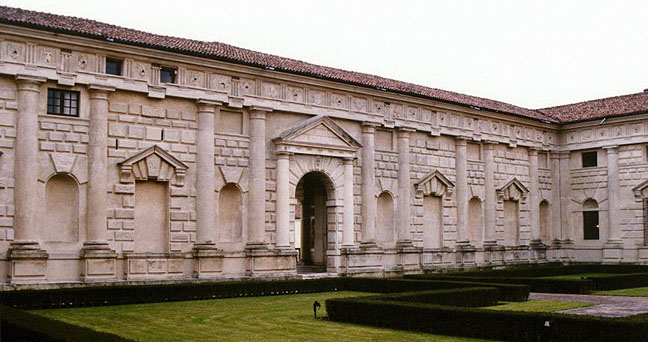
I started the exam feeling pretty confident, because I saw a whole bunch of connections and references to famous pieces of architecture. And then I noticed some architectural feature which related to the Palazzo del Té (Mantua, Italy; 1525-1535, shown here). I wrote that down, but then panicked and realized that I couldn't remember the architect's name.

What is it?
What is it?

Aaaah! I died of embarrassment, knowing that Mrs. W would find out that I couldn't remember something that she expected her AP students to know. Luckily, I woke up before we finished taking the exam. Phew!

When I woke up, I still couldn't remember the name and had to look it up. But I'm sure that I won't forget it now. The answer is Giulio Romano.

The Palazzo del Té dates from the Mannerist period in art. In this period, it was the style for figures in painting and sculpture to be elongated, twisted in physically impossible poses, depicted with unnatural colors, etc. The key idea surrounding Mannerism is that art is artifice - and for that reason, it's okay to make things look like they are not "natural." This nonsensical (and sometimes strange) style spread into architecture too, as shown in the design of the Palazzo del Té.

My favorite things about the Palazzo del Té are the ridiculously large keystones. They look really unsettled and seem like they are going to slip out from their position. Furthermore, many keystones are placed over rectangular niches (which is ridiculous, since keystones are used to help hold an arch in place, not a rectangle). I also like the impressively large Tuscan columns, that end up supporting an itty-bitty architrave. (And the architrave itself is broken into different sections, as if the triglyphs above are going to push chunks of architrave off of the structure.) He hee! It's a little silly. And I like it.

So, thanks for making this fun piece of architecture, Giulio Romano. I promise not to forget your name again.

Thursday, June 18, 2009

Correggio as Proto-Baroque

I think that the painter Antonio Allegri (better known as Correggio) deserves more study and placement in art history texts. Even though his painting Jupiter and Io graced the cover of my first art history textbook, he didn't get a whole lot of discussion in that edition of Art Through the Ages. (BTW, I noticed Jupiter's face and hand in that painting after owning that textbook for a few years - can you spot them in the cloud?) The subsequent editions of Art Through the Ages seem to mention less and less of Correggio.

Correggio was a Late Renaissance painter from Parma, Italy. His illusionistic ceilings like Assumption of the Virgin (1526-1530, Parma Cathedral dome; shown right) were a source of inspiration for many Baroque painters who followed in the 17th century. These 17th century artists revered Correggio and considered him and Raphael to be the great Old Masters. Subsequently, Correggio's works were widely collected; people went to great lengths (ahem, scandalous lengths) to get a hold of his art.1 Although Correggio's influence on Baroque painters has been mentioned before, I am particularly interested in how Correggio influenced my favorite Baroque sculptor, Bernini.

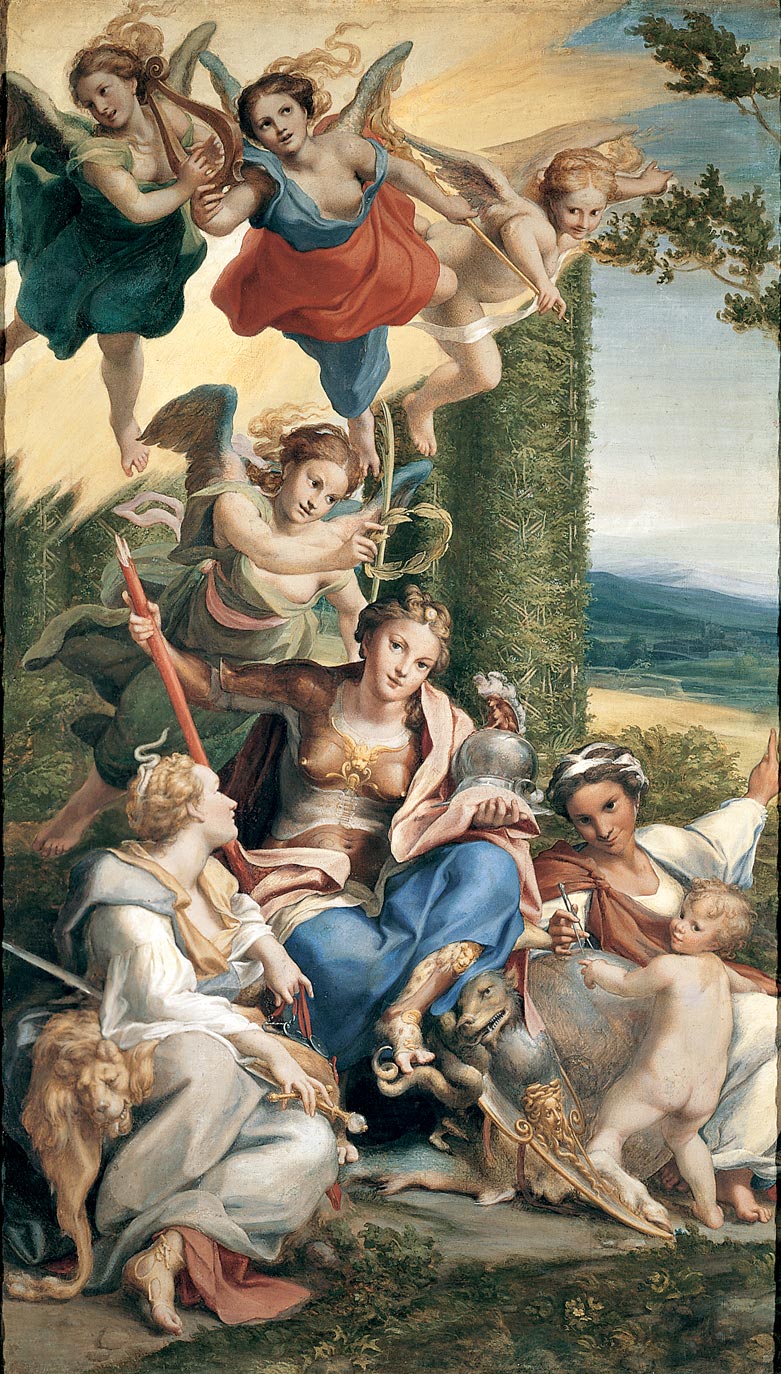
So far, I have read two comparisons between Bernini's work and that of Corregio.2 Bernini's sculpture Truth Unveiled by Time was influenced by the figure of Minerva in Correggio's Allegory of Virtue:

Bernini, Truth Unveiled by Time (1645-52), Borghese Gallery
(Don't be confused because Time isn't depicted, the allegorical figure was never executed.)


Correggio, Allegory of Virtue (1528-1530), Louvre

In addition, Bernini's St. Longinus has been compared to the Correggio's apostles at Parma Cathedral:

Bernini, St. Longinus (1629-38); St. Peter's Cathedral, Rome


Correggio, detail of apostles (1526-30), Parma Cathedral dome
(You can see how St. Longinus' outstreched arms mimic that of the apostle in the red robe.)

I've always loved Bernini and been intrigued by Correggio. It's fun to find a connection between these two artists, and it makes me like Correggio all the more.

Do you like Correggio? Do you know of any other connections between Correggio and Baroque artists?

1 David Ekserdjian writes, "The Este family of Modena were exceptionally insatiable and unscrupulous: they secretly replaced [Correggio's] ‘Notte’ by a copy, the discovery of which caused a riot in Reggio Emilia." See David Ekserdjian. "Correggio." In Grove Art Online. Oxford Art Online, http://www.oxfordartonline.com.erl.lib.byu.edu/subscriber/article/grove/art/T019595, accessed 19 June 2009.
2 Ibid.

Tuesday, June 16, 2009

Case Studies vs. Survey

I recently was offered a position to teach art history next year at a local university. I will be teaching an introductory art history course that covers Renaissance to contemporary art. I'm excited to teach this class - it will be a new challenge for me, since this art history program focuses on teaching case studies for each period, instead of the traditional method of a survey course (where students learn about/memorize artists, works of art, dates, etc.). Instead of using the texts Gardner's Art Through the Ages or Stokstad's Art History, I will be teaching out of the Art and Its Histories series. These books are structured with one specific case study for each major period in art. The case studies focus on a specific artist, a group of similar works of art, or a common theme in art.

The textbook which introduces the Renaissance - Rococo art is The Changing Status of the Artist (edited by Emma Barker, Nick Webb and Kim Woods). So far, I like the things that are introduced in this book. It seems to help students think critically about art and art history (the introduction wastes no time in explaining how the "artist as genius" idea is a construct), and it also introduces ideas by major art historians. This stress on critical thinking and art historical arguments is something that I think is important - and I also think that it is missing from the major survey texts that tend to be a little to authoritative (and not leave room for questions or debate). So, I think the class will be fun to teach. These smaller case studies and ideas also generate a lot of room for discussion in class, which should be fun.

I also worry though, about how to find a good balance between teaching survey material and these case studies. I feel like there is a lot of value to the survey course - while it is necessary to learn how to think critically, it is also important to learn about stylistic characteristics, major artists, influential works of art, etc. I also feel like some of the works of art that are selected in these books might not be the most indicative of the stylistic traits from certain periods - but does that matter? I'm trying to decide that.

The faculty is very awesome and have given me complete leniency with my lesson plans. I'm going to use these books for sure, but I also hope to find a good balance by introducing other important information and concepts that aren't mentioned in the case studies.

If you have taken an introductory art history class, what was yours like? Did you take a survey? Or did you focus on case studies? What textbooks did you use? What things did or didn't you like about the class structure?

Wednesday, June 10, 2009

Team Athens or Team London?

When I went on an art history study abroad several years ago, we began our trip in Athens and traveled north, finally finishing our studies in London. It was weird to have our term begin with a trip to the Parthenon, and then have the term end with a trip to see the Parthenon statues...in the British Museum in London. Although it was fun to get close and examine details that would be difficult to see if the statues were in situ, I still couldn't help but think how wonderful it would be to see these statues in Greece, where they originated. Recently, I have been thinking about how the Elgin Marbles are a good example of how European culture claims (and repossesses) the ancient Greek culture as European heritage. (Although, arguably, ancient Greek culture has become European heritage because of the Enlightenment.)

The Parthenon statues in London, better known as the Elgin Marbles, were taken from the acropolis in the early 19th century by Lord Elgin (a British ambassador). This week's edition of Newsweek has a great article which summarizes the displacement of the Parthenon sculptures, and also discusses the ongoing debate between the Brits and Greeks as to where the marbles belong. Understandably, the Greeks want their statues back. Part of the British argument is that there isn't a proper facility in Greece to maintain the statues. Well, that argument will soon have less weight - the new Acropolis Museum will open to the public this month. (This museum looks really awesome too - there is a glass floor in the building to show an ancient site that was discovered during the excavation and construction of the site (see photo on left)).

I do think it has been great that the statues have been in London, since they probably would have been damaged or destroyed if they had stayed in Athens. (Although, ahem, the British "cleaning" of the statues in the 1930s was not exactly helpful.) However, with this new Acropolis Museum, I feel like it is the right time to let the Greeks enjoy and care for something that is inherently theirs. Although I realize there are a lot of problems that could happen with the transition of the statues (see the Newsweek article), I think that they should end up Greece. Really though, I'm a sucker for historical accuracy and original intent.

And if the Brits cannot compromise on that issue, I think that the statues should at least be sent to Greece on a long-term loan.

Where do you think the statues should be located? Are you Team Athens or Team London?

You can read more about the debate for/against the return of the Parthenon statues here - although the entry for returning the statues to Athens seems a little biased at present.

Monday, June 8, 2009

Tree of Jesse Imagery

I was first introduced to the Tree of Jesse imagery by this window in Chartres Cathedral (c.1145-1155, shown left). This imagery was popular because it contained both Old Testament and New Testament themes, since Christ was part of Jesse's lineage. At the bottom of the window, Jesse is reclining on a bed, with a tree stem growing out of his loins. (I have to admit, the tree stem growing out of Jesse is my favorite part of this imagery. I like how artists have depicted the scripture Isaiah 11:1 literally, even though sometimes I think the trunk is, uh, a little too suggestive of Jesse's virility.)

The trunk and branches of the tree rise along a central axis of the window. Within the branches are four royal kings, each king filling a square central panel. These kings are not identified by specific attributes, but traditionally David appears as the first king "stemming" from Jesse, followed by Solomon. In this window, it is not certain who the other two kings specifically represent, but they obviously reference the rest of the royal line between Solomon and the Virgin Mary, who is depicted following the four kings. At the top of the tree is Christ, who is depicted after the Virgin.*

The Tree of Jesse has appeared in religious art for centuries, and it is found in all types of mediums. This window from Chartres Cathedral is very similar to the Tree of Jesse window in Saint-Denis (c. 1145), which isn't surprising, since the windows were made about the same time. I especially like this window, because one of the frames contains a depiction of Abbot Suger presenting the Tree of Jesse window (19th century restoration, detail shown right). It's a Tree of Jesse within a Tree of Jesse!

Are you familiar with other Tree of Jesse depictions? Do you have a favorite?

*Some of this paragraph was taken from information that I wrote for an academic database. I don't know if that database will ever get published online, but if it does, just know that I actually did write the content for this post.

Wednesday, June 3, 2009

Oz and Duchamp

One of my favorite early twentieth century paintings is Marcel Duchamp's Nude Descending a Staircase, No. 2 (1912, shown right). I used to joke that this painting must look even more interesting through 3-D glasses. In all honesty, though, I think that this painting is a fascinating depiction of animation, movement, and form.

When looking at Nude Descending a Staircase, it's easy to tell that Duchamp was particularly interested in the way form moves over time (he was inspired by Eadweard Muybridge's photographic sequences), as well as the Cubist aesthetic. This painting also has been linked to Futurism, although Duchamp argued at the time that he had not seen any Futurist paintings first-hand.1

Duchamp became well-known in the United States after this painting was exhibited in the Armory Show in early 1913. Nude Descending a Staircase got a scandalous reception, and one critic described this work as "an explosion in a shingle factory."2 Nonetheless, Duchamp's status as a celebrity was solidified.

Subsequently, Nude Descending a Staircase was copied and parodied throughout the United States, including the memorable cartoon Rude Descending a Staircase (Rush Hour at the Subway). Duchamp's painting even inspired the children's author L. Frank Baum. His character Woozy in The Patchwork Girl of Oz (1913) was inspired by Cubism and Nude Descending a Staircase. Woozy is a character made out of rectangles and squares (he is hugging a tree in the illustration on the left). Although Baum described Woozy as blue, the illustrator of the book (John R. Neill) colored Woozy brown like Duchamp's nude.3 I was excited to learn this connection between Woozy and Duchamp. I grew up reading all of the Oz books, and it's fun to find that fine art influenced Woozy's character. I never would have made that connection when I was a kid!

1Francis M. Naumann. "Duchamp, Marcel." In Grove Art Online. Oxford Art Online, http://www.oxfordartonline.com.erl.lib.byu.edu/subscriber/article/grove/art/T023894 (accessed June 3, 2009).

2 Charles C. Eldredge, "The Arrival of European Modernism,"
Art in America 61 (July-August 1973): 35.

3 Katharine M. Rogers, "L. Frank Baum: Creator of Oz," (New York: St. Martin's Press, 2002), 194.

Monday, June 1, 2009

Candida Höfer's Brazil

I first became familiar with the photographer Candida Höfer through her solo exhibition "Architecture of Absence." Höfer is particularly interested in photographing public interiors at times when they are devoid of people. I think it's interesting to see a public place when it is public-less. I really like how the space is magnified within the photographs. In a kind of oxymoronish way, Höfer's work makes absence become a presence.

Anyhow, while I was looking for some images on a Brazilian Baroque church, I stumbled across a few photographs from Höfer's Brazilian series. The image above, Teatro Nacional de São Carlos Lisboa I (2005), is another Brazilian photograph by Höfer. Since I found out that Höfer is interested in Brazilian architecture and public spaces, she's a million times cooler to me. (And she was cool already.) Nice.