Thursday, April 30, 2009

Catedral Basílica de Salvador

Next time I am in Brazil, I want to go to Salvador and visit the city's Cathedral Basilica. This cathedral was built between 1657 and 1672; originally, it was part of the Jesuit College in Salvador. All I can say is, those Jesuits sure know how to construct an awesome building.

My two favorite things on the facade are the ginormous volute scrolls between the two bell towers. So awesome! I also love all of the broken (Baroque-en!) pediments that decorate the tops of the windows. The three statues that cover the portals are the saints Ignacio, Francisco de Borja and Francisco Xavier.

The nave ceiling with the Jesuit emblem. I love the gilded, elaborate carvings.

Nave facing the shallow capela-mor and side altars. It is possible that the statue of Christ (above the main altar) is the largest wooden statue in Brazil.

Detail of the ceiling in the capela-mor

You can see a virtual tour of the Salvador cathedral here.

I'm still doing research on this cathedral, particularly to verify a few things. I read online that the interior carvings were performed by slaves, and some of the altarpieces are decorated with Candomblé symbols.1 As of yet, I haven't found any printed or scholarly material that supports this idea. But it's interesting and entirely possible; I'll add something in the comment section of this post if I ever find more information. Maybe I'll just have to fly down to Brazil and examine the altars myself...

P.S. If you want to research Brazilian architecture, I wouldn't recommend History of South American Colonial Art and Architecture (Damián Bayón and Murillo Marx, 1989). It is the most confusing, boring, and poorly edited textbook that I've come across. Then again, there aren't too many books available on this subject. Sigh. I'm just going to have to write a new survey textbook one day...

1 Candomblé is a religion-philosophy that is concentrated in Salvador. It has roots in African mysticism but also has been influenced by Catholicism (largely because African slaves were adopted/forced into the Catholic church by their owners). There are many similarities between the African deities and Catholic saints.

Wednesday, April 29, 2009

Craquelure

Although I'm not a conservator or connoisseur, I knew from my art history background that craquelure is the pattern of fine cracks that occur in old paintings. What I didn't know, however, is that there are different types of crack patterns. Craquelure can be further classified into French craquelure, Dutch craquelure, Flemish craquelure, and Italian craquelure. Check out this interesting study.

Monday, April 27, 2009

Lilith

I recently read George MacDonald's novel Lilith, which caused me to think about the Jewish legend of Lilith, Adam's first wife. Legend holds that Lilith was God's first, unsuccessful attempt at creating a female companion for Adam. This dreadful attempt resulted in a female demon who attempts to corrupt the human race through lust.

One of the best sources for the Lilith story is a medieval text called Alphabet of Ben-Sira (c. 10th century AD). According to this text, Lilith was made from the earth at the same time as Adam. Lilith was an independent woman. Since she and Adam were created the same way, Lilith refused to acknowledge Adam's superiority (was she the first feminist? ha!). Eventually she left Eden to consort with demons that live in the Red Sea. When making a second female companion for Adam, God made Eve out of Adam's rib so there would be no question of superiority.1 Some sources also refer to Lilith as a half-woman, half-serpent. Filled with jealousy for Eve, Lilith reportedly took on the form of a serpent in order to provoke the Fall of Man (as recorded in Genesis).2 You can read a little more about the Lilith legend and history here.

The story of Lilith has inspired artists for many centuries. In the Middle Ages, many artists included a half-female serpent in depictions of the Temptation of Adam and Eve.3 One Renaissance example of the half-serpent Lilith is by Michelangelo, found on the Sistine Chapel ceiling. In the late 19th century, Dante Gabriel Rossetti wrote a poem about Lilith and also painted a scene of the seductress combing her golden hair (Lady Lilith, painted 1868-69, shown to the left). Scholars agree that this painting was inspired by the description of Lilith in Goethe's Faust (Walpurgisnacht scene).2

The most interesting article I've read about Lilith is by Virginia Tuttle. She argues that Hieronymous Bosch's Garden of Earthly Delights (1505-1510, left panel of altarpiece shown below) actually includes a depiction of Adam and Lilith, not Adam and Eve. I have always wondered why there are demonic beasts in the foreground of this Garden of Eden scene (it doesn't seem too paradisaical, does it? Although, one can't take Bosch too seriously; this whole altarpiece is a little absurd.). However, if one considers this woman to be Lilith instead of Eve, the presence of demonic beasts makes sense.

Tuttle also convincingly argues that this left panel scene does not conform to the iconography of traditional Creation of Eve scenes. Traditionally, Adam is shown asleep or lying on his side, so that Eve easily can be created out of his rib. In other triptychs, Bosch follows this traditional iconographic format (see details in his Last Judgment triptych and Haywain triptych). However, in the Garden of Earthly Delights, Tuttle argues that it appears Lilith has been "raised up from the earth, as if she were created independently and immediately following Adam's creation."2 I think this is a convincing argument and I recommend that people read Tuttle's article (it can be found in JSTOR). My only reservation about this argument is that it doesn't seem to be widely accepted. This article was written almost twenty years ago, but recent art history texts continue to label this panel as Creation of Eve. Does anyone know of (or have) criticisms for this argument?

What do other people think?

1 To read a synopsis Lilith story in the Alphabet of Ben-Sira, see Virginia Tuttle, "Lilith in Bosch's 'Garden of Earthly Delights," Simiolus 15, no. 2 (1985): 123.-24.

2 Jeffrey M. Hoffeld, "Adam's Two Wives," The Metropolitan Museum of Art Bulletin, New Series 26, no. 10 (June 1968): 434.

3 For Medieval examples, see Ibid., 430-40.
4 Virginia M. Allen, "'One Strangling Golden Hair': Dante Gabriel Rossetti's Lady Lilith," The Art Bulletin 66, no. 2 (June 1984): 286.

5 Tuttle, 123.

Thursday, April 23, 2009

Is It Really by Michelangelo?

There has been some controversy and debate regarding a small wooden crucifix that has been attributed to Michelangelo. This crucifix made its public debut at the end of last year, and was recently bought by the Italian state for $4.2 million.

Like some experts mentioned in this recent article, I'm skeptical that this is an actual work by Michelangelo. Vasari's biography doesn't mention anything about the artist making small wooden statues.

I'd be interested in learning more about the people who advised the Italian government to buy this piece. If this statue isn't by Michelangelo, the Italian state has spent an unnecessary amount of money for this small, but pretty, statue.

Wednesday, April 22, 2009

The Cyclical Nature of Art

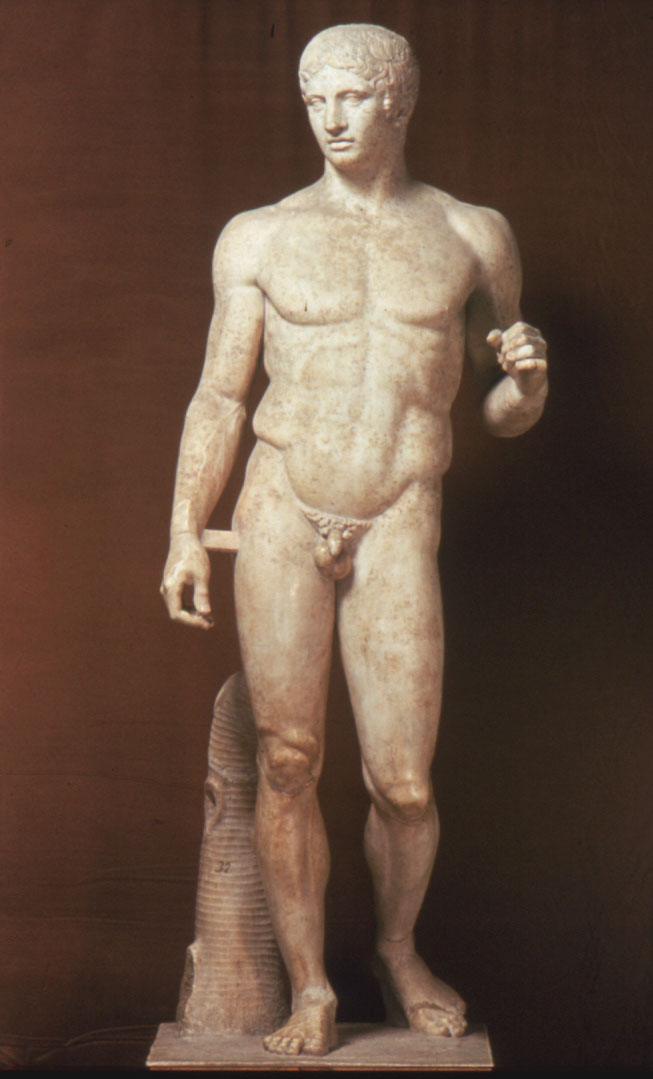
When I was in college, one of my professors explained her theory that art is cyclical in nature. Over the centuries, there are certain themes and styles in art that keep emerging and fading in popularity. I have often thought about this theory in regards to the Classical and Baroque styles. Although this theory can apply to different types of art, I am in the mood for looking at sculpture, so I'll only mostly use sculptural examples.

In early Greece, the serene, harmonious Classical style pervaded the artistic scene:

Polykleitos, "Spear-bearer" (Doryphoros), original dated c. 450-440 BC.

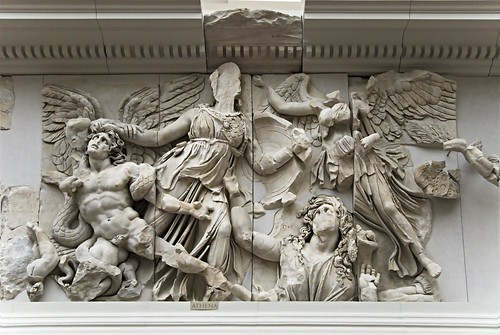
However, a short time later, the calm Classical style was disrupted by a taste for more dramatic, diagonal compositions in the Hellenistic period. In addition, relief sculptures were carved more deeply (some sculptures were practically in-the-round, almost jumping off of the relief wall) so that intense shadows could be cast:

Athena Battling Alkyoneos, Detail of the Gigantomachy Freize from the Altar of Zeus (Pergamon, Turkey, c. 175 BC).

The cycle between serenity and drama began again centuries later, when the Classical style became revived during the Renaissance:

Michelangelo, David, 1501-04

And only a century later, the Baroque period began as the artistic scene once again favored diagonal, dramatic compositions and subject matter:

Bernini, David, 1623

With the discovery of Pompeii in 1748, the interest in Classicism began the cycle all over again. This interest brought about the Neoclassical movement:

Antonio Canova, Pauline Borghese as Venus, 1808

The Romantic movement began about the same time and can be interpreted as a continuation of this cycle. In a way, the Romantics reacted against Neoclassicism by favoring drama and emotion over the serenity. This painting by Géricault focuses on dramatic subject matter by depicting a real-life event of shipwrecked passengers that were on the boat "Medusa." A shortage of lifeboats caused 150 passengers to build a raft, and survivors resorted to cannibalism in order to stay alive on the open sea. (You can read more of the story here.) Can you see how this subject matter is dramatic? To heighten the drama, Gericault depicted an emotional moment when the survivors spot their rescue ship in the distance. Géricault even follows the same dramatic diagonal compositions that were favored in earlier dramatic styles:

Géricault, Raft of the "Medusa", 1818-19

Since the Neoclassical/Romantic periods, the artistic continuum really hasn't seen another revival of the serene/dramatic styles. There have been some slight interest in traditional subject matter, such as the Regionalism movement (think of American Gothic). I guess Regionalism could be considered a continuation of serenity and tradition, if one is willing to categorize abstractionism (the style the Regionalists rejected) as dramatic. Hmm.

I'm curious to see if art will ever return back to this cycle. Since the 19th and 20th centuries, art has just exploded into different types of media and styles. Have we left traditional cycles altogether? It is interesting to think about what art will be like in a hundred years or so.

What do you think about the future of art? Have you observed any other types of artistic cycles besides this one?

Monday, April 20, 2009

Into to Neolithic Art

Unfortunately, it was necessary for me to not think about art for the past ten days or so. To get my art history groove going again, I thought I'd post a little bit about Neolithic art.

In the Near East, the Neolithic period began about 8000 BC, whereas in Europe it began around 4000 BC. There are a couple of different ways to define the Neolithic period. Initially, the Neolithic ("New Stone") Age was characterized by the development of two types of artifacts: stone polished tools and pottery. However, the Neolithic period is also different from the Mesolithic period in terms of food production; Neolithic peoples produced food (i.e. farming and stock raising) whereas Mesolithic people were food gatherers.

One of the great monuments from the Neolithic period is Stonehenge. Since I have already written a little about Stonehenge here, I want to focus this post on two of the earliest experiments in urban living, the cities Jericho and Çatal Hüyük (Turkey).

Jericho was a flourishing Neolithic city that covered about ten acres in 8000 BC. By about 7500 BC, this town housed about two thousand people and was surrounded by a thick five-foot-wall.1 A large circular stone tower (shown in this photograph to the left) was built into this wall that originally stood twenty-eight feet high. The tower is thirty-three feet in diameter and also houses an inner stairway. Considering the primitive types of stone tools that were used at this time, this tower is a significant achievement. Unfortunately, not enough of this site has been excavated to determine if this tower belonged to a series of towers.2 It will be interesting to learn if this tower is part of a series of towers that surrounded the city.

Çatal Hüyük is a Neolithic town that was located at the base of a volcano, next to a major trading route. The city inhabitants would trade obsidian, a volcanic rock that could be shaped into sharp tools. I think Çatal Hüyük is especially interesting because the city layout and plan do not contain any type of street! Instead, all of the houses adjoin each other. In order to get inside a house, one would climb through an opening on the roof. Interior and exterior ladders and stairs were used to get from one place to another. You can see a restored side view of Çatal Hüyük here.

For me, the most fascinating thing about Çatal Hüyük is a painting that is located in one of the shrines of the city. Radiocarbon dating places this painting around 6150 BC. This painting is probably the world's first landscape. The rectangular shapes in the foreground probably are houses (shown in aerial perspective), representing the city Çatal Hüyük. The background depicts an erupting volcano, which archaeologists have identified as the mountain Hasan Dağ.3 Because the painting is located in a shrine, it is thought that it contains some kind of religious significance (as opposed to relating a historical event connected to a volcanic eruption). If the painting is ever proven to be connected to a true historical event, the mural will not be considered a true landscape anymore.

There are a lot of other interesting things about the shrines at Çatal Hüyük. The rooms are decorated with bucrania (bovine skulls), which is considered to be a symbol of male fertility. I wonder if in the imagery of the erupting volcano also could be connected to male fertility.4

1 Fred S. Kleiner and Christin J. Mamiya, Gardner's Art Through the Ages: A Global History, 13 ed. (Cengage Learning EMEA, 2008), 25.

2 Ibid.

3 Ibid., 27.

4 I have found a couple of online sources which think that the volcano is related to female fertility and a "Volcano Goddess." In a relatively recent publication, Carl J. Becker briefly mentioned that the erupting volcano is connected to the female fertility; he described the eruption of volcanic ash as similar to human birth. (See Carl J. Becker, A Modern Theory of Language Evolution, iUniverse, 2004, 241; found online here). However, since in ancient times the imagery of rain was connected with semen and ejaculation, I wonder if volcanic lava could also be a similar reference for this prehistoric mural. I would be interested to know if anyone has any information or more speculation regarding male fertility and this mural.

Wednesday, April 8, 2009

W. J. T. Mitchell Lecture

Last night I went to Seattle University to hear W. J. T. Mitchell speak. I remember studying writings by Mitchell as a grad student, and I was intrigued by his lecture title, "The War of Images: 9/11 to the Present." The lecture was interesting and I was struck by Mitchell's persona; he was approachable and seemed to be constantly thinking and reviewing new ideas.

A large part of Mitchell's work revolves around the discussion of words and images - how words and images are different, what words are used to describe images, etc. I was not surprised in this lecture, therefore, to see that Mitchell was interested in the examining the word "terror" and the metaphoric war that is currently being waged on the emotion signified by that word. (How are you supposed to fight an emotion?)

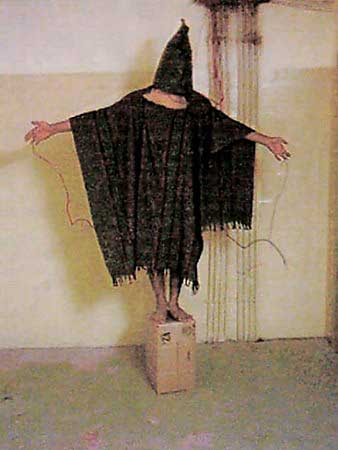
During the lecture Mitchell showed many pictures that have been distributed and displayed as a result from the "war on terror." I was living out-of-the-country when the Abu Grahib photos began to emerge, so I had to read a little more about them after the lecture. These images of prisoners being tortured and abused led to an internal investigation within the US Army. It is thought by many that this "Hooded Man" depiction will always be remembered as the iconic photograph for the war in Iraq:

Mitchell showed different places and instances where this Abu Ghraib photograph has emerged and reemerged as part of the discourse on the war. As a counter-message, reproductions of the "Hooded Man" appeared in a silkscreen format that parodies the current iPod ads:

Mitchell briefly suggested that in addition to decrying the war in these iRaq posters, another counter-message is created by referencing the iPod - the iPod is related to self-pleasure. Although we didn't end up discussing any narratives or ideas created by this contradicting image of self-pleasure and torture, I think it's an interesting idea. (Does anyone want to further this idea or suggest a narrative?) In addition to self-pleasure, I think that the iPods also embody self-absorption; one seems to shut out the world when iPod buds are in their ears. It's interesting to think about this poster in regards to the criticisms of self-absorption that have been heaped upon the Bush administration and America since the inception of this war.

I was surprised that Mitchell showed only a few pictures of Saddam Hussein, not for political reasons but for historical comprehensiveness (my bias as a historian is apparent!). The first photograph, shown right at the beginning of the lecture, was an equestrian statue of Hussein. As a historian, I think of the equestrian statue tradition as connected with antiquity. I wondered if by selecting this photograph Mitchell was historicizing Hussein's role in the war, perhaps suggesting that Hussein's role in the war is dated and passé, like this statuary tradition. I also thought this equestrian statue seemed very irrelevant and out-of-place with the other images shown in the presentation; the other images were more contemporary and often used Photoshop technology. It was interesting to think about what kind of statements about the war and Hussein's role could be derived from a "dated" and perhaps "irrelevant" image. Interestingly, though, the last image in the presentation was also of Saddam Hussein, this time a photograph of the leader soon after his capture. By depicting Saddam's medical examination by an Army doctor, I think this photograph was supposed to show the concern of the Americans for their prisoner. However, Mitchell pointed out that this photograph actually a degrading and humiliating depiction of Saddam:

It didn't take long for people to criticize the American government through this photograph. In Mitchell's presentation, a caption included with this photo (no doubt found by Mitchell on the internet, but I can't find where), said "The search for weapons of mass destruction continues..."

I felt like this was a fitting photograph for the end of the lecture. Since I felt the inclusion of the equestrian statue dated and historicized Saddam, I liked that Mitchell included an active, more contemporary photograph of Saddam at the end of the presentation. Although Saddam was not responsible for the 9/11 attacks, I felt that his historical role with the (ongoing) Iraq invasion was better represented with this final photograph. To me, it was appropriate to view this photograph and caption while Mitchell explained that the war on terror (and the war of images) still continues today.

Monday, April 6, 2009

The Virgin Mary and the Color Purple

In the world of art, the Virgin Mary most often is depicted in blue or red clothing. I am interested, however, in the associations that Mary has with the color purple. It is not terribly common to see Mary depicted in purple, even though there is interesting symbolism and iconography associated with that color and the Virgin. One depiction of Mary in purple (borderline indigo?) that I particularly like is an encaustic icon from the 6th century (Virgin and Child with Saints Theodore and George, St. Catherine, Sinai, shown on left). A recent conversation with my friend Jon has caused me to think about the color purple and depictions of the Annunciation (the moment in scripture when the Angel Gabriel "announces" to Mary her divine calling).

An Early Christian apocryphal text links depictions of the Annunciation with the color purple. This text, the Protoevangelium of James, dates at least to the 2nd century AD. It describes Mary as one of the pure virgins who was chosen to help spin the veil for the temple. The lot of spinning the "true purple and the scarlet" threads fell to Mary; "and she took the scarlet, and span it."1

According to the Protoevangelium of James, the angel appeared to Mary twice, once while she was fetching water with a pitcher and again when she returned to her room to resume spinning.2Although the validity of this apocryphal text has been questioned, the story has led to many representations of the Virgin spinning. Many of these representations are pre-Carolingian or Byzantine, although the Eastern church still continues to depict Mary in this fashion.3 The image below is from a 12th century icon (Tretiakov Gallery, Moscow). The arrival of the angel has interrupted Mary's spinning; she holds a distaff and the true purple thread in her lower hand. Not only does Mary hold this thread, however, but her cloak is also the same color.

I really like Lawrence Cross' interpretation of this piece. He writes that Mary is seen "holding the distaff and the scarlet and true purple thread. The power of the symbol is now clear. In her consent [to her divine calling] and conception, she herself has become the new veil of the temple of God. The scarlet and the true purple is the symbol of her motherhood through which the divine Logos will become man."4 I think the true purple cloak wrapped around Mary is a visual assertion of Mary's divine role. I also think it could be a visual manifestation of the Holy Spirit descending upon Mary, especially since her conception is referenced by the small Christ child that appears within the cloak.5 It is especially interesting that the small Christ child is the same color as Mary's cloak, as if He is covered by the Holy Spirit or by the veil of Mary's body.

The color scarlet is also a fitting color for Mary and the Christ Child, since the royal color asserts that Mary and Christ are part of King David's lineage.6 What depictions of Mary spinning/in purple do you like?

1 Protoevangelium of James 1:10-12. Text can be found online here. There is an interesting mosaic in the Chora Church (Kariye Djami) which depicts a priest handing a skein of the "true purple and scarlet" to Mary (shown on the right of the linked image).

2 In an article regarding European/Catholic art, Margaretta Salinger writes, "The author's emphasis on [Mary] taking the pitcher, to go to the well, and then later 'filled with trembling,' returning to her house and setting it down, suggests that this text accounts for the ever present ewer serving as a vase in representations of the Annunciation." See Margaretta Salinger, "An Annunciation by Gerard David,"
The Metropolitan Museum of Art Bulletin, New Series 9, no. 9 (May, 1951): 225.

3 In later periods, the theme of spinning was replaced with an emphasis on learning; the Virgin was often depicted reading a book. David Cartlidge discusses this change in subject matter and cites the apocryphal text, "No one could be found better instructed than [Mary] in the law of God and singing the songs of David" (Pseudo-Matthew 6). See David R. Cartlidge,
Art and the Christian Apocrypha, (London: Routledge, 2001), 80. Full text can be read online here.

4 Lawrence Cross, "St. Mary in the Christian East,"
Australian EJournal of Theology, no. 9 (March 2007), accessed online here.

5 A fifth-century analogy by the African monk Arnobius the Younger furthers this idea between Mary, the color purple, and the Holy Spirit. "Just as wool, to be transformed into royal purple cloth, must absorb the blood of a purple shellfish (conchylium), so the Virgin Mary absorbed the purple color of divinity when the Holy Spirit descended upon her and she was covered with a shadow of the Most High." See Luigi Gambero, Mary in the Middle Ages: The Blessed Virgin Mary in the Thought of Medieval Latin Theologians (San Francisco: Ignatius Press, 2005) 61. Citation can be read online here.
6 Maria Evangelatou, "The Purple Thread of the Flesh: The Theological Connotations of a Narrative Iconographic Element in Byzantine Images of the Annunciation" in Icon and Word: The Power of Images in Byzantium: Studies Presented to Robin Cormack, Antony Eastmond, Liz James, and Robin Cormack, eds. (Surrey, England: Ashgate Publishing, Ltd., 2003), 262. Citation found online here.

Wednesday, April 1, 2009

Brancusi's Newborn

I strongly recommend that you read read my friend Shelley's post on Brancusi's Newborn. Shelley's blog has a picture of an earlier version done in marble (1915); the picture I have is of a bronze version from 1920 (MoMA collection). I prefer the pristine, white marble version, but I like the angle of the sculpture in this image.

Shelley beautifully describes this sculpture as a depiction of a crying newborn. (She is also expecting twins at present, so perhaps her maternal hormones are helping her to write about newborns in such a lovely fashion.) Along these same lines, another writer described this sculpture as an egg that begins to stir and open:

“This Newborn [figure] may be explained thus to anyone who resists it: Here is the egg or the embryo beginning to break up and stir. It stops being a perfect egg shape and stirs into life. It flattens out at one side and seems to open up like a baby crying to be fed.”1

I know that Brancusi did not like his work to be called "abstract," but instead felt like his sculptures embodied the "essence" of things.2 Because of this, I have a hard time describing Brancusi's sculptures - I feel like I'm always going to use an incorrect term or upset someone. To play it safe, I'll just say that I feel like this sculpture embodies the essence of new life. Isn't it a beautiful sculpture?

1 Louis Slobodkin, Sculpture, Principles and Practice, Dover Publications, Inc, 1949. Citation found on an art blog post; I recommend that people read this post as well.

2 Brancusi reportedly said, "There are imbeciles who call my work as abstract; that which they call abstract is the most realist, because what is real is not the exterior form but the idea, the essence of things." See Ernest C. Marshall, "Artistic Convention and the Issue of Truth in Art," Journal of Aesthetic Education 23, no. 3 (Autumn, 1989): 74.