Friday, October 30, 2009

Goya Can Be Creepy

Halloween is here and I can't help but think of all the creepy, spooky art that exists. I think some of the creepiest art belongs to Goya's "Black Paintings" series (1820-1823). These fourteen paintings were created during the period that Goya was recuperating from yellow fever. Some have interpreted these works as Goya's response to constitutional freedom, but I think (along with many other art historians) there must have been a lot more personal, psychological motivations that inspired Goya's work.1

Goya created the "Black Paintings" on the walls of his home, Quinta del Sordo (you can see a virtual tour here). Later, the paintings were transferred to canvas in the 1870s. The most famous painting in this series is Saturn Devouring His Children (shown above to the right). This painting refers to the classical story of Saturn, the king of the gods, who feared an prophecy which said that one of his children would overthrow him. In order to stop this from happening, Saturn ate each child upon birth (although you will notice that Saturn is eating an adult body in this painting). (You can read more of the mythological story here). With grim sarcasm, Goya painted Saturn Eating His Children on his dining room wall. Doesn't it whet your appetite?

Another creepy work from the "Black Paintings" series is Witches Sabbath (The Great He-Goat) (shown left). This painting shows a group of witches who have convened with the devil, who has assumed the form of a goat. Goya was obviously drawn to this subject matter, since he created a more light-hearted version of this subject earlier in 1789 (see here). I think the "Black Paintings" version is infinitely more spooky and ominous. I identify most with the figure of the little girl on the right, who seems resistant and apart from the frightening crowd.

The earlier 1789 version of Witches Sabbath was one of six paintings of witches and devils. Goya created these six paintings for the Duke and Duchess of Osuna. If the "Black Paintings" don't convince you that Goya was interested in creepy subject matter, maybe two of these Osuna paintings will:
The Bewitched Man, c. 1798
(More information here)

Witches in the Air, 1797-98
I think this painting is freaky. (More information here)

Still not convinced that Goya liked creepy art? Then check out some of the lithographs from his Los Caprichos series, which he created around the same time as the paintings for the Duke and Duchess of Osuna. You can see a few here. Another one in the series, "There is a lot to Suck" (Capricho 45), depicts a greedy witch with her mouth wide open. The witches are catching babies in a basket, in order to drink their blood. This superstition might be connected to abortion, since women who assisted with abortion were labeled as witches.2

Are you spooked? Which work by Goya do you think is the creepiest?

Happy Halloween!

1 Priscilla E. Muller, "Goya, Francisco de", in Grove Art Online. Oxford Art Online, http://www.oxfordartonline.com.erl.lib.byu.edu/subscriber/article/grove/art/T033882, accessed 30 October 2009.


2 Rose-Marie Hagen and Rainer Hagen, Francisco Goya: 1746-1828 (London: Taschen, 2003), 36. Available online here.

Tuesday, October 27, 2009

News Updates and Twitter Flash

In an ideal world, I would have time to blog about whatever strikes my fancy. (Really, in an ideal world, I would get paid to blog about whatever strikes me fancy.) There are a couple of major events that have happened recently in the art world, but I haven't had time to write about them (mostly because I get distracted by silly things like Giovanni Arnolfini's red turban). Here are two news items that I've wanted to blog about, but haven't had the chance:

- The recent attribution of a Leonardo da Vinci painting via fingerprinting (shown above). You can read about the story here and see a BBC video clip here. Heidenkind expressed some of her reservations about this new attribution, and I kind of feel the same way. I'm not sure if I'm ready to jump on the "La Bella Principessa" bandwagon yet.

- Earlier this month Egypt cut off ties with the Louvre due to an ownership dispute regarding antiquities. In order to maintain good relations, the Louvre quickly agreed to return five fresco fragments to Egypt.

I like to keep up-to-date with major/interesting art news on this blog, but I realize that it's not feasible to write about everything (especially since I tend to get distracted and write about whatever I'm thinking about/researching). So, I've decided to start a Twitter account for Alberti's Window. Please follow me. You also may have noticed that I've also uploaded a "tweet feed" on the left side of the blog page. I'll tweet about interesting art news, short art history thoughts, and one-liner reviews of art exhibitions. It should be fun!

Friday, October 23, 2009

Terracotta Warriors

My friend rachsticle just got back from a trip to China. I am really, REALLY jealous that she got to see the terracotta warriors at Xi'an. These warriors are placed to protect the tomb of the emperor Qin Shi Hugandi, who proclaimed to be the first emperor of China in 221 BC.

So, what's the big deal about these warriors? Well, first off, it's estimated that there are about TEN THOUSAND of them. These warriors were discovered in 1974, and over the past thirty-five years only about an eighth of the warriors have been excavated. Some of these underground vaults and pits are very hard to access (there are around 600 pits that cover a 22 square-mile area), but excavations are still in progress.

Huangdi arranged a mass-production project to create all of these warriors. Almost in assembly line fashion, artisans cranked out bodies and then customized them with ears, mustaches, hats, shoes, etc. Many of the figures appear strikingly individualized, but it's not likely that they were modeled after real people. Instead, it's more probable that the workers were instructed to represent different regional types of Chinese people.

If you don't have plans to go to China soon, you could still see some of these statues in Washington DC. Next month, terracotta warriors will be on display in the National Geographic Society Museum, as part of an exhibition series which features the largest collection of these statues to ever leave China. You can read more about these statues and the upcoming exhibition in this Smithsonian article.

Sadly, I don't have plans to go to China or DC in the near future. If you're like me, then feel free to content yourself with some of rachsticle's pictures (thanks, friend!):

It appears that the artisans had different molds for body types.
Look at how some of the bodies are skinnier than others.

Monday, October 19, 2009

Giovanni Arnolfini and Van Eyck

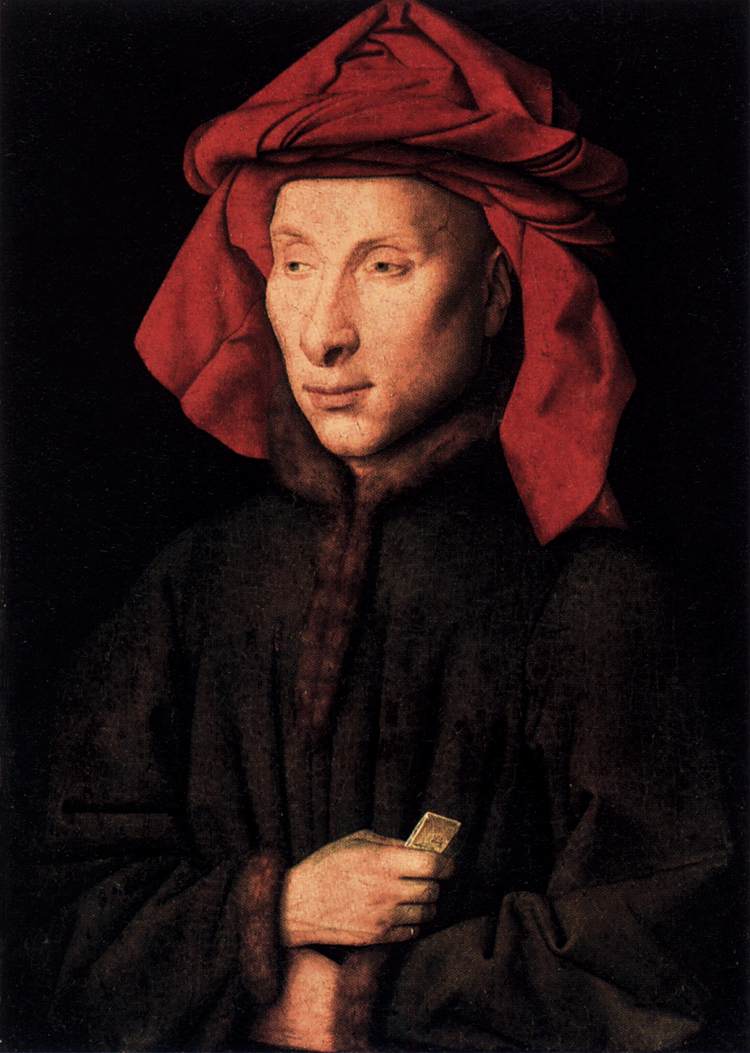
Most people are familiar with Giovanni Arnolfini because of his infamous family portrait by Jan van Eyck (1434). But did you know that Jan van Eyck made another portrait of Giovanni Arnolfini? This portrait, shown above, dates c. 1435.

I've never thought that Giovanni Arnolfini was very attractive, and seeing this portrait has further solidified my opinion. But who knows? Maybe he had a great personality, right?

What really caught my attention, however, is that there is a striking similarity between this portrait and Jan van Eyck's self-portrait, (commonly called Man in a Red Turban, 1433, see below):

Notice the red turbans (which, technically, should be called chaperons) in each painting? I realize that this headgear was popular in the mid-fifteenth century (you can see more examples here), so I guess it shouldn't be surprising that both men are portrayed this way. But there are other similarities between the portraits too, like the dark fur-lined coat and three-quarter profile view. Perhaps it isn't coincidental that these portraits are only about two years apart. I wonder if Giovanni saw van Eyck's self-portrait and then said, "Hey Jan, will you make me one of those too?"

Saturday, October 17, 2009

Sistine Chapel: Noah and Adam


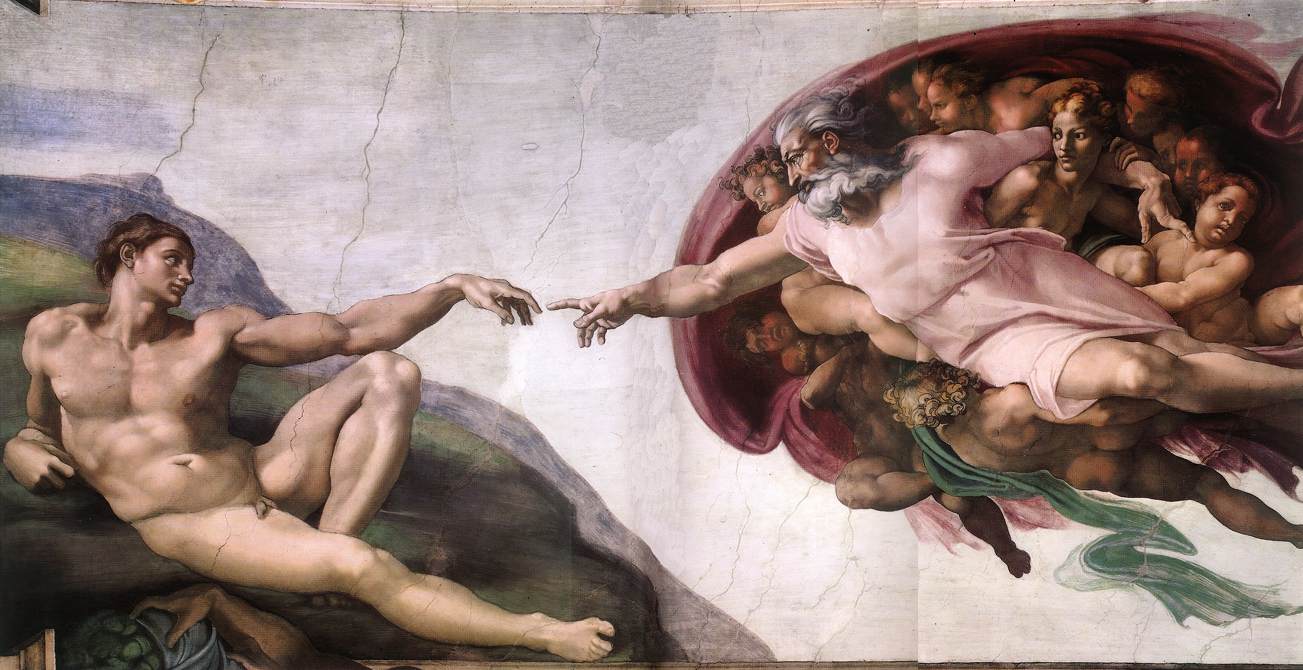
Last night I heard Gary M. Radke give a lecture on the Michelangelo's Sistine Chapel ceiling (1508-1512). Radke pointed out an interesting similarity between two scenes on the ceiling, the Creation of Adam (detail on left) and the Drunkenness of Noah (detail on right). Both of these figures are positioned in the same manner, and Radke finds that to be quite significant.

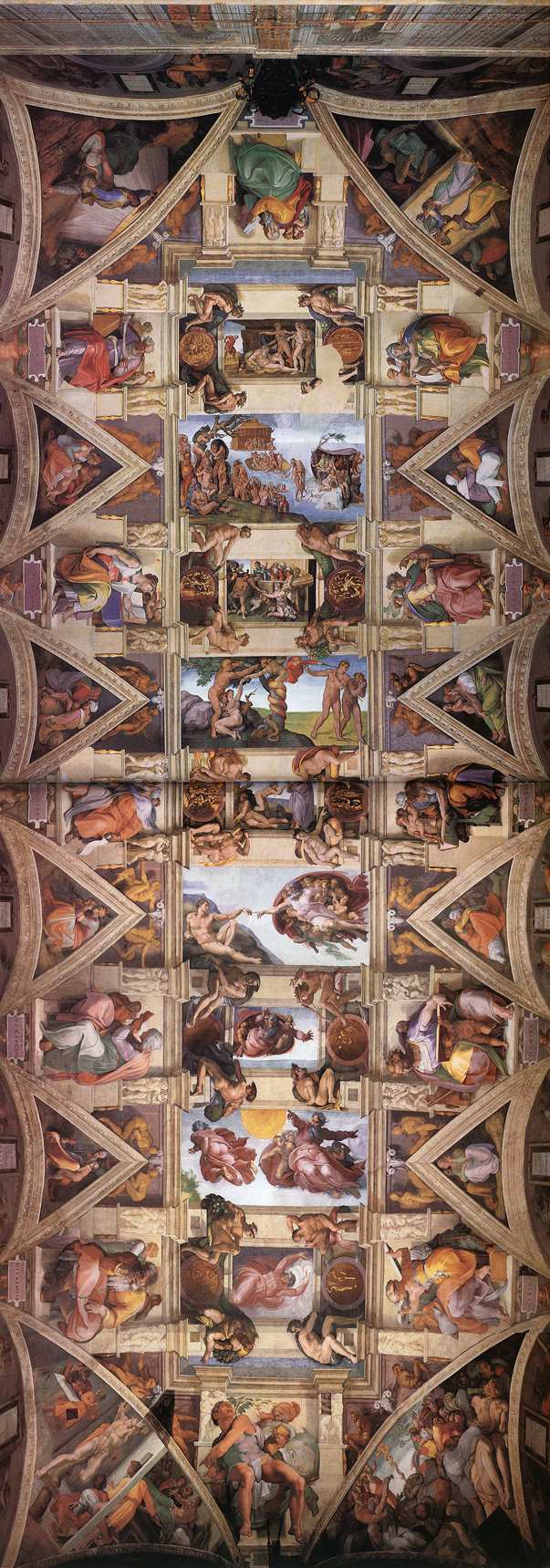
In order to understand the significance, though, I should explain more about the program of the Sistine Chapel. The panels on the ceiling depict early moments in biblical history, which mainly focus on events around/during the Creation, Fall, and Flood. What is interesting, though, is that one who enters the chapel sees the panels in an anachronistic manner. In other words, the last panel, The Drunkenness of Noah, is the one that is placed over the entrance to the chapel (The Drunkenness of Noah is at the top of this image of the ceiling). As one walks further and further into the chapel, the biblical scenes go backwards in time, showing the Flood, then the Expulsion from the Garden, then the Creation of Adam. Scenes of the Creation appear at the other end of the chapel, culminating in God's Separation of Light from Darkness (which is located over the altar).

Radke pointed out that it this reversed order is intentional. As one moves closer to the altar and celebration of the mass, one moves closer to God and closer to the moment of purity in the Creation. I think that's beautiful symbolism; it is as if one moves closer to purity as he/she walks further away from the chapel doorway and the sin that exists in the world. That point is even further emphasized by the choir screen that bisects the length of the Sistine Chapel. The Creation of Adam is placed directly above the choir screen. Therefore, the visitor arrives at that depiction of purity and innocence as he or she walks through the choir screen partition.*

With all this in mind, it's interesting to see a similarity between Adam and Noah. Noah is shown as a fallen, sinful, elderly man. In contrast, Adam represents the innocence, purity, and youth of the Creation. Yet the two figures are shown in the same position, which emphasizes that Adam and Noah also serve as broader symbols of humanity. I really like that.

*Granted, not everyone would have been able to walk through the choir screen. The lay people would have been expected to stay on the side of the screen which is closest to the doorway. (Too bad for them, huh? They would never be able to approach the pure, sinless moments depicted in the Creation scenes.) Nonetheless, one can still see how the choir screen fits into the program and symbolism of the ceiling.

Friday, October 16, 2009

Ingres' Oriental Pastiche

It took me forever to find a copy of Walter B. Denny's article, "Orientalism in European Art," but I'm glad that I finally got one (Dr. Denny was kind enough to mail me a copy). I plan on using this article as an introduction to Orientalism (i.e. European depictions of Middle Eastern/Far Eastern imagery). This article is great because it explains the concept of Orientalism in art but it really doesn't delve into any theory. How perf for an intro class!

My favorite part of this article was actually in a footnote. Denny pointed out various anachronistic and inappropriate Oriental objects in Ingres' painting, Odalisque with Slave (1839-40). For example, the slave's headwear is 18th century Ottoman, but her pantaloons are Indian in design. Furthermore, the architectural background is Cairene and the drapes are European velvet. Denny also notes that the taj helmet on the left is also out-of-place.1

What a pastiche of Oriental elements! Obviously, Ingres was trying to depict the Orient with some degree of authenticity, but he wasn't too concerned about historical, geographic or cultural accuracy.

1 Walter B. Denny, "Orientalism in Art," The Muslim World 3-4 (1983): 267.

*I decided to count my reading of this article for a category in Heidenkind's Art History Challenge.

Wednesday, October 14, 2009

"The Challenge of the Avant-Garde" & Caillebotte

I read The Challenge of the Avant-Garde (Paul Wood, ed., Yale University Press, 1999) several weeks ago for Heidenkind's Art History Challenge. This is a textbook is comprised of case studies which discuss 19th-mid 20th century art, particularly in how art relates to the concept of "avant-garde."

Overall, I was quite pleased with this book. I'll be using it for an upcoming class. I particularly like how the book examines how the term "avant-garde" and has changed over time. I did think that some parts of the book were confusing and biased (the authors seem extraordinarily bent on discussing art that has been underprivileged or underexposed in art historical studies), but I still would recommend it.

I was particularly interested in one case study that discussed Caillebotte and domestic space. I have always associated Caillebotte with modernity through his outdoor depictions of 19th century Parisian life, such as Paris Street: A Rainy Day (1877) and Pont de l'Europe (1876), I didn't realize that Caillbotte also was interested in domestic space and interior settings. Two such paintings involve depictions of floorscrapers:

Caillebotte, Floorscrapers, 1875


Caillebotte, Floorscrapers, 1876

Fionna Barber (the author of this case study) emphasizes that these paintings are also depictions of modern Parisian life - the floorscrapers are modern individuals (wearing contemporary clothes) who are involved in their professional work.1 Understandably, this painting didn't sit too well with critics at the time - largely because the image of the lower-class, "heroic worker" was clearly identified with paintings by the controversial artist Courbet (for an example, see Courbet's Stonebreakers (by the way, did you know that the Stonebreakers was destroyed in 1945 during a bombing of Dresden? Isn't that tragic?)).

If you want to learn more about Caillebotte and domestic space, I'd recommend that you pick up The Challenge of the Avant-Garde.

1 Paul Wood, ed., The Challenge of the Avant-Garde (New Haven: Yale University Press, 1999), 145.

Saturday, October 10, 2009

Artist as Thief: Filarete

If I was taught anything about Filarete in school, I don't remember it. I've been reading up on this artist in preparation for an upcoming lecture on self-portraiture. I like that Filarete included portraits of himself and his assistants on one of his best-known works, the bronze doors for St. Peter's Cathedral in Rome (see door on the right of the facade here). This portrait is located on the lowest part of the right valve of the doors, on the back. Filarete identifies himself and his assistants with Latin inscriptions, includes the date of completion (July 30., 1445) and then the statement: "To other artists satisfaction from payment or from pride, but for me - joyfulness."1

Aww, isn't that cute? Really, Filarete seems like an interesting character. He changed his real name, Antonio di Pietro Averlino, to "Filarete", which can be translated from Greek as "lover of virtue."

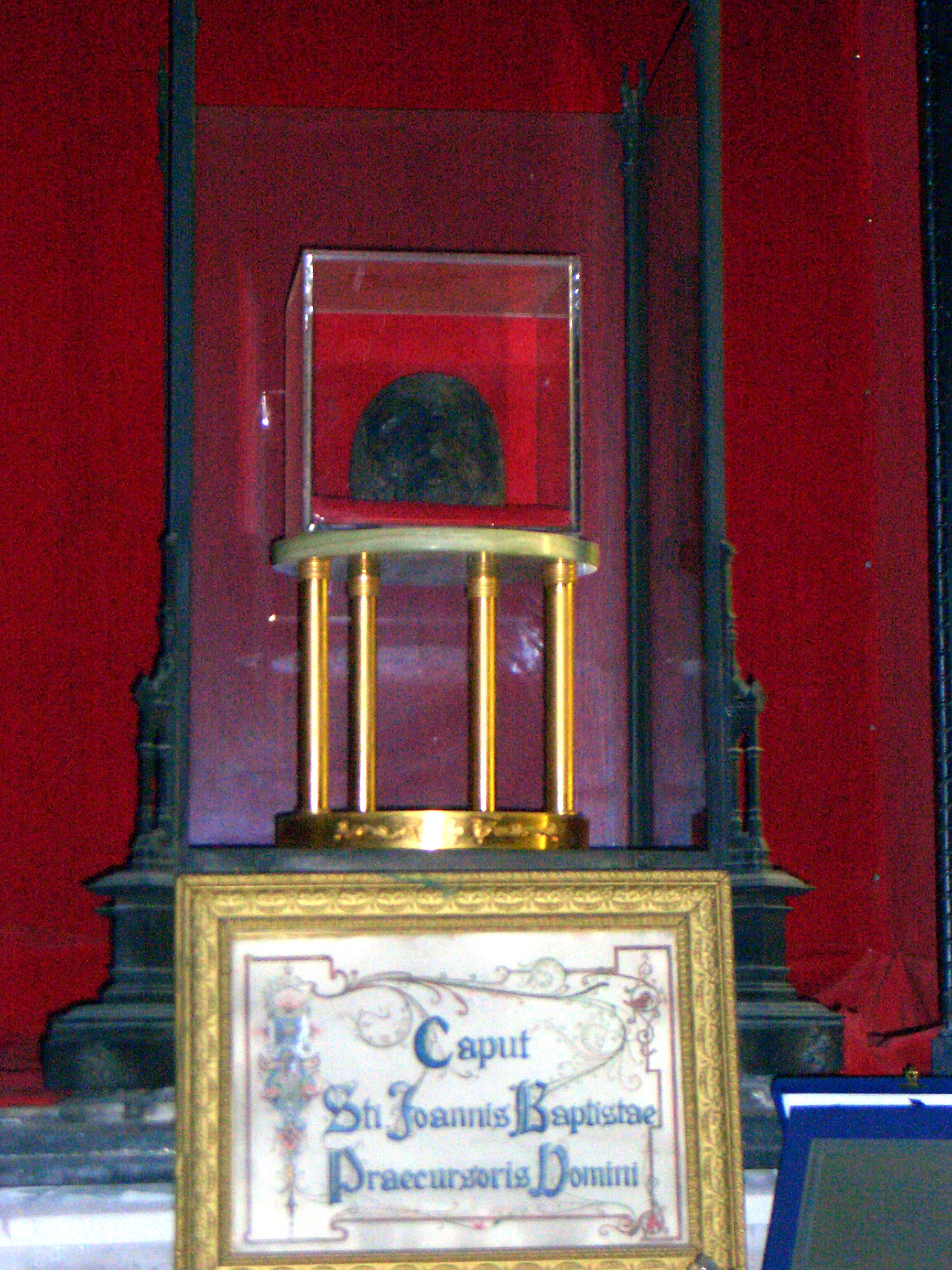
But I have to say, the more I read about Filarete, the more I question how much he loved virtue. The artist was expelled from Rome in 1448, after being accused of stealing some relics.2 And it appears that these weren't just any relics that Filarete wanted to steal - he tried to steal the head of John the Baptist that used to be located in San Giovanni in Laterano.3 I assume this is the same head that is still in Rome, but is now located in San Silvestro in Capite (shown on the right).

Why anyone want to steal the head of John the Baptist is completely outside my realm of comprehension.

And, by the way, did you know that there are several sites which claim to have the relic of John the Baptist's head? It's interesting that John the Baptist was important to multiple religions and groups. Amiens Cathedral (Amiens, France) and the Umayyad Mosque (Damascus, Syria) both claim to have the head, and you can read about a few more places/groups here. There is even a palace/museum, the Munich Residenz, which currently displays the (decorated) heads of John the Baptist and his mother (click here to see a picture of the Baptist display). I don't know if anyone is counting, but that makes a lot of heads. And I'm pretty sure that John the Baptist only had one head. Maybe the Roman officials should have given Filarete a break; if it is supposed that one of the heads is legitimate, then there is a only a one-in-six chance that Filarete actually stole something valuable.4

1 Emma Barker, Nick Webb, and Kim Woods, eds., The Changing Status of the Artist, (London: Yale University Press, 1999), 63.

2 Evelyn S. Welch, "Art and Authority in Milan," no. 8846 (New Haven: Yale University Press, 1996), 152 (page can be accessed online here).

3 John Pope-Hennessey, Italian Renaissance Sculpture (London: Phaidon, 1958), 332.


4 It's interesting to add that Mormons would find that none of the heads could be legitimate. They would say that the Baptist's head is back on the resurrected man's shoulders (see here).

Thursday, October 8, 2009

Caravaggio Restoration


QUICK! Somebody buy me a ticket to Rome!

Caravaggio's Adoration of the Shepherds (1609, shown above) is going to be restored, starting next week, and the public is invited to watch the restoration process. According to The History Blog, small groups of tourists and students will be invited to watch the restorers work. Apparently, there isn't too much restoration work which needs to be completed; the project is scheduled to end in February.

Swoon! I would love to be there. I heart Caravaggio SO MUCH.

Wednesday, October 7, 2009

Obama's Taste in Art

My brother sent me this link with some pictures of the art pieces that the Obamas have selected for the White House. Before seeing these pictures, I had already read different commentaries on how Obama had selected mostly modern pieces for his walls. Although other first families have hung modern art before, no one has displayed as much modern art as the Obamas.

There are two articles from today (one from the Guardian and another from the London Times), which discuss how Obama's taste in art can be a reflection of his presidency and policies. I think it's interesting (and kind of humorous) that Obama picked this above painting, "I think I'll..." (Ed Ruscha, 1983) for the White House collection. If you can't tell, the subject of the painting deals with indecision.

I'm sure that the White House art is a reflection of the Obama family's taste, but I can't help but think about all of the political messages that the Obamas needed to consider in the selection process. What a headache that must have been! For example, I think it's likely that the selection of Alma Thomas' Watusi Hard Edge (1963) was chosen because Alma is an African American and female. Of course, the painting is really nice, but I wonder if its aesthetic was the primary motivation for selection. What do you think?

Although some pieces entered the White House earlier this year, some paintings have just recently arrived. The painting above, Rothko's No. 17/No. 15 (1949) is kind of in limbo right now; the Obamas aren't quite sure what to do with it. I hope they find a place for this painting. It's quite lovely. (Do you think there's a reason that the Obamas want a Rothko that is comprised of red, white, and blue? Maybe? Maybe not?)

What do you think of the Obama's art? Are there any pieces that stand out to you?

Monday, October 5, 2009

Medieval Illumination

Since I am horrible at posting on medieval art, I want to direct people to the blog Medieval Illumination. My friend Shelley started this blog recently, and I think it will be a lot of fun (and a great resource). Enjoy!

Saturday, October 3, 2009

Minoan and Egyptian Goddess Cults

Minoan art was one of my first loves as an art historian. This dry fresco on the left has been nicknamed "La Pariesienne" (c. 1400 BCE) because the woman's striped dress resembled a popular Parisian dress style. I've always liked this fresco, mostly because I love the woman's curly, stylized hair. Sigh. If only I could have hair like that.

Obviously, this woman's curly locks have distracted me from paying attention to other details in the fresco. I finally noticed, after reading yesterday's post by heidenkind, that there is interesting loop knot that is located at the nape of the woman's neck. It appears that this loop could be connected to the goddess cults, and more specifically, to similar Egyptian cults by way of the ankh symbol. Heidenkind also discusses further connections between these goddess cults through priestess girdles, which is fascinating to me, since the Minoan Snake Goddess (c. 1600 BCE) is one of my favorite pieces of ancient sculpture.

This connection between Egyptian and Minoan cults totally makes sense. There were obvious ties between the two cultures. Minoan art has often been compared to Egyptian art, and you can even see a similarity in "La Parisienne" - she is depicted in profile view with a frontal eye (the traditional mode of depiction in Egyptian art).

Anyhow, you should read heidenkind's musings. It's interesting to think about.

Friday, October 2, 2009

Fuseli's Nightmares

I've had a little bit of insomnia lately. It hasn't been too bad, but substantial enough to be annoying. Last night, as I was twisting and turning in bed, I wryly thought of how much I envied the woman in Fuseli's The Nightmare (1781, shown above). Despite being surrounded by nightmarish figures, at least she was getting some sleep.

I've liked this painting ever since my first art history class in high school. It's just so bizarre and compelling. I especially like the distorted proportions of the woman's body (it reminds me of Mannerist art) and the burning eyes of the spooky horse.

It's possible his interest in this subject matter was due to his romantic attachment to a woman named Anna Landolt. Anna's uncle rejected Fuseli as a suitor, which really embittered the artist. This nightmare theme was created relatively soon after his rejection, "perhaps [as] an attempt to exorcise Fuseli’s bitterness against Anna Landolt by punishing her with a dream."1

In total, Fuseli made four versions of this nightmare theme. There is a woodcut version (n.d.) and pencil/watercolor version (1810) that aren't very interesting (they are a little too ridiculous and suggestive for my taste), but I do like this one on the right (1790). I'm really drawn to the small still-life of a glass bottles and small jar on the table; the 1781 painting also has a variant of this still-life. Although the bottles and jars might not contain any significance to the nightmarish theme, I can't help but think of the romantic aspects of tonics and potions. Even if they don't mean anything, I think they add a nice touch to the composition and give Fuseli a chance to show off his painting skills.

Anyhow, there you have it. I thought about Fuseli's The Nightmare while lying in bed last night. It's no wonder that when I actually do fall asleep, my dreams often revolve around art history...

1 Georg Paula and David Blayney Brown. "Füssli." In Grove Art Online. Oxford Art Online, http://www.oxfordartonline.com.erl.lib.byu.edu/subscriber/article/grove/art/T030261pg3, accessed 2 October 2009.